Headline: Crypto Prediction Market Drama — Someone Lost $1M on Spain as Cape Verde Hold for Historic 0-0 Draw on Polymarket
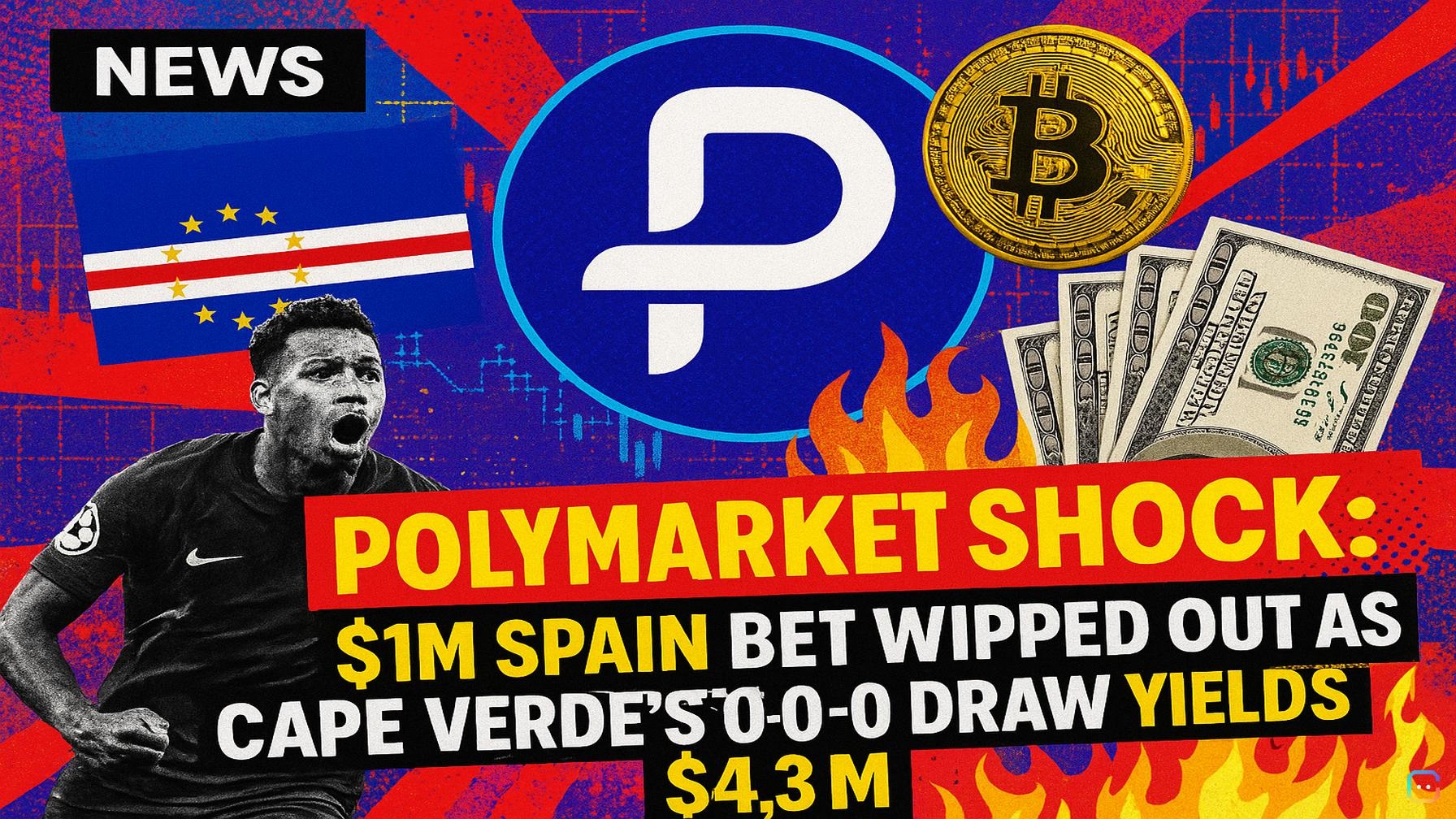
A single seven-figure wager on Polymarket — the crypto prediction market — went up in smoke Tuesday when Spain, overwhelming favorite to beat World Cup debutants Cape Verde, were held to a 0-0 draw in Atlanta.
Quick facts
- A bettor staked $1,000,000 on Spain to win; the market showed a potential payout of $1,085,943.48 if Spain had prevailed.
- The match finished 0-0, so that $1M "Yes" position resolved to zero.
- The Polymarket draw contract had traded around 6.6¢ pre-match. Spain’s win market was priced near 92¢.
- On the opposite side, a Polymarket user calling themselves Fishalive bought "No" on Spain (i.e., Spain would NOT win) at an average price of about 9¢, acquiring ~4.7 million shares. Those shares resolved at $1.00 and the position value peaked at $4,738,433.49, producing roughly $4.31 million in profit.
The game that shocked the market
Spain arrived off a 30-match unbeaten run and the pedigree of reigning European champions; Cape Verde were making their first World Cup appearance and sit around 67th in FIFA’s rankings. The result still stunned bettors and pundits alike. Cape Verde goalkeeper Josimar “Vozinha” Évora produced an 8-save masterclass, denying shots from Ferran Torres and Mikel Oyarzabal and frustrating Spain’s standout Lamine Yamal. Spain finished with 27 shots to Cape Verde’s 6 — a stat that quickly became the memeable shorthand for a “sure thing” collapsing.
How the winning trade worked
Prediction markets pay where the crowd disagrees. Fishalive effectively bought insurance against the market’s consensus by taking a large position at extreme odds (around 9¢). When the draw occurred, those "No" shares paid out at $1.00. The trade is a textbook example of taking a contrarian edge and getting paid when the unlikely happens.
Bigger picture — risk, reward and regulatory glare
- This episode underscores a familiar pattern on prediction markets: heavy losses are common for traders who buy extreme prices (below 10¢ or above 90¢).
- Academic and press research backs that up. A University of Toronto-led study of 2.4 million users found 68.8% had lost money since 2022, and Bloomberg reported in April 2026 that more than 100,000 Polymarket accounts recorded losses of at least $1,000 since January 2025.
- High-profile blowups on Polymarket have already happened: traders losing millions on sports contracts (one reportedly lost $1.58M on a single soccer bet) and others burning through multimillion-dollar bankrolls in days.
- The booming World Cup markets on crypto prediction platforms have drawn scrutiny: combined volume on Kalshi and Polymarket’s World Cup winner markets topped $2.34 billion in 2026, and some U.S. states, including Tennessee, have sent cease-and-desist letters over sports prediction markets.
Takeaway
For crypto-native prediction markets, this is both a proof-of-concept and a cautionary tale: massive, fast-moving markets create outsized winners and losers, and regulators are increasingly watching. Meanwhile, on the pitch and the screens of traders, Cape Verde advance to face Uruguay on June 21 — and someone on Polymarket is having a very good Monday.
Read more AI-generated news on: undefined/news