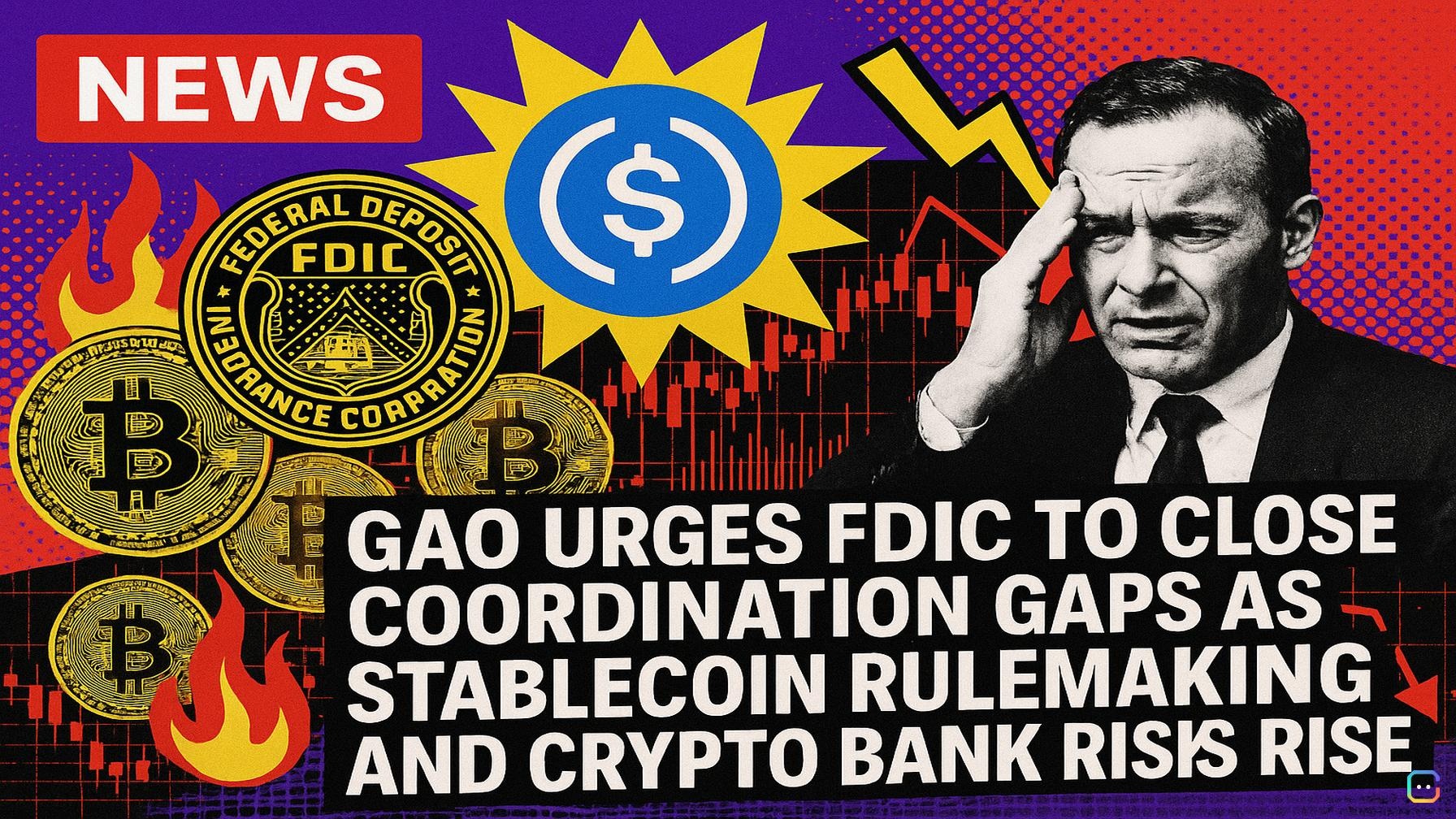
Headline: GAO presses FDIC to plug coordination gaps as stablecoin rulemaking and crypto-linked bank risks rise
The U.S. Government Accountability Office (GAO) has urged the Federal Deposit Insurance Corporation (FDIC) to step up interagency coordination on blockchain and crypto risks — warning that regulators lack a standing mechanism to identify and respond to threats before they spread across markets. The GAO sent a letter to FDIC Chairman Travis Hill on June 8, which it made public on June 15.
What the GAO found and recommended
- The GAO’s 2023 review concluded that regulators “lacked an ongoing coordination mechanism” for blockchain risks. It says a formal, standing process would help agencies spot emerging problems faster and mount a coordinated response.
- The watchdog also pressed the FDIC to strengthen bank supervision. After the 2023 bank failures — including Silicon Valley Bank, Signature Bank and Silvergate Bank — the GAO questioned whether regulators reacted rapidly enough when institutions showed weak liquidity and risk management.
- The GAO reiterated a prior recommendation that the FDIC require periodic rotation of certain case managers assigned to banks. It warned that a lack of rotation can erode independence and weaken supervision and escalation decisions.
Context: FDIC at the center of crypto policy
The recommendation lands as the FDIC’s role in crypto policy expands. Under the GENIUS Act and other legislative and regulatory activity, the agency has taken on higher-profile responsibilities for stablecoins and bank crypto activity. In April, the FDIC proposed rules for stablecoin issuers that operate through the banking system, setting standards for reserves, redemption, capital, risk management and custody. Under that framework, reserve deposits backing stablecoins could qualify for federal deposit insurance if they’re held inside insured banks — but stablecoin holders themselves would not receive deposit protection. That distinction keeps the FDIC at the heart of debates over how traditional bank rules should apply to tokenized payment products.
Recent shifts in FDIC approach
The FDIC has already signaled a shift in how it oversees bank crypto activity. In 2025 the agency said FDIC-supervised banks could engage in permitted crypto-related work without prior agency approval so long as they manage risks appropriately. Chairman Hill has described the move as “turning the page” from past practices.
How this ties into broader rulemaking
The GAO letter arrives amid active policy work in Washington. In May, the Senate Banking Committee advanced the CLARITY Act, a bill that would divide digital-asset oversight between the SEC and CFTC and create a distinct framework for payment stablecoins. Lawmakers are also scrutinizing bank charters for crypto firms, customer identification rules, and whether crypto companies that offer deposit-like products should face bank-like safeguards.
What the GAO did and did not call for
The GAO stopped short of urging any ban on blockchain products. Instead, it called for a standing interagency process so regulators can work together early and consistently — particularly on two priorities it flagged for the FDIC: blockchain-risk oversight and bank supervision. For the FDIC, that recommendation now sits alongside its ongoing stablecoin rulemaking and heightened supervisory duties as crypto-related risks and market structure debates advance in Washington.
Read more AI-generated news on: undefined/news