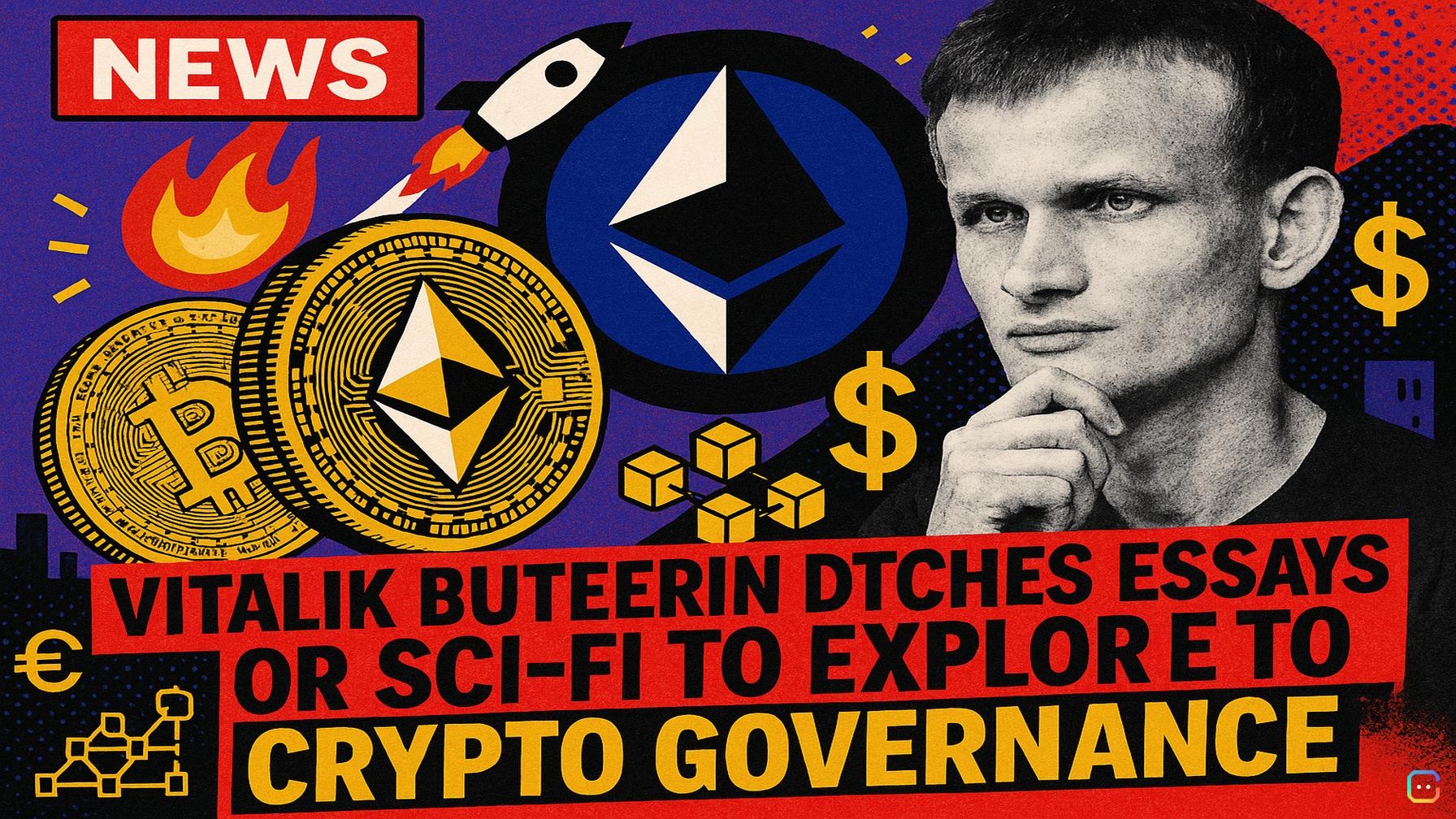
Vitalik Buterin, co‑founder of Ethereum, is swapping long-form technical essays for speculative fiction.
In a post on Farcaster from his vitalik.eth account, Buterin said he’ll pause his trademark research‑style blog posts to “try writing some science fiction stories on the theme of decentralized governance.” He also shared a link to an in‑progress novel and said he has already finished chapters one and two, shifting creative energy from essays and research notes into a sustained narrative project that explores governance experiments in crypto‑native systems.
The move is notable because Buterin’s long essays have helped shape Ethereum debates—from Layer 2 scaling and account abstraction to soulbound tokens and governance tradeoffs. By using science fiction as his medium, he intends to test coordination, incentive and power‑distribution questions in imagined worlds rather than through whitepapers or mainnet experiments. That lets him probe risky edge cases and social dynamics (things that would be difficult or irresponsible to trial on live protocols) by placing governance mechanisms inside fictional societies and crisis scenarios.
Buterin’s switch also echoes a long tradition of sci‑fi serving as a sandbox for political and economic ideas. His novel can draw on real moments from Ethereum’s history—contentious hard forks, funding debates, protocol upgrades—while refracting those themes through characters and plots rather than dev calls and forum threads.
The announcement comes as Ethereum and the wider crypto ecosystem continue wrestling with governance challenges at multiple levels: protocol upgrades, DAO treasury management, legal exposure and voter apathy. Buterin stressed that he’s not abandoning technical work; rather, he’s stepping away from regular blog output, meaning his future governance contributions may first arrive through storytelling instead of formal essays.
For the Ethereum community, fiction represents a different influence vector: accessible, narrative‑driven exploration of complex governance tradeoffs that could reach builders, policymakers and everyday readers who might not wade through dense technical posts. Whether the experiment reshapes how on‑chain governance is designed or simply enriches Buterin’s wide body of work, it signals that one of crypto’s most influential thinkers now views speculative storytelling as a serious tool for tackling the hardest problems of decentralized power.
He also reiterated an idea he’s long promoted in non‑fiction: in an ideal world, software and hardware would have “nutrition labels” listing trust dependencies—what math and which actors’ behavior the system relies on to deliver its guarantees—an insight that fits naturally into a project examining governance and trust through fiction.
Read more AI-generated news on: undefined/news