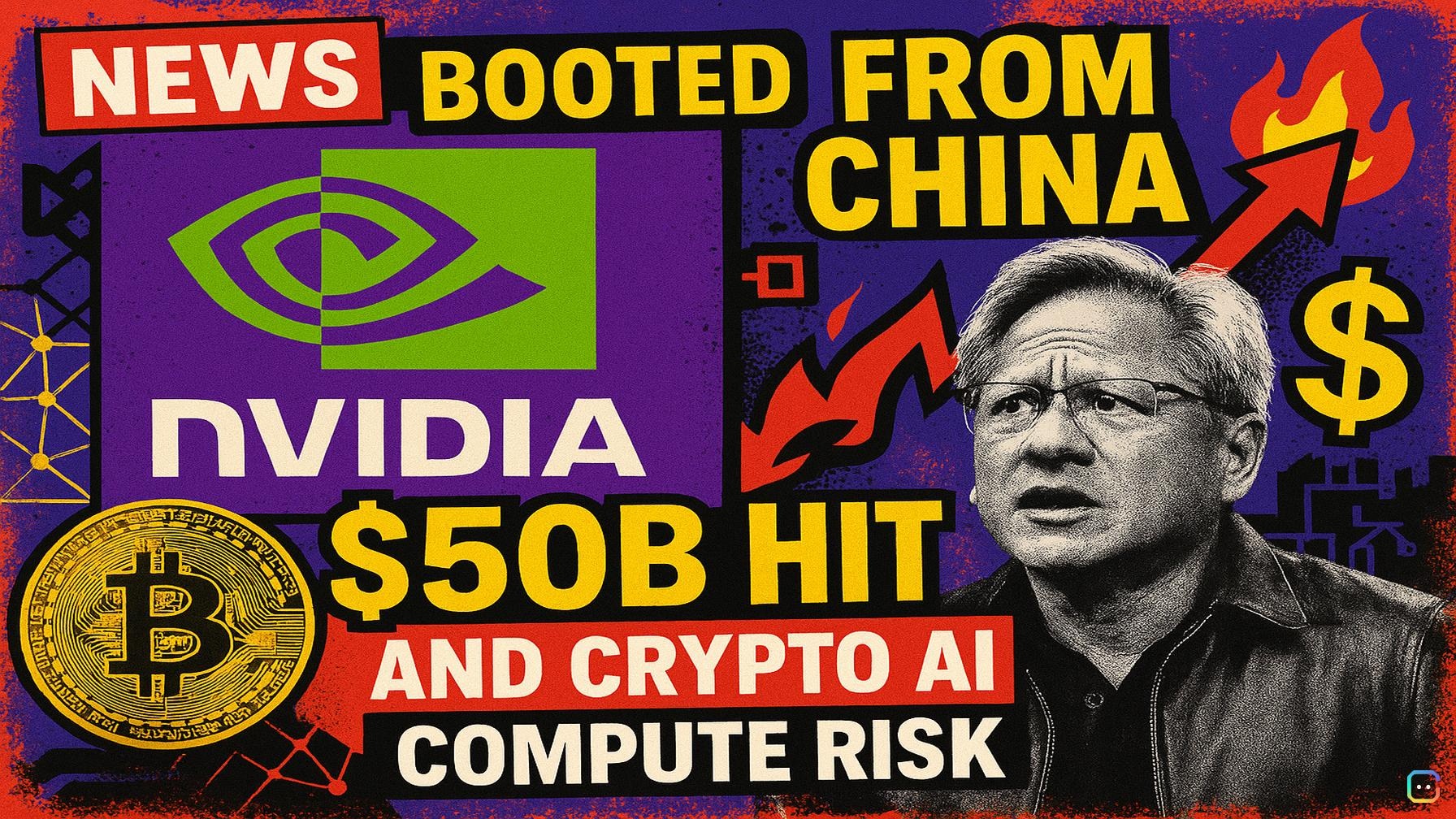
Nvidia has gone from dominant to shut out in China — and its CEO says the U.S. government’s export curbs are to blame.
What happened
- Over 2025 Nvidia’s once-dominant position in China evaporated. CEO Jensen Huang told audiences that Nvidia’s China AI market share fell “from 95% market share to 0%,” after a series of U.S. export restrictions that began in 2022 and kept tightening.
- The turning point came on April 9, 2025, when the U.S. informed Nvidia that its H20 chips — engineered to comply with earlier limits — now required export licenses to China. Nvidia took a $4.5 billion charge in Q1 fiscal 2026 for excess H20 inventory and purchase obligations it could no longer fulfill.
- Huang called the loss of the China opportunity “a $50 billion” hit and warned policymakers that conceding such a market “probably does not make a lot of strategic sense.”
Market and Wall Street reaction
- Despite the China setback, Wall Street remains broadly bullish. At the time of writing:
- NVDA’s average 1-year price target sits at $269.82 (based on 58 analyst forecasts), with a high estimate of $380 and a low of $140. That average implies roughly a 36% upside from the then-current share price of $198.45.
- Out of 70 analysts who rated the stock over the past three months, 57 called it a “strong buy,” 8 said “buy,” 4 “hold,” and only 1 a “strong sell” — no analysts issued an outright sell.
- Nvidia’s revenue forecast for the next quarter stands at $78.62 billion, underlining demand outside China that appears to be absorbing the loss of that market.
Who’s filling the gap in China
- Chinese firms such as Huawei, Cambricon, Moore Threads, and MetaX have stepped into the void with local hardware and software alternatives. Nvidia’s biggest remaining advantage in China is its CUDA ecosystem, which local rivals have not yet replicated at scale.
Why it matters to crypto readers
- For crypto markets and projects that leverage large-scale AI for trading, analytics, or infrastructure, the episode is a reminder of how geopolitics and export policy can quickly reshape supply chains for high-performance compute. Nvidia’s growth narrative now leans heavily on U.S. data centers, Europe, and Southeast Asia rather than China — a shift with potential ripple effects wherever AI and blockchain intersect.
Bottom line
- Nvidia’s China exit was rapid and costly, but investor confidence has so far held. The company still commands strong demand elsewhere, even as Chinese competitors gain ground and geopolitical policy reshapes the global AI chip landscape.
Read more AI-generated news on: undefined/news