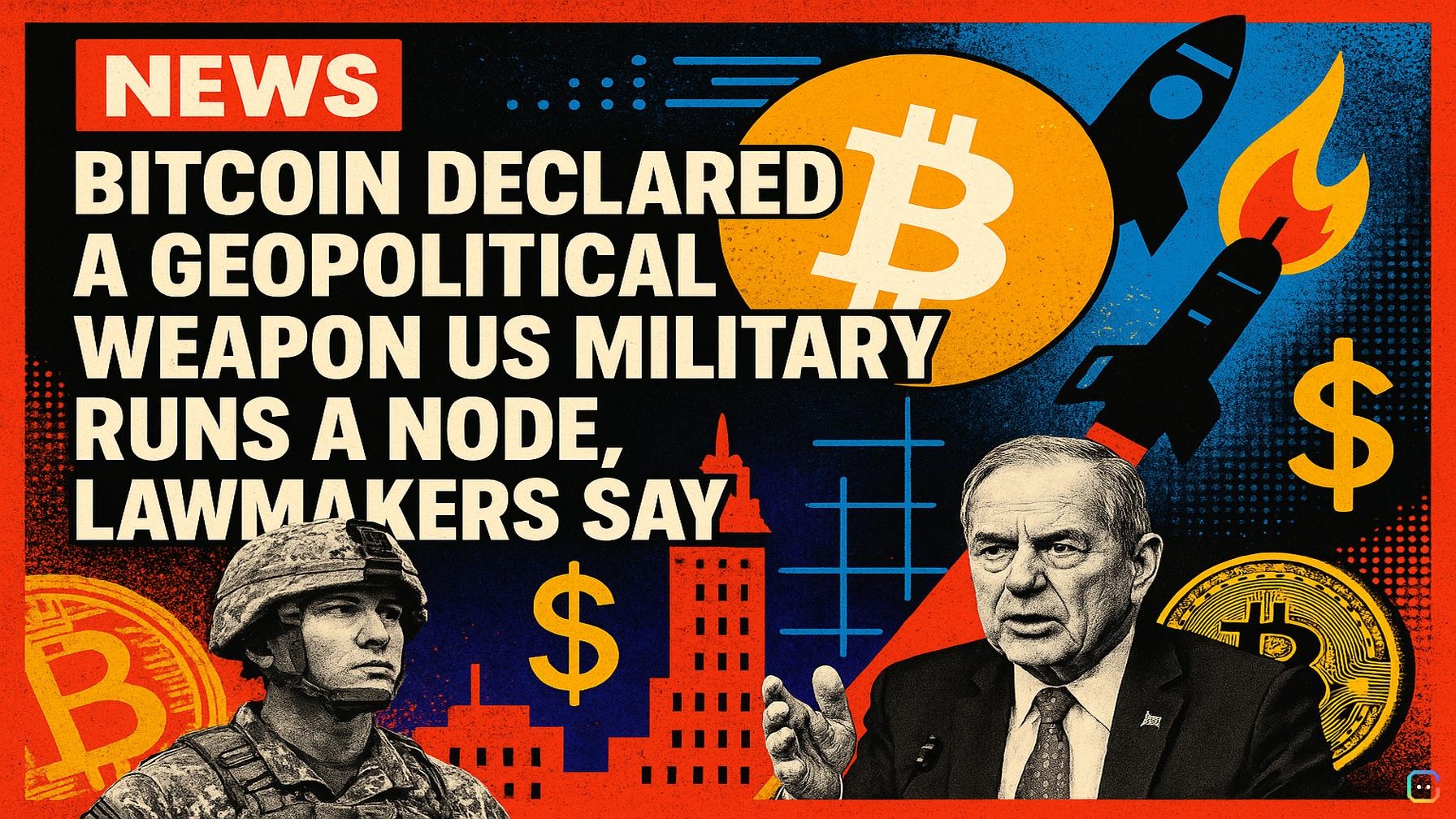
Bitcoin has quietly moved from speculative bet to frontline national-security issue, top US officials and lawmakers say — and that shift is already shaping defense strategy.
Rep. Lance Gooden (R‑TX) this week argued the largest crypto asset has become a “geopolitical weapon,” used by multiple adversaries in different ways. His comments echo recent statements from Pentagon figures, suggesting the US military is treating Bitcoin as an operational tool — and a potential vulnerability.
Classified operations, leverage and nodes
According to reporting by the TFTC agency, Pentagon leadership — including Pete Hegseth — told legislators the Department of Defense is engaged in classified efforts that either “enable or defeat” crypto capabilities as part of broader work to counter what was described as “China’s digital authoritarianism.” As Hegseth put it (as quoted by Gooden): “I am a long enthusiast of Bitcoin and crypto potential, and a lot of the things we are doing, enabling it or defeating it, are classified efforts that are ongoing inside our department, which do provide us a lot of leverage in a lot of different scenarios.”
The military’s interest isn’t merely theoretical. Admiral Samuel Paparo, commander of US Indo‑Pacific Command, testified to the Senate that Bitcoin holds “incredible potential” for cybersecurity and strategic purposes — and that INDOPACOM “has a node on the Bitcoin network right now,” arguing the network has “direct implications for power projection.”
A multi-front security landscape
Gooden mapped out how adversaries are already leveraging Bitcoin across several theaters:
- Iran: allegedly demanding Bitcoin as payment for safe passage through the Strait of Hormuz.
- North Korea: hackers tied to Pyongyang using BTC in ransomware and illicit finance schemes.
- China: believed to be accumulating large Bitcoin holdings as part of a strategic reserve.
“Over the past decade, Bitcoin has evolved from a fringe asset into a matter of national security,” Gooden said.
Reserve estimates back the geopolitical reading. The Bitcoin Policy Institute (BPI) estimates China holds roughly 194,000 BTC while the United States controls about 328,000 BTC — figures Gooden used to underline how the cryptocurrency now factors into economic and strategic debates.
Market snapshot
On markets, BTC was trading around $76,384 at the time of reporting, up roughly 1% over 24 hours after testing $75,000 support. Traders are eyeing the $80,000 area as a key resistance level that has eluded Bitcoin since early February.
Why it matters
Whether through sanctioned payments, cybercrime, reserve accumulation or military experimentation, Bitcoin’s decentralized and programmable nature appears to be rewiring how policymakers and armed services think about finance, intelligence and power projection. For the crypto ecosystem, that means increased scrutiny — and potentially new roles — as nations adapt to a digital-asset reality.
Sources: TFTC reporting, testimony from Admiral Samuel Paparo, Bitcoin Policy Institute, TradingView. Featured image: OpenArt.
Read more AI-generated news on: undefined/news