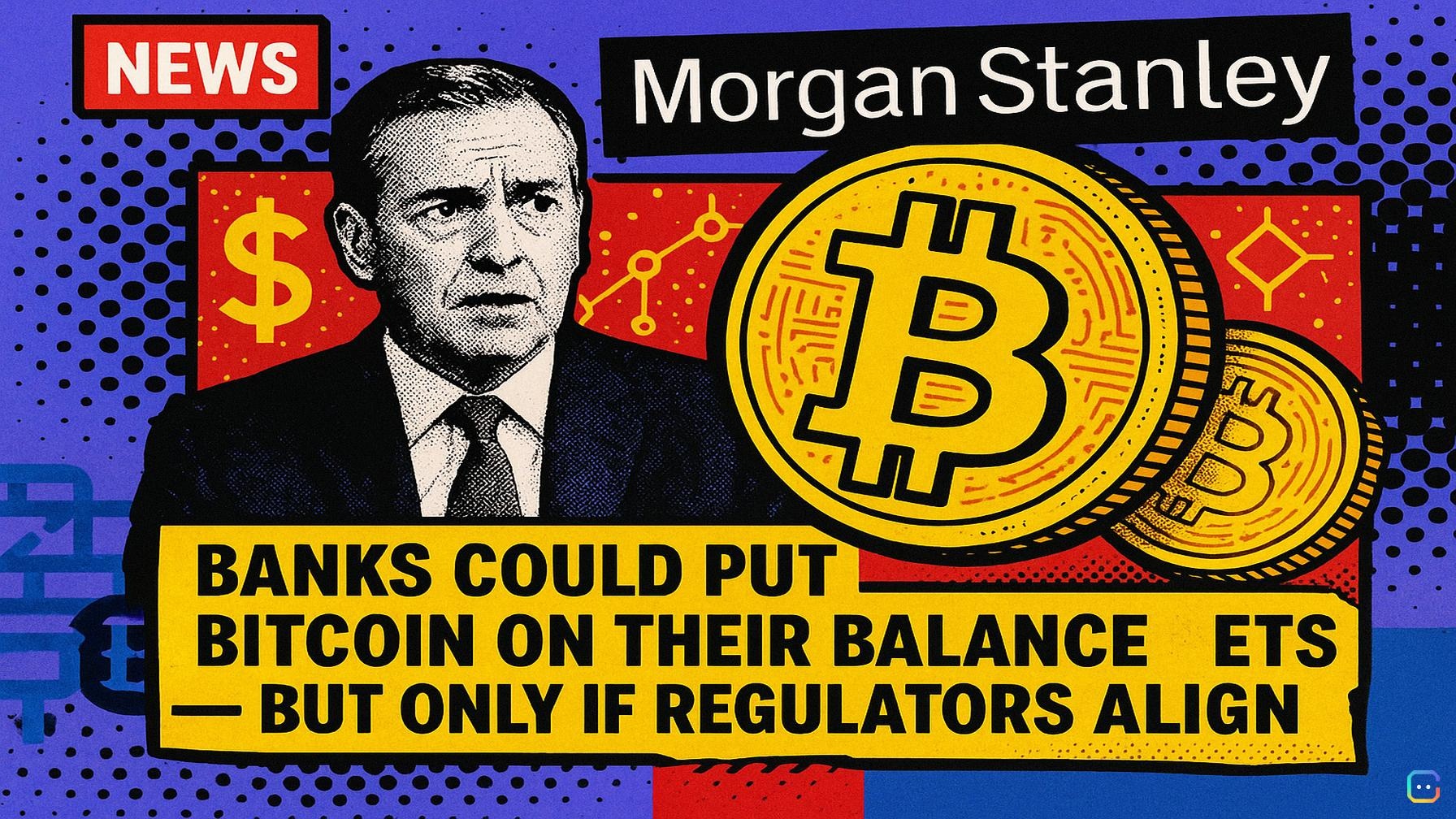
Morgan Stanley executive Amy Oldenburg told a Bitcoin 2026 panel that banks putting Bitcoin directly on their balance sheets is “not totally out of the question” — but only if a host of regulatory and prudential hurdles continue to move in the industry’s favor.
“What would it take for a bank like Morgan Stanley to move from offering client exposure to actually holding Bitcoin as a treasury asset?” Oldenburg was asked. After pausing on the premise, she said: “I think if we continue to see the progress that we’ve made over the last 16 months or so in regulatory, that that’s something that you may see going forward. It’s not totally out of the question.”
Why the caveats matter
Oldenburg’s comment is notable less as an announcement than as a framing: direct bank ownership of Bitcoin sits at the far end of institutional adoption. It would require more than ETFs, custody relationships, or client-facing products — it touches accounting, capital planning, liquidity, examiner expectations and board-level risk appetite.
She highlighted that the barrier isn’t a single rule. SAB 121, the SEC accounting guidance that previously complicated bank custody of crypto, has been rolled back and eased part of the constraint. But Oldenburg emphasized the bigger picture: “It’s Fed guidance, it’s Basel guidance. When you’re a large G‑SIB bank, it’s not just one agency that you report to.” Large, systemically important banks must satisfy multiple regulators and capital frameworks simultaneously, she said, and they need “a little bit more alignment across the board with some of those agencies.”
The Basel problem
A central regulatory sticking point is the Basel Committee’s prudential standard for cryptoassets. The committee’s current approach treats unbacked crypto assets like Bitcoin with extremely conservative capital charges — industry critics point to a 1,250% risk weight as effectively making direct balance-sheet holdings uneconomic for big banks. The Basel Committee said in February 2026 that it had expedited a targeted review of its cryptoasset standard, with an update due later in the year.
US agencies evolving, but not done
Regulatory movement in the U.S. has been uneven but notable. In April 2025 the Federal Reserve withdrew prior guidance on banks’ crypto-asset and dollar-token activities, saying it wanted expectations to evolve with the risks and to avoid stifling innovation. The FDIC and OCC have also stepped back from prior-approval frameworks, even while reiterating that sound risk management is required.
More recently, U.S. banking agencies clarified that eligible tokenized securities should get the same capital treatment as their non-tokenized equivalents — a technology-neutral stance that separates blockchain rails from asset risk. That helps, but it doesn’t directly solve Bitcoin’s balance-sheet problem, because Bitcoin is not a tokenized traditional security.
What it would take
Oldenburg’s bottom line: regulators would have to align on treatment and supervision. If Basel keeps punitive capital charges and the Federal Reserve and other examiners don’t provide a coherent supervisory framework on safety, soundness, liquidity and operational risk, G‑SIBs have little economic incentive to hold Bitcoin as a treasury asset — even if client demand exists.
Outside groups are already engaging. The Bitcoin Policy Institute said in March it planned to review and comment on the Federal Reserve’s Basel implementation, arguing current treatments discourage banks from holding or servicing Bitcoin.
The takeaway
Direct bank ownership of Bitcoin is now being discussed as a realistic possibility rather than pure fantasy — but the timeline depends on multilateral regulatory shifts, not just isolated changes. Until capital rules and supervisory alignment evolve in concert, large banks will likely remain cautious about warehousing Bitcoin on their own balance sheets.
At press time, BTC traded at $1.3716.
Read more AI-generated news on: undefined/news