Headline: The secretive crypto backer behind Nigel Farage: who is Christopher Harborne and why does it matter?
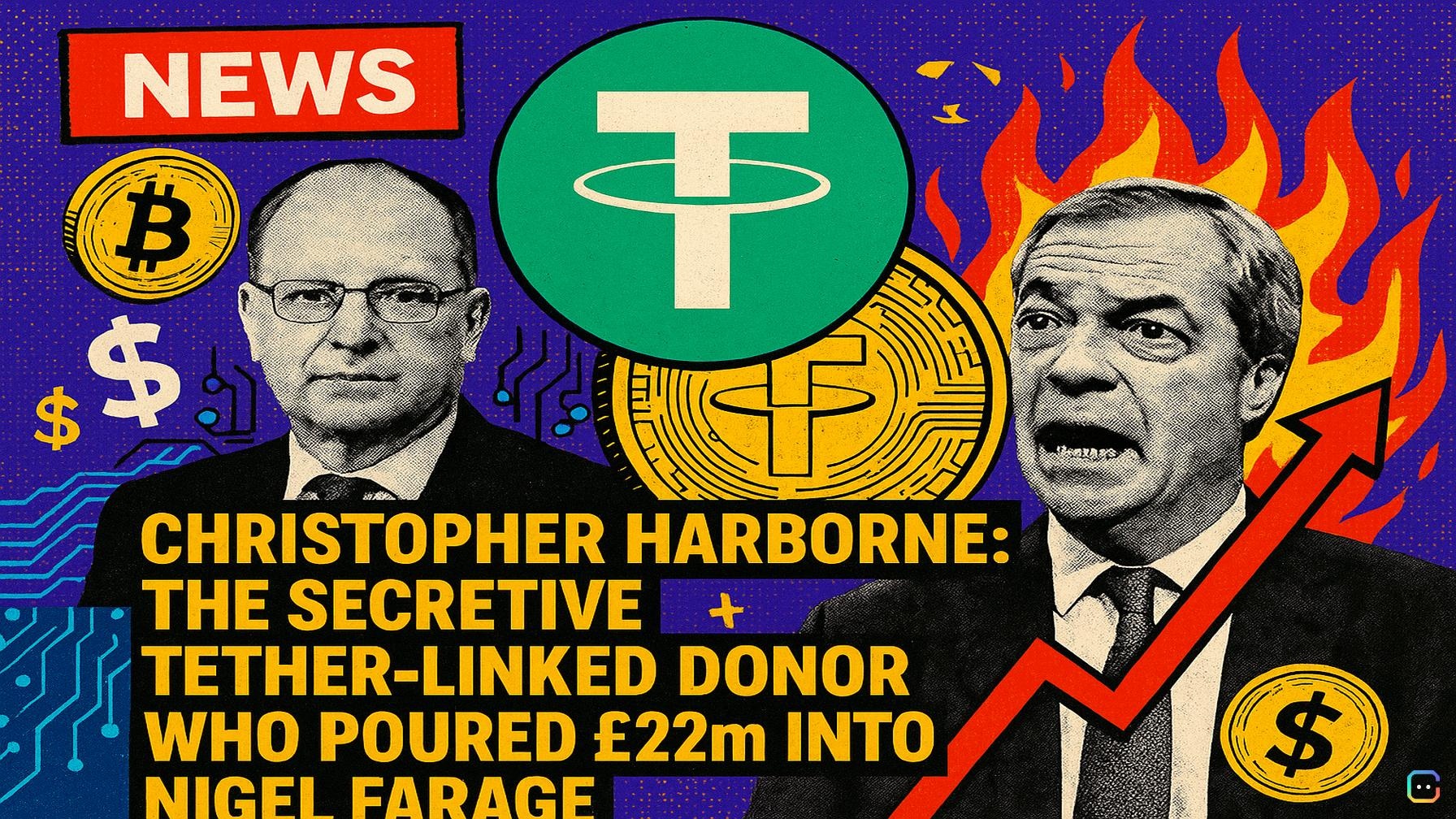
When Nigel Farage sat beside a relaxed, polo‑clad guest at a birthday party on Koh Samui in December 2022, few outside a small circle recognised the man who would soon bankroll the UK’s most unusual political machine. Chakrit Sakunkrit — the Thai name used by Christopher Charles Sherriff Harborne after he naturalised in 2011 — is the quiet, intensely private donor who has poured more than £22m into Reform UK over the past seven years. That sum represents roughly two‑thirds of the party’s funding, including a record £9m single donation in August and a further £3m in November — the biggest gifts ever reported from a living donor in Britain.
Why a crypto news audience should care
Harborne’s fortune stems largely from cryptocurrency. He was an early buyer of bitcoin and an early backer of Ethereum; he later acquired a reported 12% stake in Tether, the issuer of the world’s most widely traded stablecoin. Tether has issued hundreds of billions of dollars of stablecoins — digital tokens pegged to the dollar — and has become central to global crypto liquidity. But Tether is also controversial. Regulators and investigators in the US and the UK have probed its reserve practices and use in illicit activity, and the company has repeatedly declined to publish full audited accounts that skeptics say would reassure markets.
That mix — huge, opaque crypto wealth and the largest donor to a rising populist party that openly courts digital‑asset industry support — creates a story that sits squarely at the crossroads of crypto, politics and regulation.
A brief profile
Born in Mosborough near Sheffield in 1962, Harborne trained as an engineer at Cambridge, worked at McKinsey and held corporate roles before moving to Thailand in the mid‑1990s. He founded Sherriff Global and later AML Global, a jet‑fuel brokerage active at more than 1,200 sites worldwide. Aviation is a repeated theme in his business filings; he is also known for a high‑profile light‑aircraft crash in 2008 that left him badly injured.
Harborne’s political giving predates crypto: he made a modest donation to the Conservatives in 2001. His crypto windfall began after buying bitcoin in 2011 and accumulating early Ethereum in 2014 — investments that, by his own legal filings, now account for a large proportion of his net worth. He surfaced publicly in a defamation suit against the Wall Street Journal that revealed parts of this history, and has otherwise remained guarded: his lawyers call him “intensely private.”
Tether, tokens and ownership
Tether Ltd — often described as one of the most profitable companies per employee in history — issues USDT, a stablecoin broadly used as a digital dollar across exchanges. According to leaked documents and reporting, Harborne joined a small group of founders and early owners after acquiring special tokens issued by Bitfinex (Tether’s sister exchange) used to compensate customers after a 2016 hack. Those tokens reportedly converted into an ownership stake in Tether.
Tether’s rise has been meteoric: it has issued well over $100bn of stablecoins and underpins trading and transfers across crypto markets. But that growth has drawn scrutiny: New York’s attorney general issued subpoenas in 2018; a fraud investigation followed; and Tether settled a New York case in 2021 for $18.5m and agreed not to operate in that state. More recently the US Department of Justice reportedly opened probes into possible sanctions and anti‑money‑laundering breaches — investigations that, according to multiple sources, became politically sensitive as the US administration shifted.
Political spending and policy outcomes
Harborne’s money has not been neutral. Between 2019 and 2024 his donations helped transform the Brexit party into a better‑funded political force that later became Reform UK. Party insiders say Harborne spent time at campaign offices and encouraged a pro‑crypto outlook. Reform became the first UK party to accept crypto donations and has proposed tax breaks and a Treasury crypto reserve. Outside Reform, several large recipients of Harborne cash — including high‑profile Conservatives — also adopted friendlier stances toward cryptocurrency at moments that coincided with his donations. Downing Street spokespeople have denied any link between donations and policy.
Nigel Farage has been an outspoken advocate for stablecoins and has publicly predicted that Tether could be valued as a $500bn company. Farage says Harborne asks for nothing in return; Reform insists no donor has been offered preferential treatment. Harborne’s lawyers likewise deny he has influenced politicians to support business interests.
Regulatory concerns and enforcement
Critics point to repeated instances where Tether stablecoins have been used in fraud, money‑laundering and sanctions evasion by criminal groups and hostile states. UK investigators, including the National Crime Agency, have flagged schemes running on Tether that allegedly supported parts of the Russian war effort. Experts in blockchain tracing note that while investigators can follow token flows, anonymity and lack of full transparency about reserves make enforcement difficult.
If Tether’s valuation did reach the levels touted by some boosters, Harborne’s stake would place him among the world’s richest — and simultaneously deepen questions about the role of crypto capital in politics. In response to concerns, the UK government has moved to limit foreign donations over £100,000, and Labour scrapped the non‑dom tax status that previously helped some donors avoid UK tax. Those changes narrow but do not fully close the avenues used by wealthy expatriates to donate.
Family, allies and global ties
Harborne’s family links and social circles connect him to other crypto figures and political actors. His son Will was reportedly an early Tether employee and now runs a stablecoin venture. Harborne has hosted and funded high‑profile gatherings — from a Koh Samui birthday that included Nigel Farage and other right‑wing figures to travel costs for Farage’s trips to the US. Other fintech billionaires with crypto origins, like Ben Delo, have echoed Harborne’s approach by moving residence to sidestep donation limits and by funding political causes that align with a pro‑crypto agenda.
What to watch next
The story of Christopher Harborne is both a portrait of an individual crypto billionaire and a wider case study about what happens when concentrated, opaque crypto wealth meets democratic politics. Key questions for the crypto community and regulators remain:
- How transparent are Tether’s reserves and ownership structures, and what will regulators demand next?
- Can legal limits on foreign political donations keep pace with complex corporate and residency arrangements?
- Will parties that take crypto money enact policies that materially reshape the regulatory landscape — and what will that mean for consumer protections and illicit‑finance controls?
Harborne declines interviews and his lawyers stress that he has not sought to influence policy. But whether viewed as a principled libertarian, a tech investor pushing for market access, or a donor whose interests align with political change, his involvement underscores a growing reality: crypto capital is no longer confined to niche conferences and exchanges — it is a political force with the potential to shape law and leadership at national levels.
Read more AI-generated news on: undefined/news