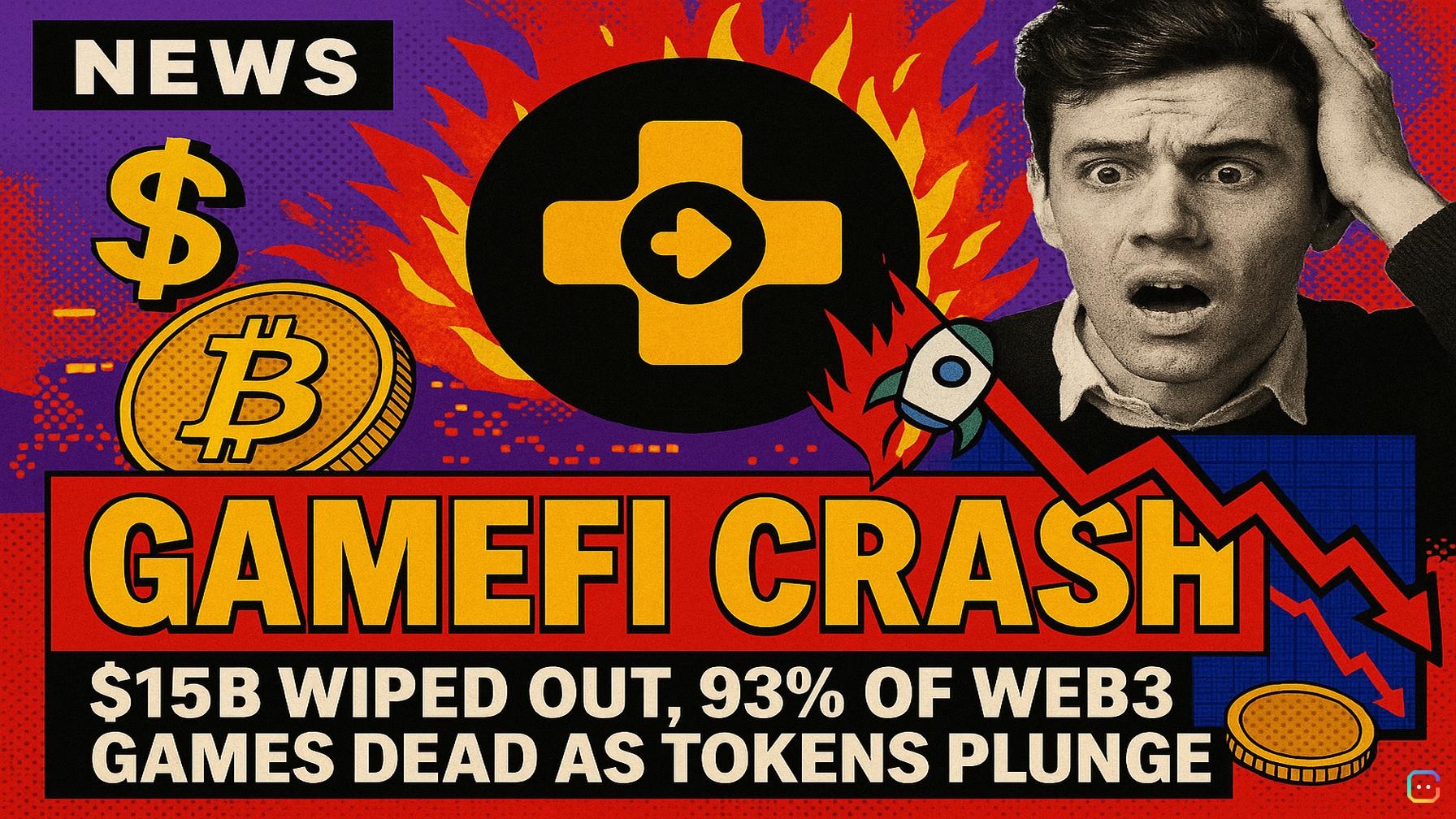
Web3 gaming’s boom went bust — and fast. A new report from market-maker and trading firm Caladan finds that the sector burned through as much as $15 billion chasing a token-driven future that gamers largely ignored, leaving GameFi projects and their backers with catastrophic losses.
Key numbers
- Caladan estimates roughly 93% of GameFi projects are effectively dead.
- Token values tied to these projects are down about 95% from 2022 peaks.
- Funding to studios has collapsed roughly 93% by 2025.
- More than 300 blockchain games have shut down, per DappRadar.
- At the height of the mania, gaming took 62.5% of all Web3 venture investment in 2022; by 2025 that share fell to single digits as capital flowed to AI, real-world asset tokenization and infrastructure.
“Capital was destroyed at every layer simultaneously,” the report says — pointing to venture funds, retail NFT buyers, gaming guilds and the mass tap-to-earn wave on Telegram as parallel casualties.
Blows that define the collapse
- Flagship tokens and projects cratered: YGG’s gaming-guild token trades roughly 99.6% below its November 2021 peak.
- Hamster Kombat lost 96% of its users within six months of launch.
- Axie Infinity, once the sector poster child, saw daily active users fall from about 2.7 million at peak to roughly 5,500, according to DappRadar.
- Project post-mortems are brutal: Pixelmon raised $70 million in a 2022 NFT mint and still has no public game; Ember Sword burned through $18 million over seven years before shutting down last May with no refunds. Gala Games faces a lawsuit alleging a co-founder diverted $130 million in tokens. Even legacy publisher Square Enix quietly wound down its Symbiogenesis experiment last July.
Why GameFi failed to stick
Caladan’s data suggest the collapse wasn’t just a cyclical downturn or poor execution — it was structural. GameFi’s play-to-earn model turned gameplay into a financial feedback loop: players bought tokens and NFTs, earned rewards in those same assets, and relied on new entrants to sustain payouts. When inflows slowed, token economics unraveled, rewards evaporated, and users left en masse. The demand side never matched the speculative supply: a Coda Labs survey cited by Caladan found only about 12% of gamers had tried a crypto game even at the peak.
Capital and timing made things worse. Studios raised massive sums before shipping playable, sticky games, removing market pressure to build experiences that retained players. Development timelines commonly stretched three to five years while token markets moved in real time — by launch, many project tokens had already collapsed.
Where the money went next
Investors have already redirected capital. Animoca Brands — once the sector’s most prolific backer — has reduced gaming to roughly 25% of its portfolio and is pivoting toward stablecoins, real-world assets (RWAs) and AI. Across the industry, VCs followed suit, shifting funds toward infrastructure and tokenization projects rather than consumer-facing games.
What this means going forward
The Web3 gaming experiment exposed the limits of grafting financial engineering onto entertainment without product-market fit. The sector’s retrenchment leaves a smaller, more cautious landscape where investment leans toward infrastructure, token design that aligns incentives with long-term engagement, and use cases that tie crypto mechanisms to demonstrable value beyond speculative yield.
Watch next
- Funding flows: whether VCs continue reallocating from gaming to infrastructure, AI, and RWAs.
- Tokenomics evolution: projects that focus on sustainable in-game economies and real utility.
- Legal and governance risks: lawsuits and governance failures that could reshape investor confidence.
- User metrics: whether any new titles can meaningfully convert mainstream gamers beyond the single-digit adoption rates seen during the boom.
The Web3 gaming saga is now a cautionary tale: rapid speculative capital and nascent token models can fuel explosive growth, but without compelling gameplay and real product-market fit, those gains can evaporate just as quickly.
Read more AI-generated news on: undefined/news