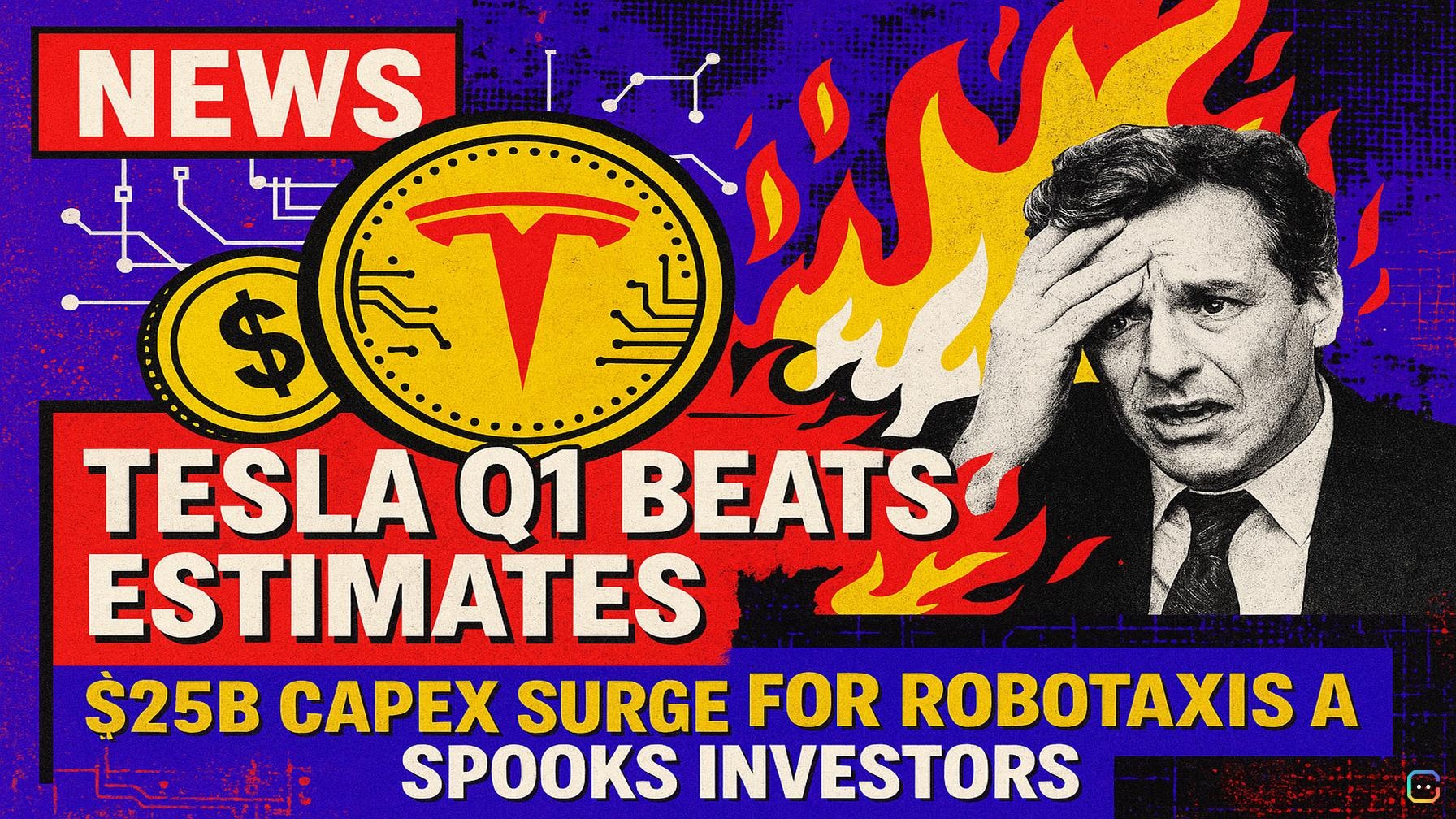
Tesla’s Q1: beats on the sheet, but investors are focused on Robotaxis and a big capex pivot
Tesla reported Q1 results that beat Wall Street’s estimates but left the market with mixed feelings. Adjusted EPS came in at $0.41 versus the $0.36 consensus, and revenue of $22.39 billion cleared expectations. Gross margin surged to 21.1% (from 16.3% a year ago) — Tesla’s strongest Q1 margin in some time — fueling an initial after-hours rally in TSLA that quickly reversed once management detailed a much larger capital spending plan.
What moved the needle
- Autonomy progress: Tesla expanded its Robotaxi service into Dallas and Houston, operating unsupervised rides with no safety driver present. Robotaxi miles nearly doubled sequentially in Q1, and Tesla says Cybercab — a two-seat vehicle built specifically for full autonomy — remains on track for volume production in 2026. Tesla still does not disclose fleet sizing or how many vehicles are running truly driverless at any moment, making business sizing difficult.
- Big capex increase: CFO Vaibhav Taneja told analysts Tesla now expects capital expenditures above $25 billion for 2026 — up from a $20 billion target last quarter and a steep rise from $8.6 billion in 2025. Management also guided to negative free cash flow for the rest of the year. The stock’s after-hours reversal was driven largely by that spending outlook.
Why Tesla is spending more
Taneja: “Our current expectation for 2026 is over $25 billion of CapEx … we’re further increasing our investment in AI-related initiatives, including the AI infrastructure to support Robotaxi and the launch of Optimus.” He added, “We are in a very big capital investment phase, which is going to start now and would last a couple of years.”
The planned investments span six factories (some already active, others coming online this year), AI compute infrastructure, battery materials, Cybercab, Tesla Semi, Megapack 3, the Optimus humanoid robot program, and the Terafab chip manufacturing facility Tesla intends to build in Austin. On the demand side, Tesla finished Q1 with its largest Q1 order backlog in over two years, with order growth across EMEA, APAC and North America.
Optimus and production timing
CEO Elon Musk said Tesla still aims to reveal Optimus V3 in July or August, near the start of production, and that preparations for a large-scale Optimus factory — with an eventual target of one million units per year — begin in Q2. Musk framed initial production of Cybercab and Semi as slow to start but accelerating “exponential[ly]” later in the year and into next year. He also explained a tactical reluctance to show V3 too early, saying rivals dissect and copy Tesla’s releases.
On full self-driving and older cars
Musk confirmed that older Teslas with Hardware 3 do not have the capability to support unsupervised FSD — the hardware simply lacks the necessary compute and sensors. That clarification, along with the extended timeline for fully unsupervised Robotaxis, drew scrutiny from investors. Future Fund partner Gary Black warned that although the quarter beat expectations, Tesla’s valuation multiple could face downward pressure amid what he called “backpedaling on timing of unsupervised FSD and Robotaxi from 2Q until late-2026 or even 2027.”
What this means for investors (and crypto audiences)
Q1 offered a clear floor: stronger margins, revenue and EPS upside, and tangible Robotaxi progress. But the dramatic capex ramp and guidance for negative free cash flow reshape Tesla’s near-term capital profile and investor expectations. For crypto traders and institutional allocators who watch TSLA for market sentiment or macro cues, the story is twofold: Tesla is doubling down on AI, chips and robotics — areas that overlap with data-center and semiconductor demand — while explicitly prioritizing long-term technology investment over near-term cash generation.
Bottom line: Tesla’s results show operational strength, but the stock’s after-hours flip — up on the beat, down on the capex — underscores how quickly the market re-rates companies when timelines and cash needs change.
Read more AI-generated news on: undefined/news