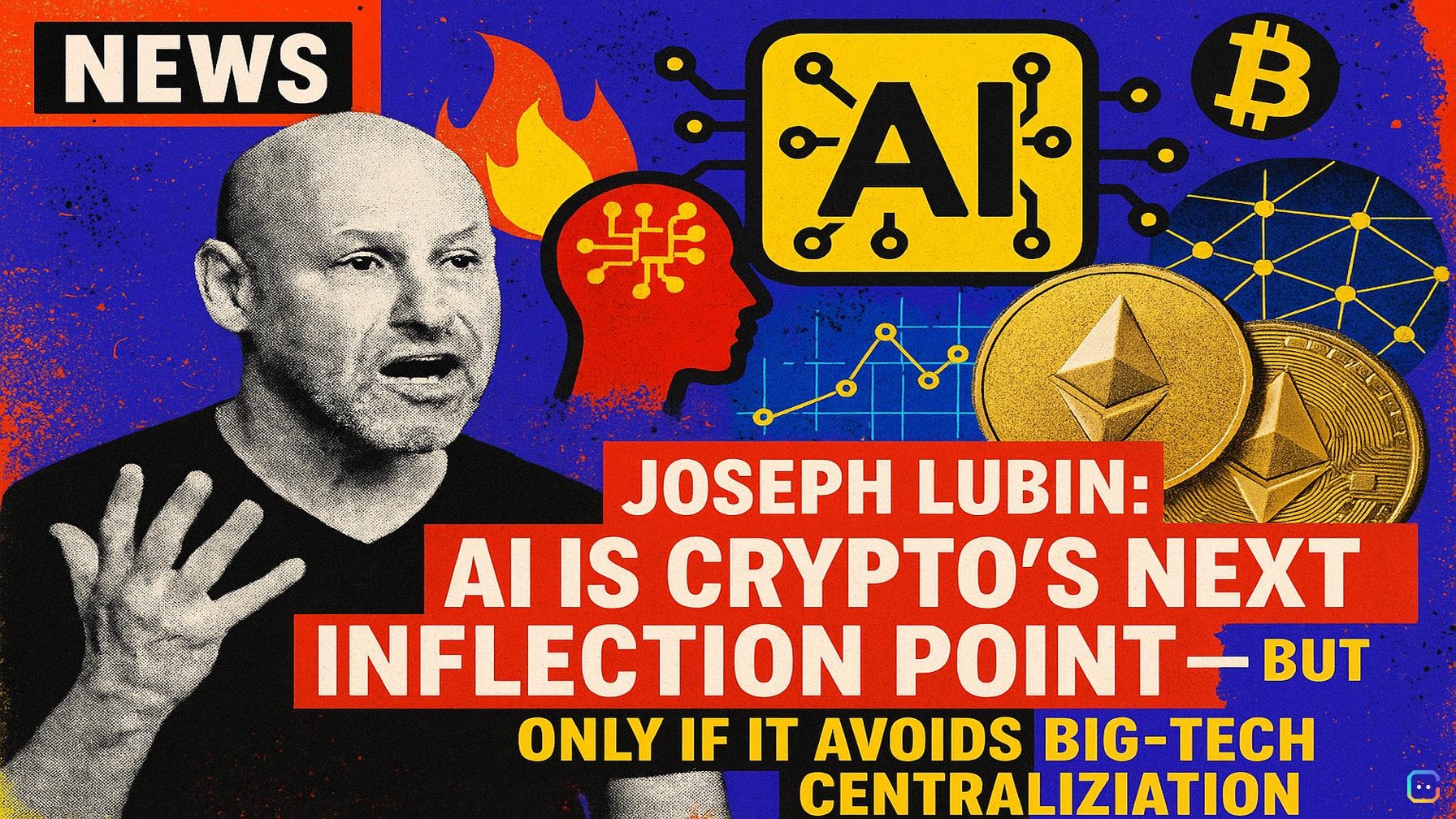
Headline: Joseph Lubin: AI Is Crypto’s Next Inflection Point — But Only If It Avoids Big-Tech Centralization
Consensys CEO and Ethereum co-founder Joseph Lubin told CoinDesk that artificial intelligence will be a major catalyst for crypto’s next phase — provided decentralized infrastructure prevents control from concentrating in the hands of a few large tech firms.
Lubin argued that autonomous and semi-autonomous AI agents can transact, coordinate and verify one another on decentralized networks, using crypto rails as the backbone for machine-driven economic activity. “I’m sympathetic to the idea that blockchain is for machine intelligences,” he said, noting that increasingly intelligent interfaces will likely abstract complexity away from users so people can interact with protocols through intent rather than manual inputs. In that model, AI becomes the intermediary layer between humans and decentralized systems.
That vision comes with clear risks. If the infrastructure powering AI remains dominated by a small number of big tech companies, Lubin warned, “we could be in trouble.” He emphasized that cryptography and decentralized architectures will be crucial to ensure accountability — enabling machines to “check on one another” in transparent, verifiable environments rather than operating inside opaque silos.
Products across the Consensys stack are already being reshaped for this future. Lubin said MetaMask is being rebuilt as “a new kind of neobank that you own and control,” part of a transition toward a “personal money operating system.” In practice, AI-powered agents could act on users’ behalf to manage assets, execute transactions and navigate a growing decentralized economy. “You can walk around with your personal financial system in your pocket,” he said.
On the infrastructure side, Lubin expects a proliferation of “corporate chains” as businesses seek higher throughput and greater control. Even so, he advised that assets are best issued on Ethereum’s base layer: “the best way to ensure that an asset is durable… is to mint it on Ethereum layer one,” even if those assets are later used or moved across other networks.
Stablecoins, Lubin said, are accelerating adoption but are not the end state. He called them a “stepping stone” toward fully decentralized financial systems, noting that many current stablecoin models still rely on centralized issuers. Over time, he predicts growth in decentralized collateral that will enable more crypto-native forms of money.
Lubin also framed tokenization as a convergence of traditional finance and decentralized finance — combining centuries of financial innovation with the programmability and granularity that blockchains enable. The result, he suggested, will be a more programmable global economy.
Addressing longer-term technical threats, Lubin took a measured view on quantum computing: not an immediate crisis, but something Ethereum developers have been preparing for “for years,” and which he expects will be absorbed into the natural evolution of the protocol.
Lubin will expand on these themes at Consensus Miami 2026 next month, as the industry watches how AI, wallets like MetaMask, stablecoins and corporate chains evolve in tandem.
Read more AI-generated news on: undefined/news