After Google’s recent “doomsday” whitepaper reignited a wave of quantum panic across crypto, analysts and developers have been stress‑testing ledgers and drafting post‑quantum plans. One prominent voice in the XRPL community says XRP’s architecture leaves far less of its supply exposed to a hypothetical quantum attack than Bitcoin.
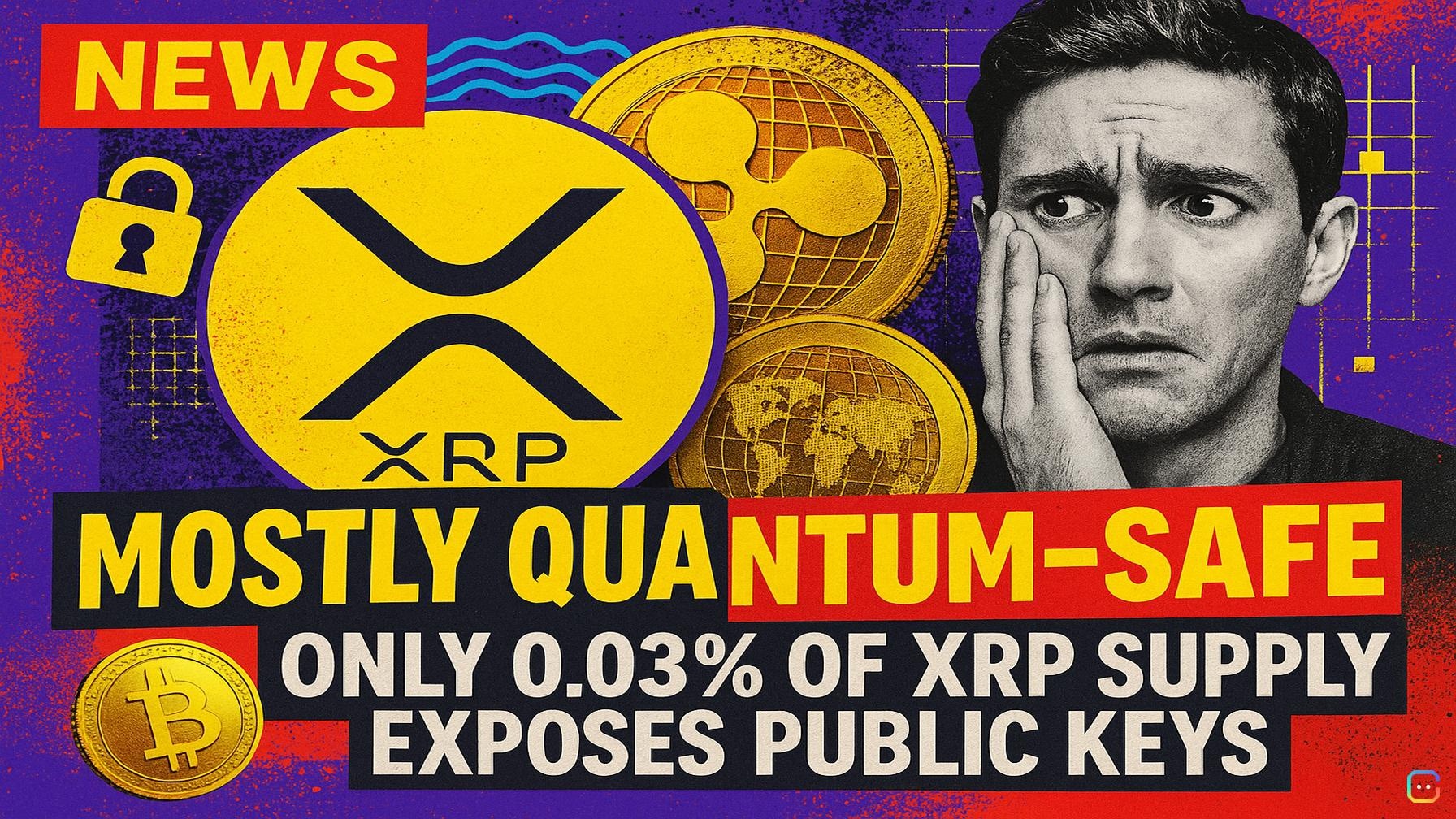
Vet, an XRPL validator and longtime contributor, posted a short on X summarizing a quick audit of on‑chain exposure. His findings: roughly 300,000 XRP accounts—together holding about 2.4 billion XRP—have never sent a transaction, so their public keys have never been revealed and are therefore “quantum‑safe by default.” By contrast, only two long‑dormant whale accounts (inactive for more than five years) have exposed public keys and together hold roughly 21 million XRP—about 0.03% of the circulating supply (circulating supply ≈ 61 billion XRP, Coinglass, early April 2026).
Why does this matter? The primary quantum threat to today’s blockchains is this: once a wallet broadcasts a transaction, the public key becomes exposed. A sufficiently powerful future quantum computer could, in theory, derive the corresponding private key and drain the funds. Vet’s check suggests XRPL’s current on‑chain state leaves a relatively small attack surface because so many accounts have never revealed their public keys.
XRPL’s account model also gives holders practical defenses that don’t require moving funds. Key rotation can be performed without transferring tokens, and native features like escrow and time‑locks allow funds to be placed behind conditions—tools that make preemptive hardening easier for holders ahead of any quantum breakthrough.
That contrasts with Bitcoin’s legacy exposure. Early P2PK (pay‑to‑public‑key) outputs and other historically exposed public keys leave an estimated 11%–37% of BTC potentially vulnerable under a future quantum scenario—an issue amplified by Satoshi‑era coins whose keys can’t be rotated without moving them.
Vet closed his post with reassuring context: there are no known quantum computers today capable of breaking public‑blockchain cryptography, and the industry will likely find mitigation paths if such machines arrive. For now, on‑chain data and XRPL’s tooling point to a relatively contained quantum risk surface—especially for active users who can rotate keys now.
Market implications: the quantum debate is emerging as a new risk‑pricing axis between Bitcoin and major altcoins. If that narrative gains traction, tangible progress on XRPL’s quantum‑resistant testnets or mainnet upgrades could become a security‑driven catalyst for rotation in the weeks and months ahead.
Read more AI-generated news on: undefined/news