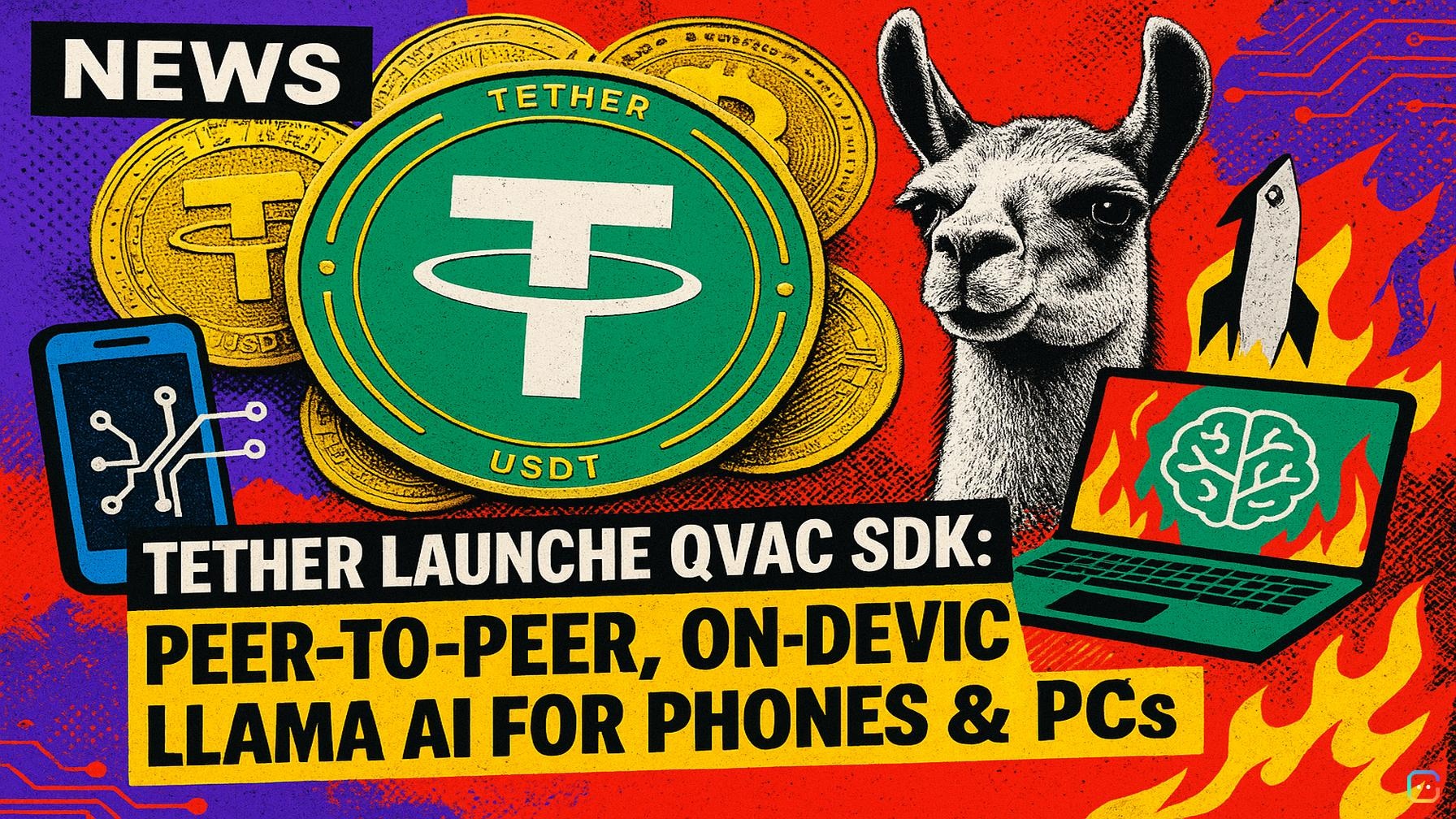
Tether has quietly moved beyond its stablecoin roots with the launch of QVAC SDK, an open-source toolkit that brings on-device, llama-based AI to mainstream hardware. Aimed at developers who want “local-first” intelligence, QVAC lets apps run fully on users’ phones and PCs—iOS, Android, Windows, macOS and Linux—without depending on centralized cloud servers.
What QVAC does
- QVAC is built on a customized fork of llama.cpp called QVAC Fabric and exposes core AI capabilities: text generation, speech processing, visual recognition and translation.
- Instead of pulling models and inference from a data center, the SDK uses the Holepunch protocol stack for peer-to-peer model distribution and delegated inference. Devices in a network can share model files, split inference workloads and receive updates from each other.
- Practically, developers can ship assistants, translators or vision tools that run primarily on-device, with heavy lifting distributed across a swarm of peers rather than a single cloud endpoint.
Why it matters for crypto and decentralization
- The move deepens Tether’s footprint in decentralized infrastructure at a moment when data privacy, cloud dependence and AI centralization are hot topics in both crypto and broader tech communities.
- Local inference reduces exposure to centralized outages and limits sending sensitive data to remote servers—shifting ownership of both data and compute closer to the user.
- At the same time, running AI at the edge transfers more responsibility for model optimization, security and UX to device-level environments—a trade-off QVAC aims to smooth by abstracting platform-specific integration.
Roadmap and implications
- Tether plans to expand QVAC beyond inference: future additions include decentralized training and fine-tuning, plus specialized toolkits for robotics and brain–computer interfaces. That would evolve QVAC from an inference SDK into a distributed full-stack ML environment.
- The big question is adoption: QVAC will need a strong developer community and demonstrable parity with cloud AI experiences if it’s to become infrastructure rather than an experimental edge project.
Bottom line
QVAC SDK signals a clear bet from Tether that the next wave of AI could be hybrid: not just hyperscale clouds, but peer-to-peer networks that keep compute and data closer to users. If the project attracts developers and delivers the promised tooling for decentralized training and deployment, it could be an important piece of crypto-era infrastructure. If not, it may remain an intriguing, but niche, experiment at the intersection of AI and decentralization.
Read more AI-generated news on: undefined/news