Meta rolls out Muse Spark — a “personal superintelligence” for your browser (and a potential game‑changer for crypto apps)
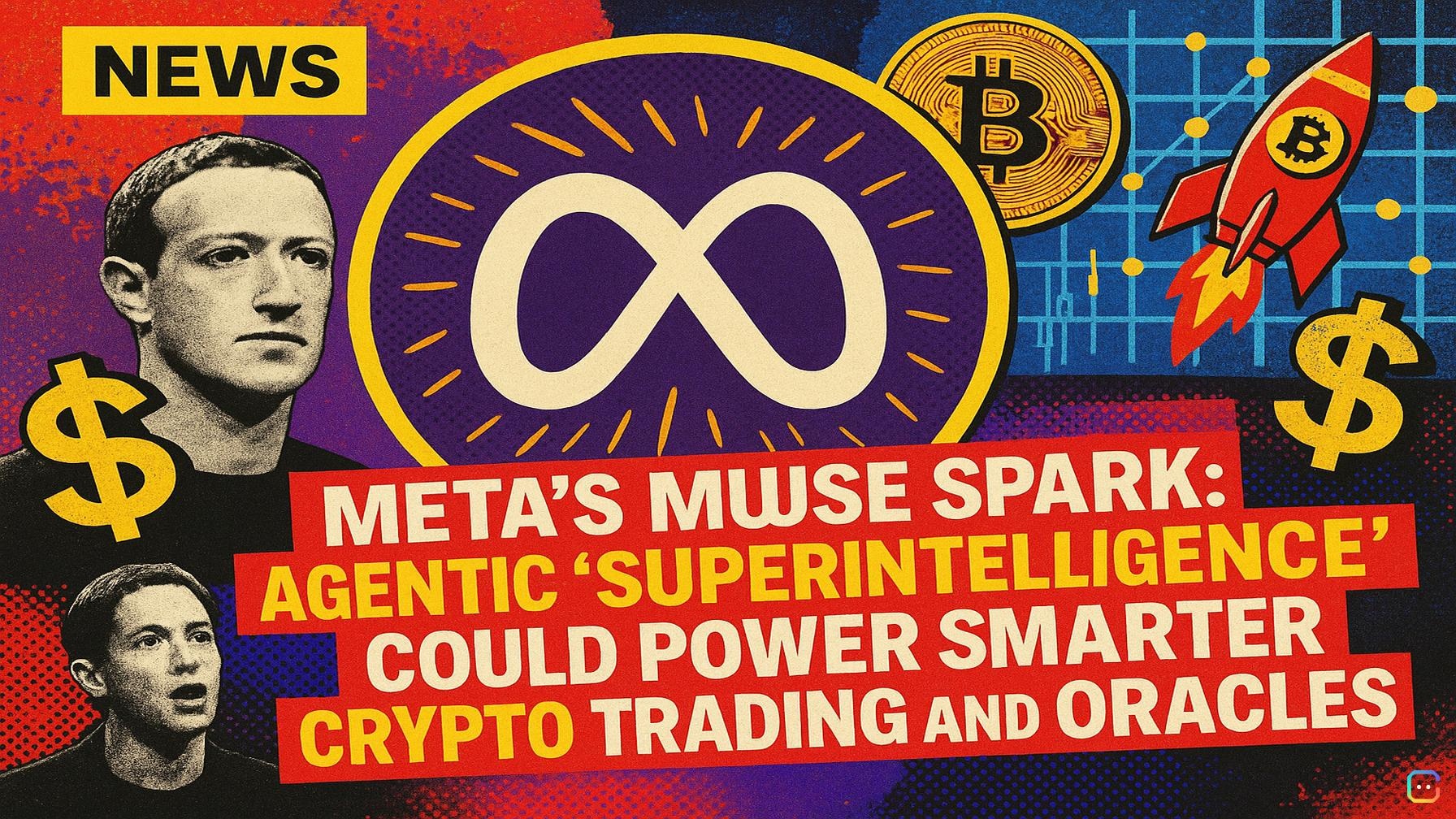
Meta this week unveiled Muse Spark, the first model from its new Meta Superintelligence Labs unit and what the company calls a first step toward putting “personal superintelligence” in users’ hands. Announced April 8 and highlighted by X account Coin Bureau, Muse Spark is already available on meta.ai with a private API preview being offered to select partners. Meta says the model will gradually reach WhatsApp, Instagram, Facebook, Messenger and Ray‑Ban AI glasses.
What Muse Spark is
- Small and fast by design: Meta claims Muse Spark achieves strong reasoning on complex science, math and health questions while using “over an order of magnitude less compute” than previous builds, a result of a nine‑month rebuild of its AI stack under the Superintelligence Labs banner (Meta blog).
- Multimodal and agentic: Muse Spark can process and generate text and images, call external tools and orchestrate multiple sub‑agents to break down and solve complex tasks — from financial modeling to troubleshooting appliances.
- “Contemplating” mode: A new feature that runs multiple agents in parallel before answering, pitched as Meta’s answer to “deep thinking” modes in frontier models like Gemini Deep Think and GPT Pro. Meta says this mode helped Muse Spark score 58% on Humanity’s Last Exam and 38% on the Frontier Science Research benchmark, putting it in the race with other high‑reasoning models (Financial Times).
Why health is central
Meta is leaning into medical and wellness use cases, calling health “one major application of personal superintelligence.” The company says it collaborated with more than 1,000 physicians to curate training data, and cites external evaluations where Muse Spark scored 42.8% on the HealthBench Hard benchmark — outperforming models including Gemini 3.1 Pro and Opus 4.6, and edging out GPT‑5.4. Reuters notes practical demos where Muse Spark can estimate calories from a meal photo and overlay virtual objects in images, showcasing its combined visual and reasoning skills.
Business and strategic context
- Rebuild and reposition: Superintelligence Labs was formed after Mark Zuckerberg vowed to “put superintelligence in the hands of everyone” and accelerate Meta’s AI efforts to catch up with OpenAI and Google. The Muse Spark launch signals a shift from broad Llama open‑source releases toward a more closed, vertically integrated stack focused on targeted capabilities (Bloomberg/FT).
- Market reaction: Investors appeared receptive — Meta’s stock rose about 9% on the announcement, according to trading platform Invezz — as the company positions AI as a driver of new revenue across apps and hardware.
Risks and scrutiny
Analysts warn that embedding advanced health guidance into a social platform could invite regulatory scrutiny, particularly around medical advice and data privacy in the U.S. and EU (FT). The shift toward closed, proprietary models also marks a strategic pivot that may draw debate within developer and policy circles.
What it means for crypto and Web3 (analysis)
Muse Spark’s combination of small, fast reasoning, multimodality and agent orchestration could matter to crypto projects in a few ways:
- Smarter trading and portfolio tools: Agentic models could automate multi‑step strategies, risk analysis and cross‑exchange arbitrage with faster inference and lower compute costs.
- On‑chain analytics and smart‑contract monitoring: Multimodal reasoning could help parse complex on‑chain data, audit contracts, or summarize transaction flows for end users.
- Oracles and hybrid apps: Integrated AI that can call external tools and APIs might be paired with oracle services to bring richer off‑chain insights to DeFi interfaces.
- Privacy and compliance concerns: If Meta integrates health or financial advice into social apps, handling sensitive user data — including wallet and transaction info — will raise security and regulatory questions.
Bottom line
Muse Spark represents Meta’s bet on targeted, high‑value use cases rather than competing purely on raw scale. With agentic reasoning, multimodal capabilities and a heavy health focus, the model aims to lock users into Meta’s ecosystem — and could open new opportunities (and regulatory headaches) for apps in crypto and beyond as Meta expands the tech across its platforms.
Read more AI-generated news on: undefined/news