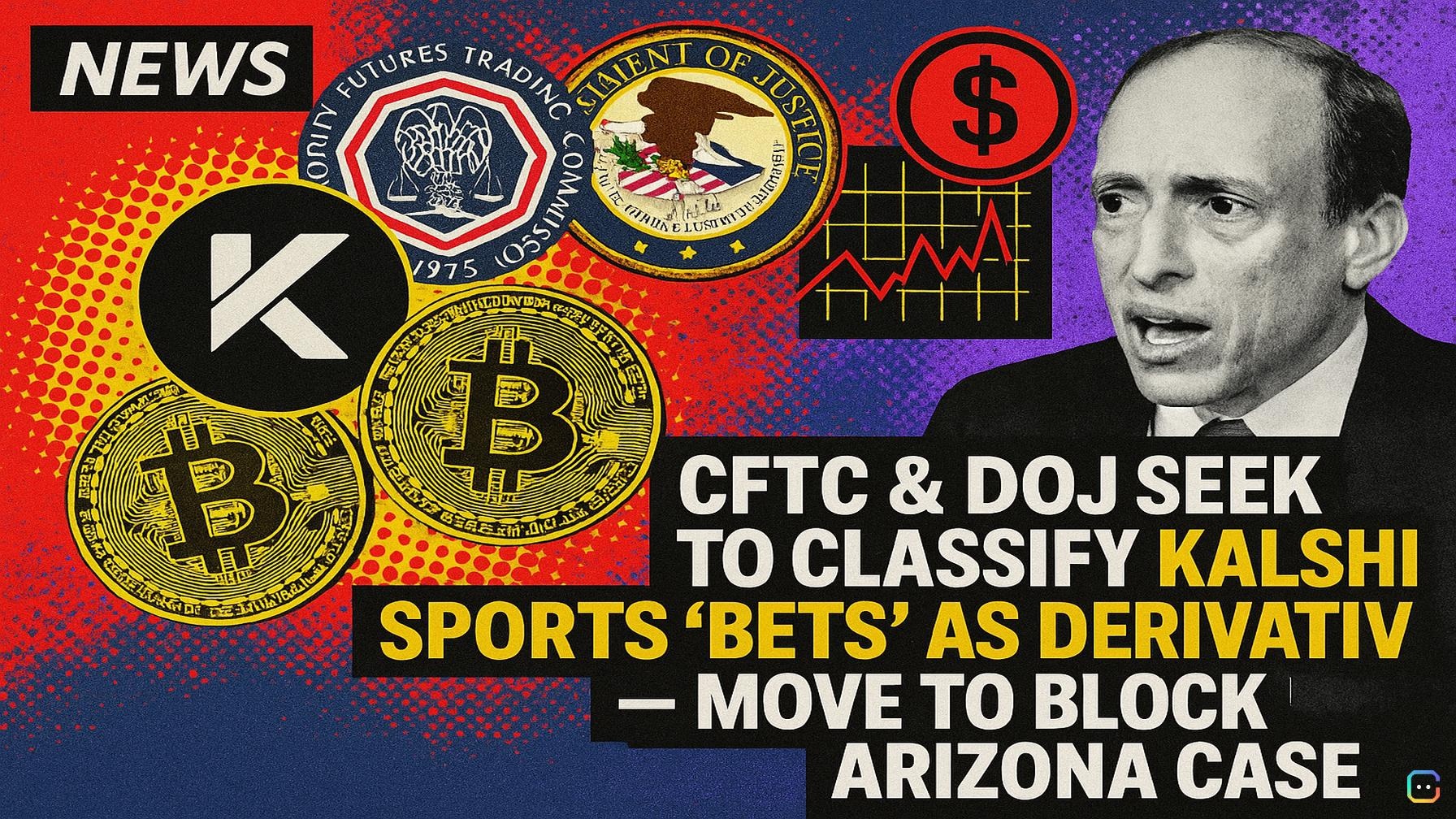
Headline: CFTC and DOJ tell court that sports “bets” are actually financial derivatives — move to block Arizona prosecution of Kalshi
The federal government has made its clearest push yet to treat prediction markets as finance, not gambling. In a late Tuesday filing, the Commodity Futures Trading Commission (CFTC) and Department of Justice asked a federal court to stop Arizona from enforcing state gambling laws against prediction-market operator Kalshi — arguing the contracts at issue are financial “swaps” under federal law, not ordinary wagers.
Why this matters
- If the court accepts the government’s view, contracts tied to sports, elections and other real-world events would fall under the Commodity Exchange Act and the CFTC’s “exclusive jurisdiction.” That would shift oversight away from patchwork state regulation and allow prediction platforms to operate nationwide under a single federal framework.
- If the court disagrees, these products could be forced into state gambling regimes — subject to licensing, age limits and other local rules — or even be shut down in key jurisdictions. For crypto and web3 projects experimenting with event-based products or tokenized prediction markets, the outcome could reshape business models and compliance obligations.
The core dispute
Arizona and several other states treat event-based contracts that pay out based on outcomes (like sports results) as traditional wagers. Arizona has escalated matters by filing criminal charges against Kalshi; the company is due to be arraigned on April 13.
Federal regulators counter that the legal question should hinge on contract structure, not the underlying event tracked. The CFTC and DOJ say because payouts depend on whether a future event occurs — and those events can have economic consequences — the instruments are legally indistinguishable from derivatives tied to commodities or interest rates. Under that logic, a contract about the Super Bowl is fundamentally the same class of financial product as one tied to oil or interest-rate movements.
Conflicting court signals
The filing lands amid a patchwork of judicial rulings. A federal appeals court in New Jersey recently sided with Kalshi, finding its sports contracts are presumptively allowed under federal law unless the CFTC acts. Other courts, however, have been more receptive to state enforcement efforts, allowing prosecutions to proceed in some jurisdictions.
The government warned in its filing that allowing states to criminally prosecute federally regulated exchanges would “undermine a national market” that Congress intended to oversee at the federal level.
What’s next
The dispute now turns on the courts. A ruling for the CFTC would consolidate oversight at the federal level and could unlock broader, nationwide availability for prediction-market products. A ruling in favor of state authority would reinforce a fragmented regulatory landscape and heighten legal risk for platforms offering event-linked contracts — including crypto-native and tokenized markets.
For now, regulators are taking an expansive view of their authority: emphasizing contract form over subject matter and arguing that an event-based contract tied to the Super Bowl is not meaningfully different from one tied to oil prices or interest rates. Courts will decide whether that analogy holds.
Read more AI-generated news on: undefined/news