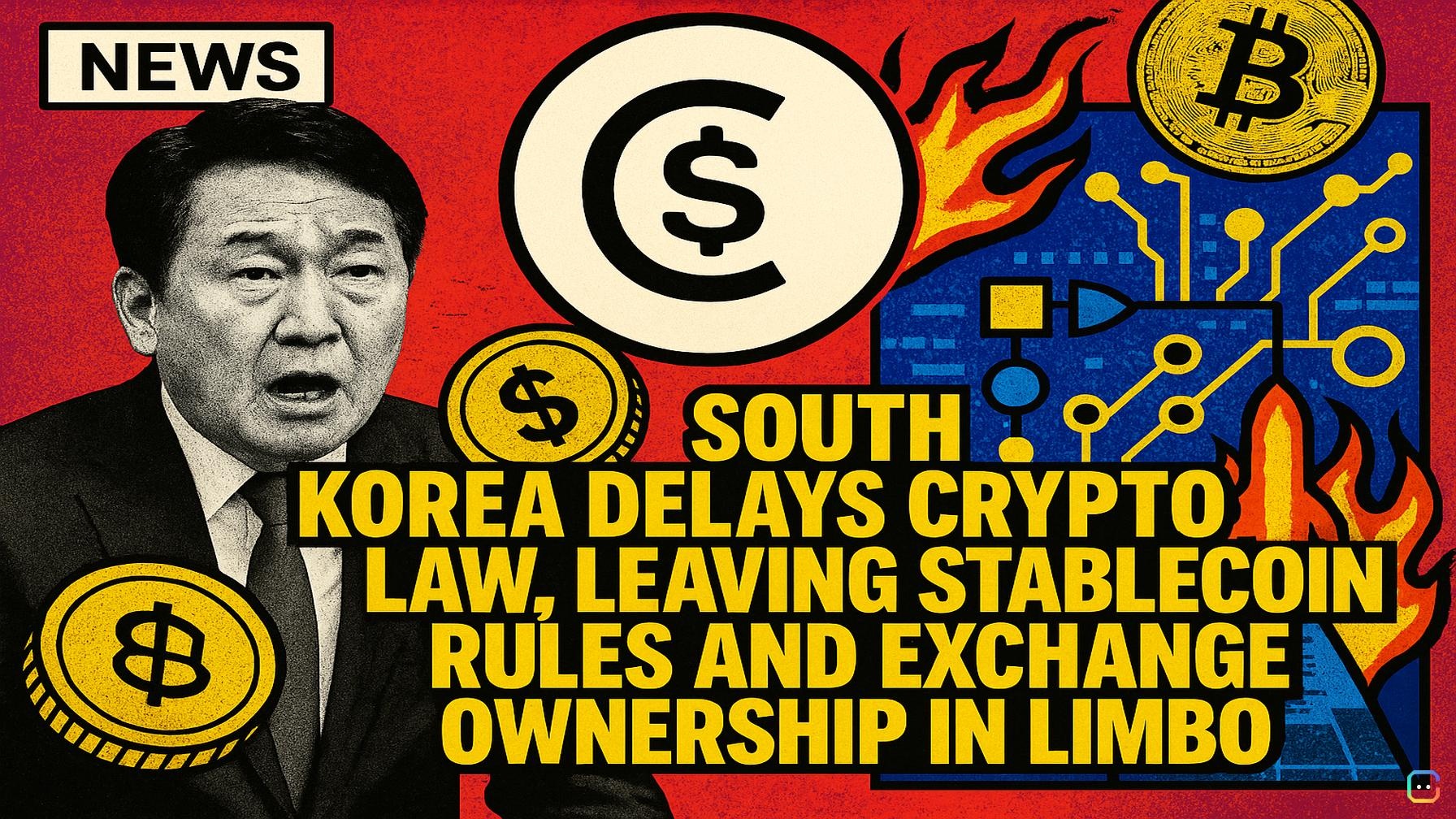
South Korea has delayed a pivotal crypto law push, leaving the industry in limbo as lawmakers punt “second‑phase” digital asset rules until after local elections on June 3.
What happened
- On March 31 the National Policy Committee removed the Framework Act on Digital Assets from its agenda, according to Maeil Business Newspaper, effectively shelving the second‑phase crypto bill until after the elections.
- That same day lawmakers forwarded five finance bills to a subcommittee (Framework Act on Administrative Regulation, Credit Information Protection Act, Microfinance Support Act, Insurance Business Act, and Capital Markets Act). No crypto bills were included in that slate.
- Separately, Representative Kim Nam‑geun’s “Partial Amendment to the Act on the Protection of Virtual Asset Users, etc.” was passed to the Bill Review Subcommittee by the Political Affairs Committee’s plenary session.
Why lawmakers hit pause
Officials opted to avoid pushing through controversial changes during an election-sensitive window rather than risk stoking political backlash. Two of the most explosive issues—ownership caps for exchanges and who may issue won‑pegged stablecoins—have become legislative “landmines,” with the presidential office and the Financial Services Commission (FSC) reportedly at odds over how strict to be.
The core fights
- Stablecoins: The Bank of Korea (BOK) has advocated a bank‑led consortium model that would require commercial banks to hold at least 51% of any issuer of won‑denominated stablecoins. The FSC agrees stablecoins need strong safeguards but opposes a hard 51% bank‑ownership rule, arguing it would exclude tech platforms, fintechs and exchanges that build user products (reported by Bitcoinist last October). Because stablecoin rules are slated to be enshrined in the Digital Asset Basic Act, each month of delay leaves current and prospective KRW stablecoin issuers operating in a legal gray zone or sidelined — a problem industry players say is raising costs and stalling strategy. As one insider told Aju Economy: “We need the bill to be finalized quickly to determine our business direction, but currently, we are keeping all possibilities open, which is only increasing the cost burden.”
- Exchange ownership caps: The FSC has pushed to treat major crypto exchanges more like securities or alternative trading systems, limiting any single “same person” to roughly 15–20% ownership. After industry pushback, regulators and the ruling party have converged on a 20% ceiling for major shareholders, with a narrow carve‑out allowing stakes up to 34% for new entrants—mirroring the 33.3% veto threshold under Korea’s Commercial Act (reported by Bitcoinist last month). For established platforms such as Upbit and Bithumb, founders and early backers already hold stakes far above 20%. A strict cap would force substantial sell‑downs over a transition period (three years for some, six for smaller players), potentially disrupting M&A and changing market control.
Wider regulatory context and market implications
Seoul is clearly moving from episodic crackdowns to a more systematic crypto regime. That effort includes heightened surveillance and enforcement tools—AI monitoring, market manipulation probes, and enhanced tax tracking—alongside occasional easing on other fronts, such as reconsidering earlier restrictions on exchange stakes and corporate crypto trading.
Near term, the policy deadlock keeps risk premia on Korean venues elevated and makes local listing and market‑making plans harder to model. After the election, two distinct outcomes could reshape the market:
- A bank‑heavy stablecoin framework combined with tighter governance would advantage well‑capitalized incumbents and banks, potentially concentrating liquidity and narrowing altcoin listings.
- Looser ownership limits or broader access to stablecoin issuance could be a clear risk‑on signal for KRW‑denominated products and attract global firms targeting Korea’s retail base.
Bottom line
By postponing the Framework Act on Digital Assets, lawmakers bought political cover but left the crypto sector without decisive rules on two existential issues: who can issue won stablecoins, and who can control exchanges. The post‑election phase will likely determine whether Korea’s next chapter favors incumbent banks and large exchanges—or opens the market to tech platforms and new entrants.
Image credits: cover image from Perplexity; BTCUSDT chart from TradingView.
Read more AI-generated news on: undefined/news