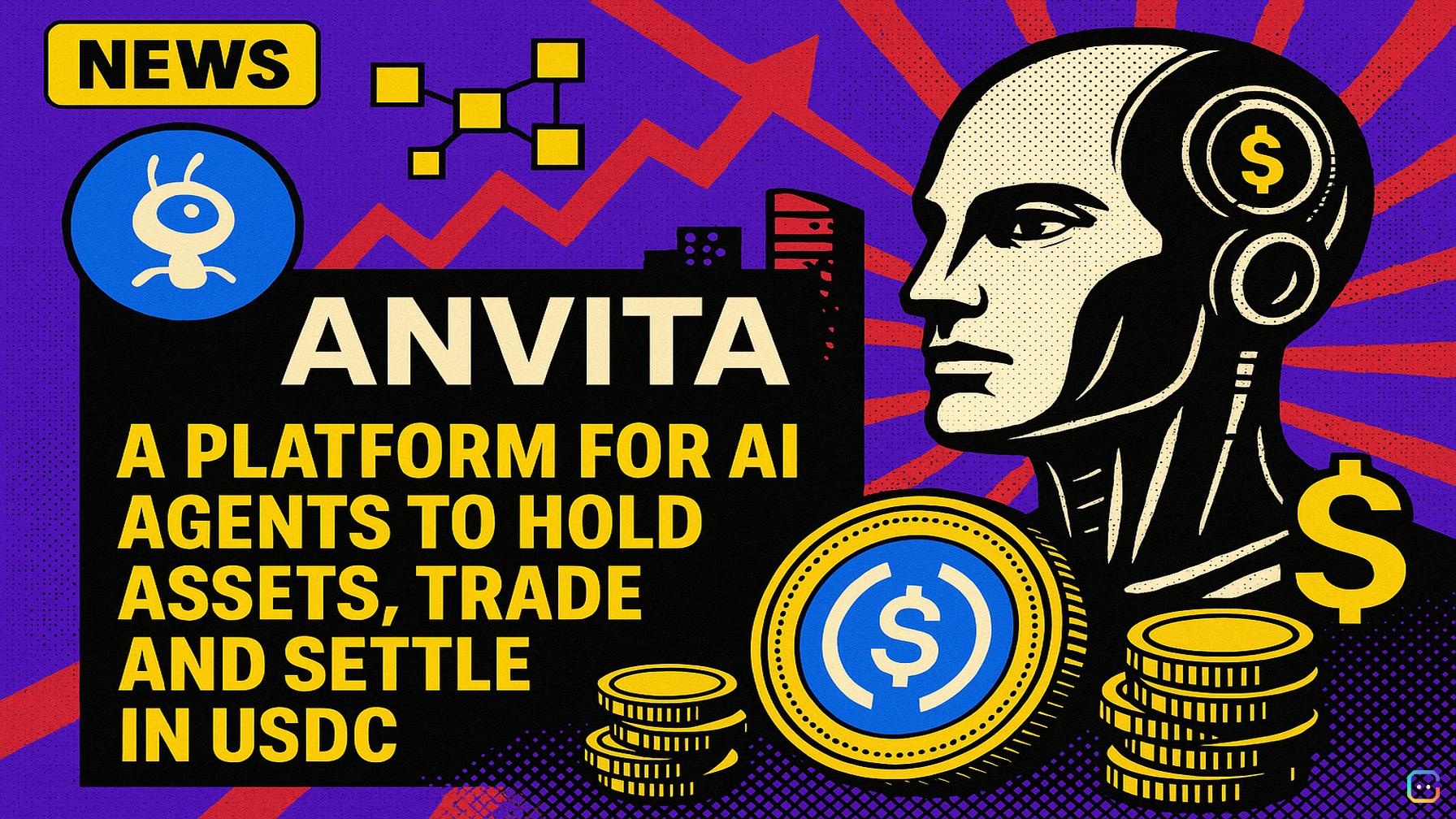
Ant Group’s blockchain unit has launched a platform designed to let software agents, rather than humans, become the primary actors in crypto transactions.
At its Real Up summit in Cannes, Ant Digital Technologies introduced Anvita — a two-pronged bet on what the firm calls an “agent-to-agent economy.” The system is intended to let autonomous AI programs hold assets, execute trades, coordinate services and settle payments with minimal human intervention.
Anvita debuts with two core products. Anvita TaaS (Tokenization-as-a-Service) targets institutions, offering tokenization of real-world assets alongside custody and treasury tools. Anvita Flow is built for the agents themselves: a registry and discovery layer where agents can find counterparts, coordinate tasks and settle payments in real time.
“The real transformation lies in moving toward an onchain agentic economy, where autonomous agents will not just analyze data — they will hold assets, execute trades, and optimize portfolios,” said Zhuoqun Bian, president of Ant Digital Technologies’ blockchain business.
A key technical component is integration of the x402 protocol — developed by Coinbase and Cloudflare — which enables stablecoin payments directly over HTTP. Agents on Anvita can reportedly complete sub-cent transactions instantly using USDC, removing reliance on traditional billing, subscription systems or manual approvals. The platform also includes an Agent Store with plug-and-play modules for data collection, financial analysis and gaming; developers can list agents and use popular frameworks such as OpenClaw and Claude Code, with flexible hosting options.
Ant Digital frames Anvita as extending tokenized assets from “static infrastructure” into an active onchain economy: agents could allocate capital, execute trades, provide services and automatically settle micro-payments as they interact.
Anvita arrives amid growing industry activity around agent-based commerce and payments. Visa and Coinbase have each published competing approaches — Visa with a Trusted Agent Protocol aimed at card-rail checkouts, Coinbase with x402 for stablecoin micropayments — and Google released an Agent Payments Protocol (AP2) in September backed by more than 60 organizations. Traditional networks are moving too: Mastercard’s $1.8 billion acquisition of stablecoin firm BVNK is the largest stablecoin infrastructure deal to date.
Onchain activity shows early signs but remains mixed. The Solana Foundation says its network has already processed more than 15 million agent transactions, and Coinbase CEO Brian Armstrong has predicted agents will eventually outpace humans in transaction volume. McKinsey projects AI agents could mediate $3 trillion to $5 trillion of global consumer commerce by 2030. At the same time, x402’s current onchain volume is modest — roughly $28,000 a day — much of it testing, and Artemis analysts have flagged about half of observed transactions as artificial activity.
Ant Digital’s blockchain already supports tokenized assets from various financial institutions. The company is pursuing USDC integration with Circle and applying for stablecoin licenses in Hong Kong, Singapore and Luxembourg as it pushes Anvita into live use.
Read more AI-generated news on: undefined/news