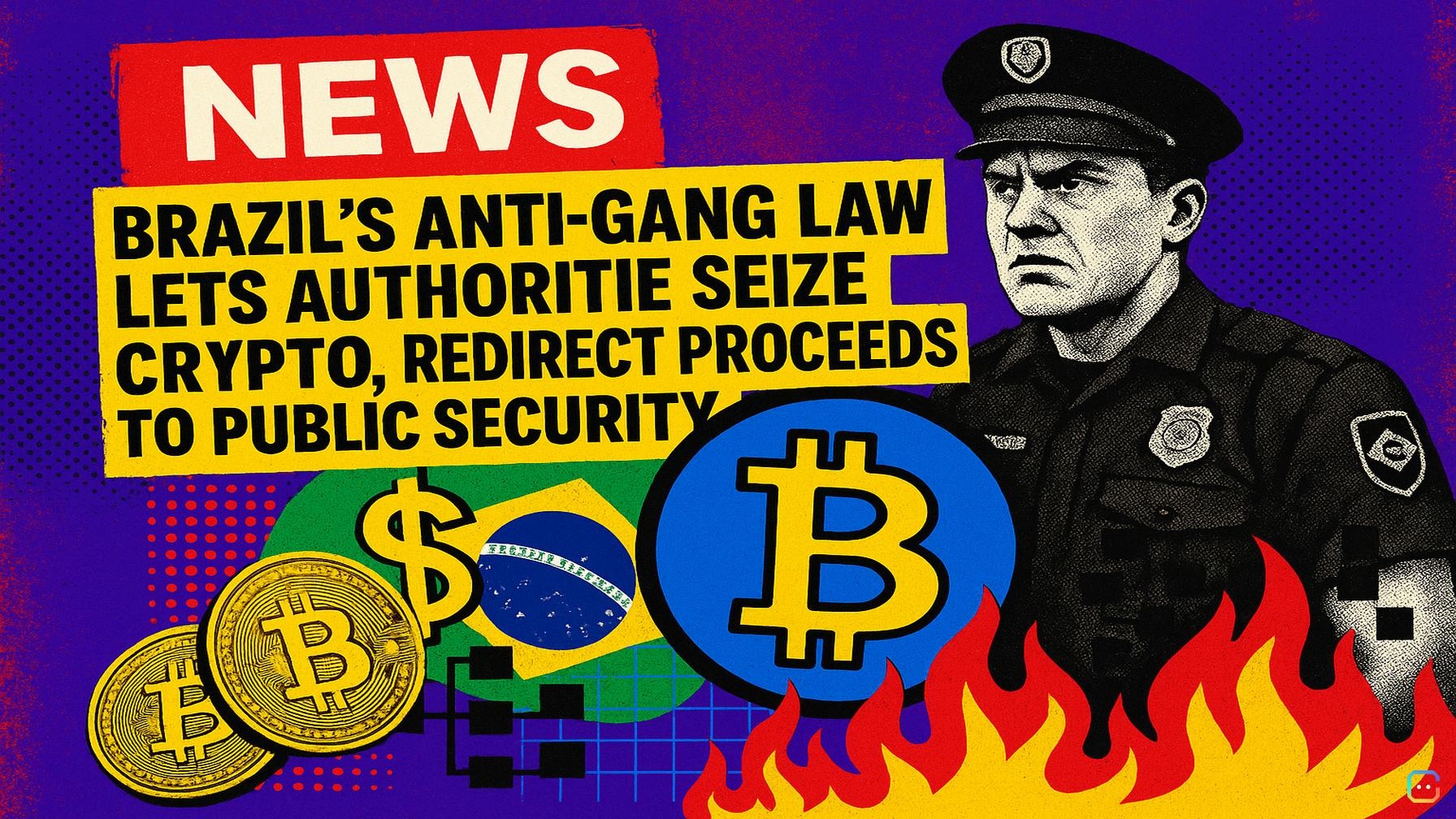
Brazil has passed a high-profile law that gives authorities the power to seize and even repurpose criminals’ digital assets to fund public security efforts.
President Luiz Inácio Lula da Silva signed the so‑called “Anti‑Gang Law” on Tuesday, strengthening penalties for organized crime leaders and authorizing a range of tools aimed at what the government calls the “financial, logistical, and material strangulation” of criminal networks. “The law represents progress in combating organized crime, by incorporating mechanisms for financial strangulation and strengthening the state's capacity to respond to the growing complexity of these criminal structures,” Brazil’s Minister of Justice and Public Security Wellington Lima said. “The focus is on reaching their highest levels, with more effective instruments and coordinated action,” he added.
Although the bill doesn’t name cryptocurrencies explicitly, it permits judges to order precautionary measures — including “seizure, attachment, blocking or freezing of movable and immovable property, rights and assets, including digital or virtual assets” — when there is sufficient evidence of a covered serious crime. In certain cases, judges may also authorize the early sale of seized assets, with proceeds directed to public security funds.
Custody of assets seized under precautionary measures will generally be the responsibility of public authorities, unless a judge finds “the material impossibility or technical inadequacy of custody by the public authorities is demonstrated.” That caveat highlights a key operational challenge: handling crypto safely and transparently is technically demanding, and governments have struggled with it elsewhere.
Brazil’s move follows real-world examples of those pitfalls. In South Korea, law enforcement failed to follow custody protocols and briefly lost access to $1.4 million in Bitcoin. In a separate incident, photos of seed phrases — the 12‑word keys that unlock crypto wallets — were exposed by tax officials, allowing someone to transfer roughly $4.8 million in tokens before the funds were ultimately returned.
The Anti‑Gang Law was introduced to Congress in November amid parallel initiatives from Brazil’s government and central bank aimed at cracking down on organized crime and illegal uses of Bitcoin and stablecoins. It comes on the heels of other enforcement actions, including the September takedown of an illegal Bitcoin‑mining operation.
Implications for the crypto sector
- The law gives Brazilian authorities clearer legal footing to target crypto holdings linked to criminal activity and to channel proceeds into public security budgets.
- Practical implementation will depend on courts, law enforcement capability, and custody infrastructure — areas where many jurisdictions still face gaps.
- Exchanges, custodians and compliance teams operating in or with exposure to Brazil will likely watch implementation closely for new procedures around asset seizure, evidence standards and disposition of proceeds.
As Brazil moves to convert seized digital assets into tools for public safety, the country will also need robust operational safeguards and transparent protocols to avoid repeating custody mistakes seen elsewhere.
Read more AI-generated news on: undefined/news