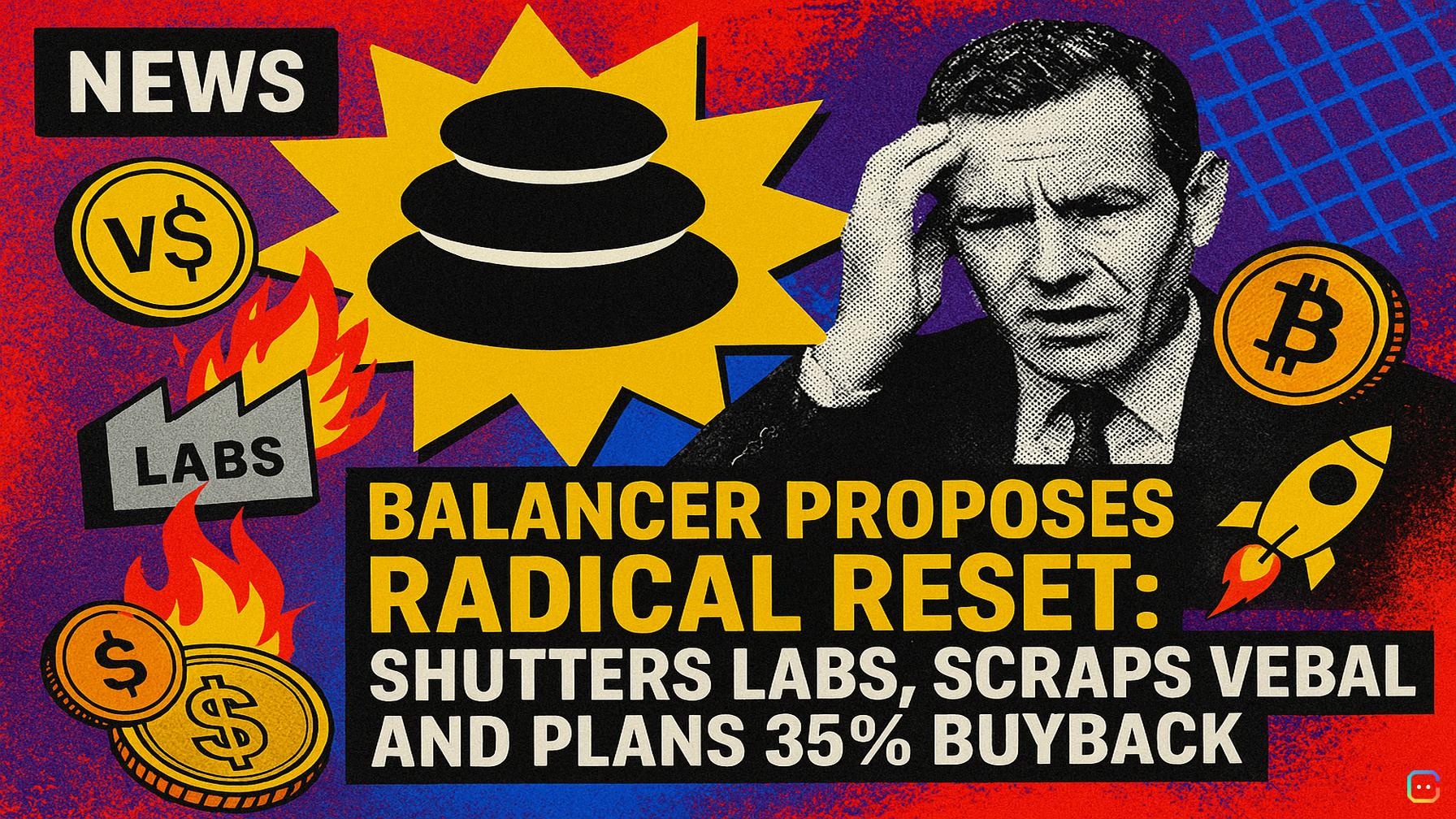
Balancer Labs is preparing a dramatic reset after founder Fernando Martinelli proposed shuttering the corporate arm tied to the project and ripping up much of Balancer’s old playbook. The move is a response to mounting pressure following a November 2025 exploit that siphoned off more than $100 million and exposed deep technical and structural weaknesses. Though the protocol itself will keep running, the plan marks a decisive break from the past and puts the BAL token’s future squarely on whether the overhaul can rebuild trust.
What’s being changed
- Emissions and governance: All BAL emissions would be halted and the veBAL (vote-escrowed BAL) governance model would be scrapped, ending the token-locking system that previously granted voting power and fee-share incentives.
- Incentives and fee flows: Incentive programs — including partner fee splits and vote-market mechanisms — would be shut down as sources of inefficiency and value leakage. Instead, all protocol fees would flow directly into the DAO treasury; previously only a small portion was captured.
- Liquidity strategy: Balancer plans to reduce swap fees in V3 to attract organic liquidity rather than relying on token rewards.
- Buyback and burn: A large buyback-and-burn program could remove up to 35% of the BAL supply over time, paired with compensation for former veBAL participants to reset supply dynamics and attempt to restore confidence.
Why Balancer is moving now
The proposal is driven by fundamentals and recent shocks. Although Balancer generates over $1 million a year in fees, the protocol retained little value while ongoing emissions created continuous selling pressure — a dynamic that hamstrung long-term growth. Governance was also concentrated in the hands of a few large actors (notably Aura Finance), producing misaligned incentives. The November 2025 exploit exacerbated these problems and introduced legal risk connected to the corporate entity. Martinelli argues that closing Balancer Labs removes that liability and nudges the project closer to a fully decentralized model. Development and maintenance are expected to continue under a new structure so the protocol doesn’t stall.
What this means for BAL price
At the time of reporting BAL was trading near $0.15, hovering just above recent lows and in a zone where sentiment can flip quickly. Key technical levels to watch:
- Support: around $0.126 — a drop below this could signal further downside and weakened confidence.
- Near-term resistance: about $0.1785 — a sustained move above this would indicate improving sentiment.
- Psychological barrier: $0.20 — a meaningful break above this would be notable.
The proposed buybacks are critical: if executed at scale, they could provide a solid price floor. But the ultimate determinant will be execution — how faithfully the DAO implements the plan and whether the community accepts the new model.
Bottom line
This is a radical reset for one of DeFi’s early automated market makers: emissions and veBAL are gone, incentives are being restructured, fees will be captured by the DAO, and a sweeping buyback could materially shrink supply. The overhaul is meant to resolve chronic value leakage, governance concentration and legal risk — but its success hinges on the DAO’s ability to execute and restore confidence in BAL. Traders and holders should watch implementation milestones, buyback activity and whether the protocol can attract organic liquidity under the new fee regime.
Read more AI-generated news on: undefined/news