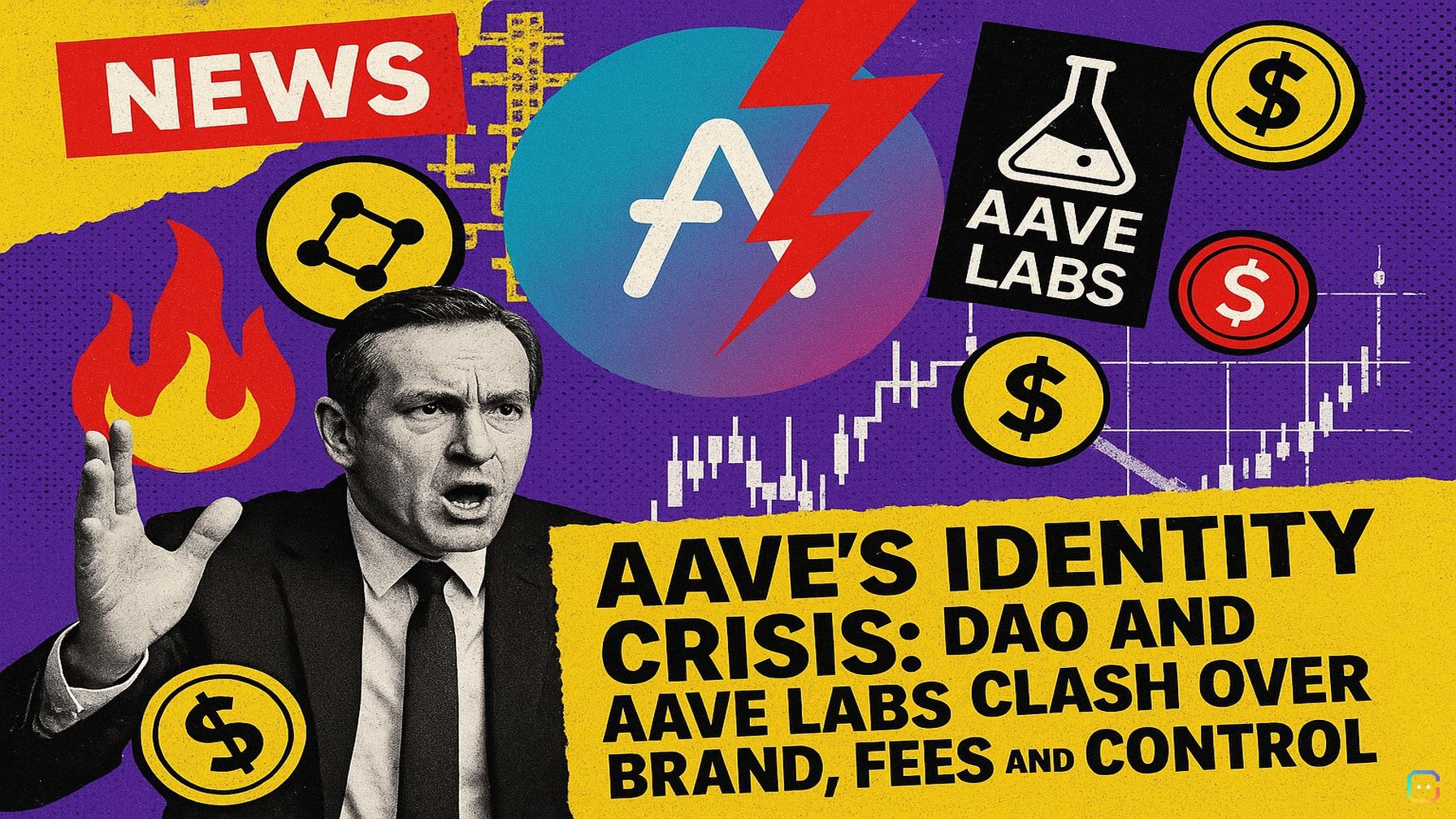
Aave is in the middle of an identity crisis that has split its community and put one of DeFi’s core governance questions on full display: who should control a protocol’s brand — the token-holders who govern it, or the centralized builders who ship its software?
What sparked the fight
The dispute intensified after Aave integrated CoW Swap for trade execution, and swap fees from that integration flowed to Aave Labs — the centralized developer firm that builds much of Aave’s front-end and tooling — rather than to the DAO treasury. Critics say the arrangement exposed a deeper issue: Aave’s brand assets (trademarks, domains, social accounts and other storefront pieces) are effectively controlled outside of the DAO, even though the protocol has more than $33 billion locked across its network.
Why it matters
This is not just an internal spat. It highlights a growing tension across large crypto projects between decentralized governance and centralized execution teams. As protocols scale and brand value grows, the question of who ultimately controls those assets — and therefore who can shape the protocol’s public face and monetization — is becoming existential for tokenholder rights and long-term governance.
Positions harden on both sides
Supporters of keeping brand control with Aave Labs argue that operational autonomy enables faster product delivery, clearer accountability, and smoother partnerships — especially with regulated institutions that need an identifiable legal counterparty. Former Aave Labs staffer Nader Dabit warned on X that DAOs are “structurally incapable of shipping competitive software,” arguing that requiring governance-level approval for most product moves would slow or kill time-sensitive opportunities.
KPMG’s George Djuric and others add that forcing Labs into a grant-dependent model risks turning engineers into “political actors” who must repeatedly compete for funding, which would stifle innovation. Proponents also note that protocol-level revenue remains under the DAO’s control and that interface monetization can expand the economic pie and fund development that benefits the whole ecosystem.
DAO proponents counter that the engine of Aave — risk management, upgrades, and recurring revenue generation — is now governed and funded by token holders, while the brand functions as the public storefront. Longtime contributor Marc Zeller argues that when a private actor controls the storefront, token holders lose leverage over representation, monetization and long-term steering. In this view, the DAO should own the brand and delegate operational management under enforceable terms, reflecting current reality: Labs acts as a core service provider within a DAO-funded ecosystem.
Broader stakes and community reaction
Investment partner Louis Thomazeau called the dispute “probably the most important live debate around tokenholder rights today,” saying lessons from Aave will be watched by other token communities. Messari analyst Sam Rushkin pushed back on comments that the debate is stale, underscoring continued community passion.
Where the vote stands
A governance vote to transfer ownership of Aave-linked assets to the DAO has been hotly contested. As of the latest tallies, roughly 58% of votes cast oppose transferring those assets to the DAO, and about one-third of voters have abstained. The vote is scheduled to conclude on Friday. Aave Labs did not respond to requests for comment.
Market impact
The governance fight has coincided with market pain for AAVE tokens: Aave fell roughly 18% over a recent week as the dispute weighed on sentiment, outpacing declines in many major crypto tokens.
Bottom line
Beyond Aave, this debate is a test case for governance models across crypto. It forces projects to confront how to balance decentralized control with the practical benefits of centralized teams — and who holds the keys to a protocol’s public identity as DeFi moves deeper into mainstream markets.
Read more AI-generated news on: undefined/news