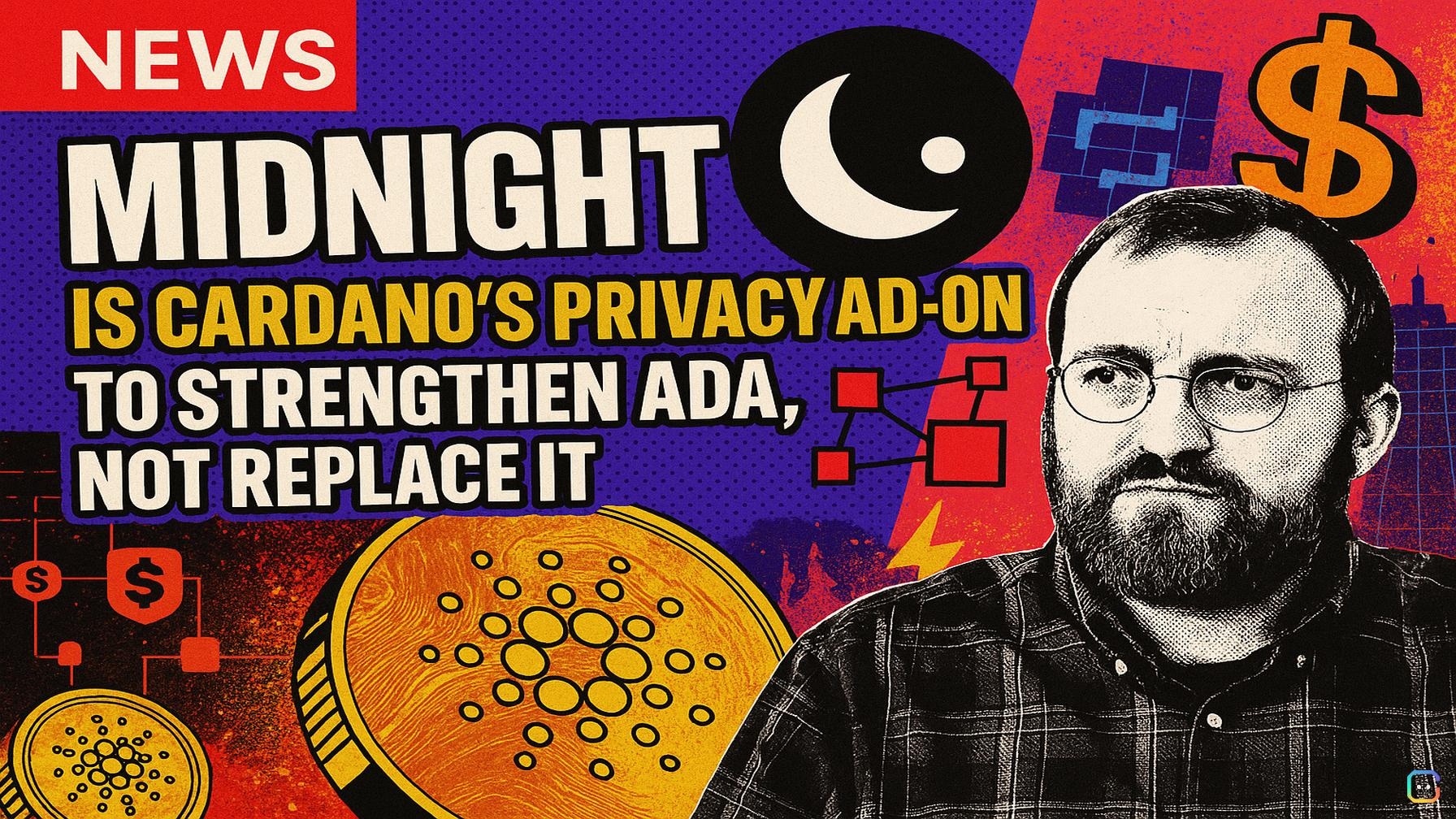
After the successful Midnight (NIGHT) token airdrop, Cardano founder Charles Hoskinson was confronted with a common question from ADA holders: if Midnight is Cardano’s privacy token, why not sell ADA and migrate to NIGHT? Speaking on the Discover Crypto podcast on Dec. 21, Hoskinson rejected that premise — arguing Midnight was built to extend and strengthen Cardano, not replace it.
“Midnight is the ChatGPT of privacy. That’s its job,” he said, calling Midnight a blockchain-to-blockchain infrastructure module that “actually makes Cardano applications have privacy.” The core pitch: Midnight supplies privacy tooling as an add-on infrastructure layer for Cardano-native apps rather than a competing base asset that pulls liquidity away from ADA.
Hoskinson painted Midnight as a differentiator for Cardano dApps in a crowded DeFi market. He suggested smaller, fast-moving Cardano projects will adopt privacy features first to win users, while large incumbents like Uniswap or PancakeSwap — “slow moving” and conservative because of their large value flows — will be less likely to move quickly. “Which ones do you think are going to adopt privacy first? … No, it’ll be Cardano applications. Because they need to gain users and so this is how they leapfrog the competition,” he said.
He broadened the case into a cross-chain liquidity thesis centered on Bitcoin DeFi. Hoskinson described Bitcoin as “agnostic” capital that flows where yield, credit and utility are available, and argued that Cardano’s UTXO model makes it a natural landing spot for BTC liquidity. “When you look at Bitcoin… it doesn’t care if it goes to Ethereum or Solana or Cardano… it’s going to go to the closest continent and the closest continent is Cardano because it’s a UTXO system and Bitcoin is UTXO system,” he said. With Midnight, that yield could be privacy-preserving, he added, potentially attracting BTC and other assets (he mentioned XRP) into Cardano-native DeFi without forcing holders to sell their base assets.
Hoskinson also emphasized that Midnight is designed to “hybridize” on-chain and off-chain infrastructure rather than “steal TVL or steal luster from other systems.” On distribution and security, he pointed out that Cardano “launched Midnight,” giving ADA holders preferential participation: early access, the largest share of the airdrop, and a security relationship where Cardano secures Midnight — a mechanism that ties ADA holders economically to NIGHT token distribution.
Pressed on price predictions, Hoskinson declined to give targets and instead laid out a “value leakage” theory tied to Bitcoin’s institutional bid. He argued large allocators are structurally anchored in BTC via ETFs and buy-and-hold mandates, which limits the traditional retail-driven BTC→alt rotation. In this environment, he suggested, the main path for capital to move from Bitcoin into other ecosystems is via Bitcoin DeFi yield — letting BTC holders earn yield and credit exposure without selling their Bitcoin. If Cardano can provide that yield in a risk profile institutions find acceptable, capital could “leak” outward from BTC into Cardano-based products, potentially syncing the chain more with Bitcoin’s price action.
The takeaway from Hoskinson’s comments: Midnight is presented as an additive infrastructure layer that expands Cardano use cases and keeps ADA holders involved through security and token allocation, not as a replacement for ADA. At press time, ADA traded at $0.36.
Read more AI-generated news on: undefined/news