Today's Cryptocurrency Prices by Market Caps
The global cryptocurrency market cap today i $2.31T
Market Cap
$2.31T
24h Trading Volume
$70.34B
BTC Dominance
56.22%
|
#
|
Name
|
Price
|
1h %
|
24h %
|
7d %
|
Market Cap
|
Volume (24h)
|
Chart (7d) |
|---|---|---|---|---|---|---|---|---|
|
|
—
|
|||||||
|
No cryptocurrencies found Try adjusting your search query |
||||||||
Latest Crypto News
View All News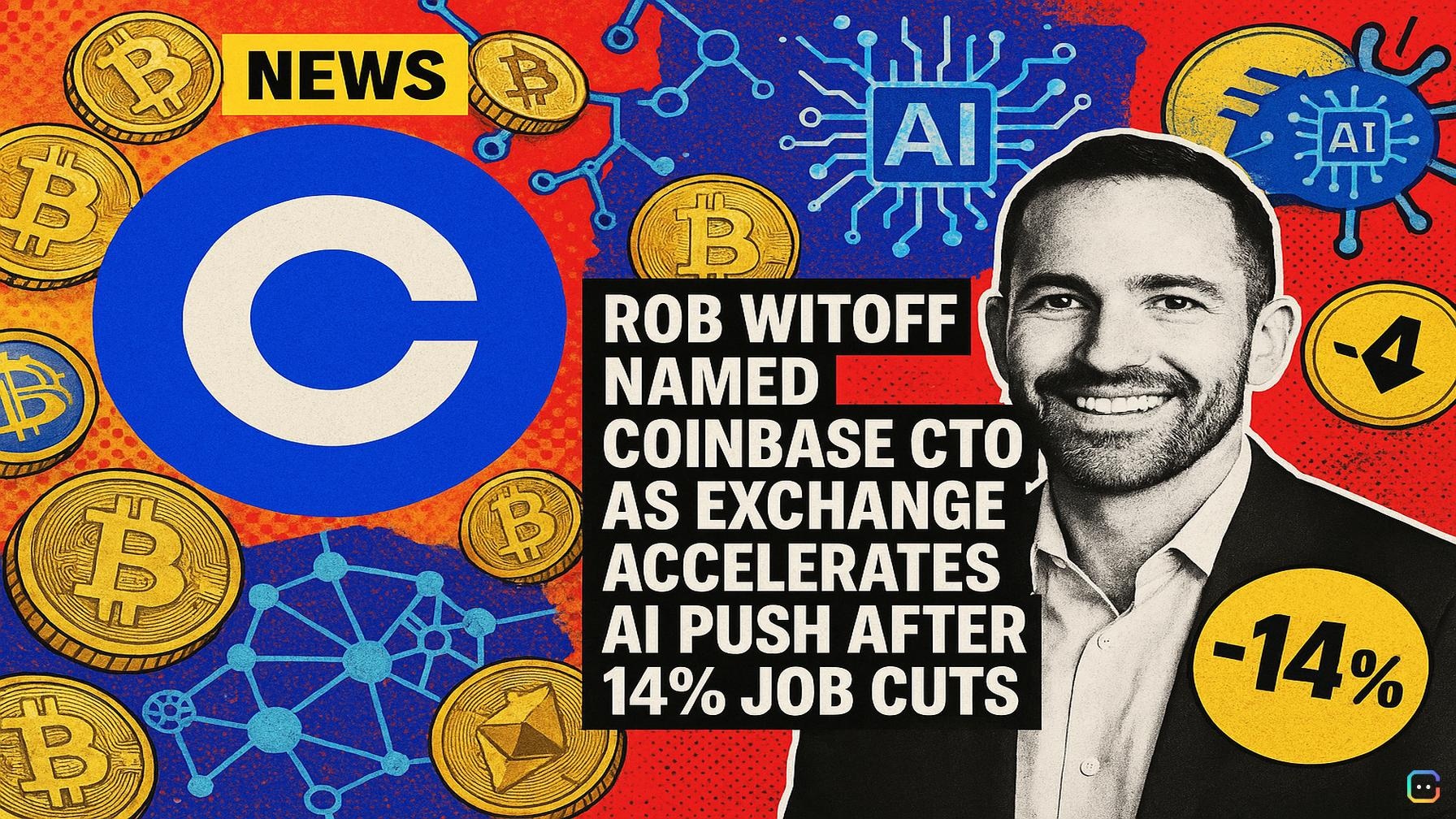
Rob Witoff Named Coinbase CTO as Exchange Accelerates AI Push After 14% Job Cuts
Headline: Coinbase names Rob Witoff CTO as exchange pushes deeper into AI after 14% job cuts Coinbase has appointed Rob Witoff as its new chief technology officer, a strategic hire that brings an early company engineer back into the C-suite as the U.S. crypto exchange accelerates AI-driven product development. The promotion was announced by CEO Brian Armstrong on X on July 28, and Coinbase’s leadership page now lists Witoff as CTO. A return to lead engineering Witoff first joined Coinbase in 2014, where he worked on security and infrastructure, rose to chief architect and helped build some of the exchange’s earliest systems. He left in 2017, later founding institutional custody firm Unit 410 — a business Coinbase ultimately acquired. He rejoined the company in December 2024 as head of platform and an executive team member. Armstrong praised Witoff on X, saying he had been “the driving force behind us being one of the most AI-enabled companies in the world.” The characterization is Armstrong’s assessment rather than an independently verified ranking. Witoff himself has said his interest in Bitcoin dates back to 2009 and has described Coinbase’s early technical setup as supporting a single cryptocurrency on one codebase with a small engineering team — comments that provide historical context but have not been independently detailed by Coinbase. Why this matters: AI at the center of product and org changes Witoff’s elevation comes amid a broader overhaul of how Coinbase builds software. In May the company announced a restructuring that cut about 14% of its workforce — roughly 700 roles — while flattening management and organizing smaller teams around AI tools. Armstrong has said AI enables engineers to do in days work that previously took weeks and described experiments with “one-person teams” that blend engineering, product and design responsibilities. Coinbase has pushed the AI message into its engineering metrics. In a July report the company said the share of newly merged code that was AI-generated and human-reviewed climbed from 5.7% in Q1 2025 to roughly 100% by mid-2026 — a company claim that signals how central AI-assisted coding has become to its development pipeline. CTO responsibilities and near-term tests As CTO, Witoff will oversee Coinbase’s technology stack while the firm expands into derivatives, stablecoin payments, prediction markets and services for AI agents — areas that require dependable infrastructure, robust security controls and rapid incident response. Coinbase’s recent operational issues underscore those demands. On July 14 the exchange suffered a roughly 50-minute service disruption after a routine configuration update affected a shared production cluster. Transfers, card payments and some on-chain services were interrupted; the company said customer funds were not at risk and subsequently rolled out new deployment safeguards and recovery procedures. Witoff’s background in security, architecture and platform engineering aligns with the kinds of challenges highlighted by that incident, but Coinbase has not released new performance targets, budget commitments or a separate technology roadmap tied specifically to his appointment. Executive shuffle continues The CTO appointment follows another executive change: Chief Legal Officer Paul Grewal told the company on July 8 that he would step down July 31. Molly Abraham is expected to take over as general counsel and corporate secretary, while Grewal will stay on as an adviser through October. Ongoing commitments and the big question Coinbase says it will continue to institutionalize AI in its processes — including quarterly reviews of an AI-focused engineering interview process and 45- and 90-day assessments for new hires. The central test for Witoff will be whether Coinbase can keep accelerating product delivery using AI while preserving security, reliability and regulatory controls — a balance that will shape the exchange’s competitiveness and risk profile as it pushes further into AI-native finance. Read more AI-generated news on: undefined/news

FCA: Stablecoins Primed for Cross‑Border & Trade Finance, Not UK Retail
The UK’s financial regulator has concluded that stablecoins are most likely to shine as a cross-border payments tool — but have limited appeal for everyday retail use in the UK, according to findings published after the Financial Conduct Authority’s “Stablecoin Sprint.” What the FCA heard - The FCA ran a two-day Stablecoin Sprint in March 2026 and a follow-up trade finance roundtable in May, gathering about 75 industry delegates including banks, payment firms, merchant acquirers, fintechs, infrastructure providers, stablecoin issuers and industry groups. Another ~30 participants later discussed programmable payments for trade finance. - Participants overwhelmingly pointed to cross-border transfers as the clearest commercial use-case. Stablecoins can cut settlement delays and improve access to dollar-based payments in markets where banking infrastructure and access to USD are limited. - By contrast, the consensus was that UK consumers have little incentive to swap their bank transfers or card payments for stablecoins, since domestic systems are already fast, cheap and ubiquitous. Businesses and merchants, however, may still benefit from lower transaction costs and faster settlement—especially where intermediary fees or payment delays persist. - Trade finance conversations highlighted programmable payments: smart-contract-driven settlement could automate commercial payments and streamline execution. Regulatory context and timelines - The report accompanies the FCA’s broader stablecoin policy work. On June 30 the regulator finalized rules requiring UK-issued stablecoins to be fully backed by reserve assets and redeemable at par. The FCA says feedback from the Sprint will continue to shape future policy. - Under the new digital-asset regime, firms seeking to carry out regulated crypto activities can apply for FCA authorization from Sept. 30, 2026, ahead of the full regime’s start on Oct. 25, 2027. The framework covers trading platforms, custodians, staking providers and stablecoin issuers. Existing anti-money-laundering registrations will not automatically convert into the new licensing regime. Changes after industry feedback - The FCA reduced a proposed capital buffer for stablecoin issuers to 1% of issued value, down from a 2% proposal, after reviewing industry evidence—an adjustment the regulator said was made following consultation (noted by David Geale, FCA Executive Director for Payments and Digital Finance). - Most sterling-denominated stablecoins will remain under FCA supervision; tokens judged systemically important would be overseen by the Bank of England. Bank of England response and international issues - The Bank of England has been revisiting parts of its own stablecoin proposals after industry pushback. Regulators had suggested issuers hold at least 40% of reserves in non-interest-bearing Bank of England deposits and considered temporary caps on individual and corporate holdings during rollout. Firms warned those measures — especially non-interest reserves and ownership caps — could hurt commercial viability and be hard to enforce across wallets and venues. - BoE Deputy Governor Sarah Breeden said the bank is reassessing those temporary limits and reserve proposals. BoE Governor Andrew Bailey also flagged that the global rise of dollar-backed stablecoins will likely require closer international regulatory coordination, with engagement expected with US counterparts. Stablecoins, AI and the future of payments - The FCA’s July review on the future of retail financial services connected stablecoins to another emerging theme: autonomous AI agents. The regulator suggested that AI-enabled agents managing payments, investments and savings could increase demand for programmable digital money, because traditional banking rails may struggle to operate at machine speed. - The review also warned firms that legal accountability cannot simply be pushed onto AI systems—even where payments and settlements are automated. Why it matters - The FCA’s Sprint confirms a pragmatic market view: stablecoins are poised to add the most value where legacy systems are slow, costly or dollar access is scarce—typically cross-border corridors and certain business use-cases such as trade finance—rather than displacing routine retail payments in mature markets. Regulators in the UK are moving to build a framework that aims to protect consumers while accommodating innovation, but debate continues over the right balance on reserves, capital and international coordination. Read more AI-generated news on: undefined/news

Hungary U‑turn: Scraps Mandatory Crypto Validator, Clears Way for CoinCash
Hungary has scrapped a controversial layer of crypto oversight, removing a mandatory third‑party validator check that had complicated crypto trading and pushed several firms to suspend or leave the market. The repeal, approved by Parliament, brings Hungary’s rules closer to the EU’s Markets in Crypto‑Assets (MiCA) framework and clears the way for companies such as CoinCash to resume and expand services. What changed - Parliament voted to eliminate the validator requirement after the rule disrupted domestic crypto activity, Finance Minister Kármán András said. The decision was reported by Hungarian tax and legal outlet Ado.hu. - The repeal removes an extra transaction‑approval step that had existed alongside MiCA, but leaves standard licensing and compliance obligations for crypto asset service providers intact. Background: what the validator rule did - The validator regime was introduced in Hungary’s 2024 crypto assets law and took effect on July 1, 2025 — earlier than the EU’s extended transition deadline of July 1, 2026 that other member states could use. - Under that law, certain crypto‑to‑fiat and crypto‑to‑crypto conversions required approval from a licensed local validator before they could be legally recognized. - Validators — supervised by Hungary’s Supervisory Authority of Regulated Activities — were mandated to verify wallet ownership, trace the origin of assets, check customer identities and transaction history, and issue a compliance declaration. Why it mattered - The extra validation step created operational friction and legal uncertainty. Several firms suspended services or left Hungary, and trading volumes fell. - Earlier legislation also attached criminal penalties to unauthorized crypto activity. Reporting at the time (Forbes) outlined prison terms for individuals and operators depending on transaction amounts — penalties that the current government has said it plans to remove or soften. - The restrictive approach prompted criticism from industry and EU scrutiny; officials have signaled a desire to align Hungarian policy with MiCA and to remove disproportionate sanctions. Political context - The U‑turn follows Hungary’s April 2026 election, which brought a pro‑European government led by the Tisza Party into power and ended Viktor Orbán’s long tenure. New ministers and spokespeople described the prior framework as excessive and politically motivated. - Government spokespeople and the Innovation and Technology Minister, Zoltán Tanács, publicly backed moving closer to MiCA and revising the harsher aspects of the previous law. Industry impact and milestones - Budapest-based CoinCash (operator Tiwala Solutions) completed its MiCA licensing process: the National Bank of Hungary granted authorization on July 20, allowing the firm to offer custody, crypto‑to‑fiat exchanges, crypto‑to‑crypto trading, asset transfers, investment advice and portfolio management under EU rules. CoinCash had suspended operations in December 2025 while preparing for MiCA compliance. - Other providers reacted earlier by scaling back services; Revolut suspended crypto in Hungary, and some companies reportedly considered relocating to Estonia or Lithuania. What to expect - With the validator requirement gone and plans to remove criminal penalties previously linked to routine trading, Hungary’s regulatory stance is now closer to the EU norm under MiCA. That should reduce legal uncertainty and make it easier for licensed firms to rebuild services and for trading activity to recover. - The EU’s investigation into whether Hungary’s earlier rules complied with union law remains a factor in the broader regulatory picture. Bottom line: Hungary has removed a contentious validation layer that had hindered crypto activity and driven enforcement concerns. The move, coupled with MiCA authorizations like CoinCash’s, signals a recalibration toward EU‑level regulation and a more industry‑friendly operating environment. Read more AI-generated news on: undefined/news
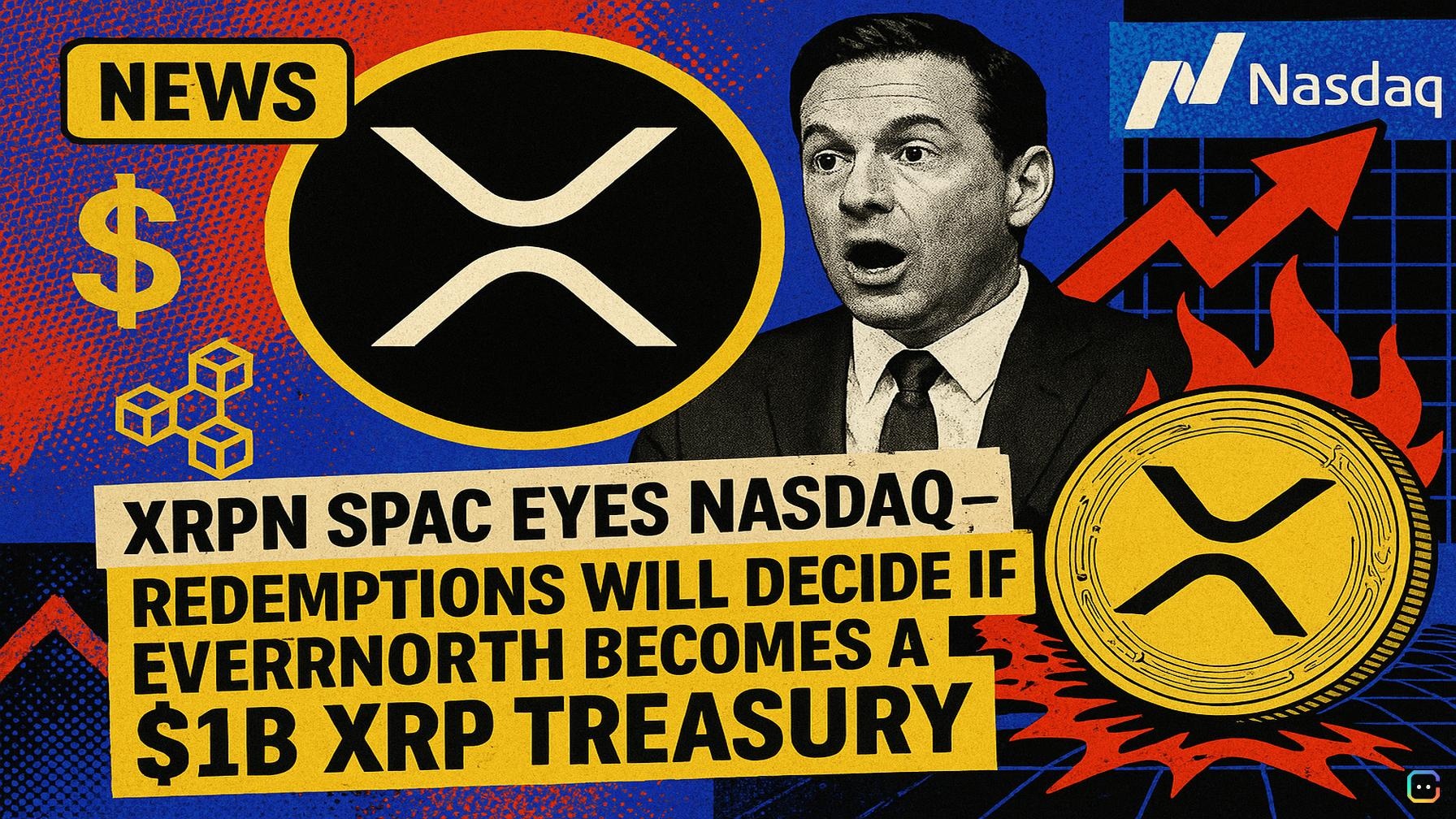
XRPN SPAC Eyes Nasdaq — Redemptions Will Decide If Evernorth Becomes a $1B XRP Treasury
Evernorth’s SPAC is heading to Nasdaq under the ticker XRPN — but whether it arrives as a billion-dollar treasury or a much smaller vehicle depends on one simple investor choice. Quick snapshot - Evernorth assembled roughly 473 million XRP at an average cost near $2.54 per token (about $1.2 billion of paper cost). - XRP trades around $1.10, leaving the position with an unrealized deficit of more than 50%; Evernorth recorded a material impairment in its 2025 accounts. - The deal was capitalized with roughly $1 billion of commitments from credible backers including Ripple (which contributed ~127 million XRP), SBI, Pantera, and Kraken. - Initial registration was filed in March with amendments in April and June; Evernorth filed Amendment No. 1 to its Form S-4 as it pursues a Nasdaq listing. - Pro forma cash available to the combined company has already been revised down from about $1.1 billion to roughly $870 million across filings — an early sign of redemption pressure before the vote. - Evernorth has named independent directors including Robert Kaiden (OpenAI Foundation CFO) and Derar Islim (Antalpha COO). Why this listing is unusual Treasury-style crypto SPACs succeed when they can raise money, buy tokens, trade at a premium to net asset value (NAV), then issue more shares at that premium and buy more tokens — a self-reinforcing “flywheel.” That model breaks when the premium vanishes. Evernorth will test the inverse scenario: it is trying to list while its token holdings are already deeply underwater. But the immediate determinant isn’t XRP’s market price per se — it’s the SPAC redemption mechanic. The redemption mechanism that decides the deal When a SPAC announces a business combination, public SPAC shareholders get two independent rights: a vote on the merger and a right to redeem their SPAC shares for their pro rata portion of the trust (effectively cash near the original offering price plus interest). A holder can vote yes and still redeem. This unconditional redemption right exists to protect investors in a blind-pool vehicle, but it means deals subject to skepticism bleed cash between announcement and closing as rational holders take the cash instead of equity they value below the trust amount. Applied to Evernorth, each SPAC holder faces a binary choice: accept cash at trust value, or accept equity representing a pro rata share of an XRP position marked more than 50% below cost. Many of the institutional SPAC shareholders and arbitrage funds that sit in trusts to capture the redemption floor default to taking cash. That dynamic explains why pro forma cash already fell by over $200 million in amended filings. Why redemptions matter for a treasury vehicle Redemptions don’t automatically kill a deal, but they shrink it — and for a treasury company, scale is everything. A materially reduced deal yields: - a smaller token position that can’t meaningfully influence markets or support liquidity in the stock, - a thin public float that discourages institutional participation, - no credible path to follow-on accretive share issuances, which is the mechanism that made the model work when markets were willing to pay premiums. Compounding the problem: the sector-wide premium compression. This year, treasury vehicles have generally seen the premium on wrappers compress toward parity or below, halting the issuance-then-buy cycle. Evernorth must convince the market to pay a premium not just for exposure to XRP, but for a wrapper built around a position already at a sizable loss — a harder sell when the market has grown reluctant to pay premiums even for better-positioned vehicles. Context from XRP spot-product demand Evernorth isn’t arriving into a vacuum. The spot XRP ETF complex that launched after regulatory clarity drew initial inflows totaling roughly $1.49 billion, but those inflows have decayed substantially (flows down ~99% from launch in the analysis cited) and the ETFs’ cumulative inflows mark against net assets with an unrealized deficit near $493 million. In short, a simpler, brokerage-accessible product that already tested institutional demand for XRP saw the bulk of that demand evaporate — which weakens Evernorth’s pitch to allocators who can already access XRP through ETFs. The other side of the ledger This is not a one-sided indictment. The committed capital is real, and names like Ripple, SBI, Pantera, and Kraken are credible backers. Supporting a treasury vehicle assembled near a cycle low can be a sound long-term strategy if the cycle turns. Sponsors also have tools to defend scale at closing — forward purchase agreements (FPAs), private placements (PIPEs), or non-redemption agreements can backstop redemptions, though they are costly and revealing when disclosed. What to watch — the decisive milestones - Redemption tally at closing: the single most informative number. It converts investor conviction into dollars and fixes the size of the surviving company. - Opening trade relative to NAV: whether the stock opens above NAV (enabling the flywheel) or at/below NAV (which forecloses accretive issuance). - Sponsor moves disclosed after listing: any backstop agreements, lock-up terms for committed investors (notably Ripple’s stake), and whether remaining cash is earmarked for further accumulation or just operating runway. - Any additional accumulation: whether Evernorth averages down or raises new capital to alter its cost basis materially. Bottom line Evernorth is a high-stakes experiment in the treasury model: a well-backed vehicle assembled near a cycle low but carrying a deep mark-to-market loss, and heading into a listing where SPAC shareholders’ redemption rights will determine the company’s scale before it ever trades. If redemptions are light and committed capital holds, the thesis is coherent: a low-cost entry into XRP can pay off over time. If redemptions shrink the deal materially, the company may list as a much smaller, less functional treasury. The redemption figure at closing and the opening trade will tell the story quickly — probably within days. This is educational analysis, not investment advice. The transaction is pending, terms and timing are uncertain, and data reflect filings and reporting available as of July 29, 2026. Always do your own research. Read more AI-generated news on: undefined/news

Binance disappears from Google Play in certain EU countries
Binance’s Android app is unavailable on Google Play in some EU markets amid scrutiny over MiCA compliance.
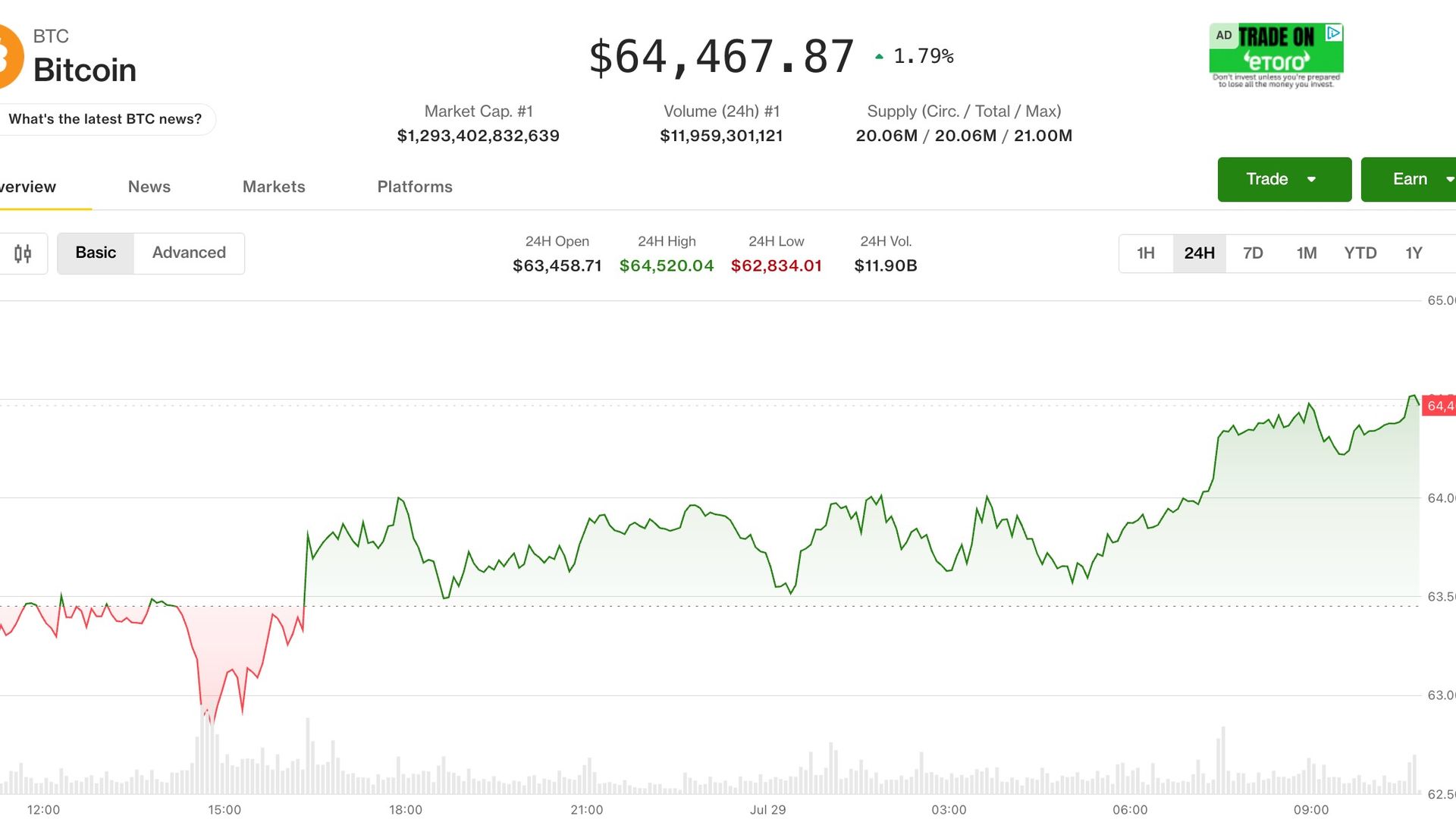
Bitcoin steadies above $64,000 as crypto looks to Fed interest-rate decision
BTC added 0.75% before the Federal Reserve's rate decision. Inflation at 4.1% keeps an increase firmly on the table even as oil prices ease.