Today's Cryptocurrency Prices by Market Caps
The global cryptocurrency market cap today i $2.31T
Market Cap
$2.31T
24h Trading Volume
$70.34B
BTC Dominance
56.22%
|
#
|
Name
|
Price
|
1h %
|
24h %
|
7d %
|
Market Cap
|
Volume (24h)
|
Chart (7d) |
|---|---|---|---|---|---|---|---|---|
|
|
—
|
|||||||
|
No cryptocurrencies found Try adjusting your search query |
||||||||
Latest Crypto News
View All News
Pulped for AI: Book-Buying Frenzy Sparks Crypto Calls for Provenance, Payback
Like a real-world echo of Fahrenheit 451, some AI firms are buying up and literally destroying piles of printed books to turn them into training data — a developing supply chain that’s already changing the used-book market and raising fresh legal and ethical questions. What’s happening - Intermediaries are quietly sourcing books at industrial scale for AI clients, according to a report from 404 Media. These middlemen advertise the ability to locate hundreds of thousands of titles while promising strict confidentiality — a sign of how sensitive this practice has become. - Books are being stripped, scanned and discarded. Pre-2023 titles — works written entirely by humans before the generative-AI boom — are particularly prized as high-quality training material that buyers say can help preserve human-authored knowledge from being “diluted” by AI-generated content. Market effects - Used-book sellers report a dramatic spike in demand after AI buyers entered the market. One unnamed bookseller told 404 Media his weekly sales jumped from about 20 books to several hundred. While the boom has been profitable, sellers worry that uncommon or out-of-print books are being permanently lost after destructive scanning. “I don’t like the end-use, and I don’t like that uncommon books are being pulped,” he said. Legal backdrop - The practice echoes projects like Anthropic’s “Project Panama,” which digitized millions of books via destructive scanning. Courts are split but have issued important rulings: in Bartz v. Anthropic PBC, a federal judge in San Francisco found that scanning legally purchased physical books into digital copies — even when originals were destroyed — could be transformative fair use. Federal judges later reached similar fair-use conclusions in separate cases involving OpenAI and Meta. - At the same time, legal consequences have arrived: a different federal judge in the same district this week approved a $1.5 billion settlement requiring Anthropic to compensate thousands of authors — roughly $3,000 per book — after the company used pirated copies of works to train its Claude model. Industry reaction - The backlash is prompting public responses from AI figures. Elon Musk, for example, urged his SpaceXAI team to preserve rare books and “scan them the hard way vs just cutting off the spine and scanning,” arguing for less-destructive handling. Why crypto readers should care - For a crypto and Web3 audience, the story flags issues around data provenance, ownership, and long-term preservation of human-created content. As AI models ingest massive offline collections to generate value, questions about transparent sourcing, immutable records of rights and compensation, and market externalities (like the permanent loss of rare content) will only grow — and they’re areas where blockchain-based provenance, licensing and micropayments are often proposed as solutions. Bottom line: The destructive-book-to-dataset pipeline is real, profitable and legally contested. As AI companies race to assemble pristine human-written data, the consequences — for authors, sellers, readers and the archive of human knowledge — are starting to play out in courtrooms and on the ground. Read more AI-generated news on: undefined/news
Anthropic AI Breaks HAWK: Claude Mythos Exposes Critical Post-Quantum Flaw
Morning Minute — Tyler Warner GM! Big story today: an AI model just exposed critical weaknesses in post-quantum cryptography. Anthropic says an unreleased build of its most powerful model, Claude Mythos Preview, discovered two previously unknown attacks on cryptographic algorithms. One of those attacks hit HAWK — a digital-signature scheme designed specifically to resist quantum computers and previously advanced to round three of NIST’s post-quantum competition as the last lattice-based contender. Why this matters: HAWK’s selling points were compact keys and fast signing, traits that matter a lot for blockchains because larger signatures consume block space and drive up fees. Claude found a mathematical symmetry in HAWK that human researchers hadn’t exploited, collapsing the work needed to break HAWK’s smallest key from 2^64 operations down to 2^38 — roughly a 67 million× reduction. Anthropic says the necessary fix essentially doubles key sizes, which “eliminates many of the reasons” HAWK was attractive in the first place. To be clear: nothing in production is broken. HAWK hasn’t been deployed anywhere, and Bitcoin still runs on ECDSA (a pre-quantum scheme). But the discovery is a major development because the broader push to make crypto quantum-resistant — from institutional initiatives to roadmaps from Vitalik, NEAR, Zcash, and others — assumes the replacement schemes themselves are secure. Claude Mythos has just demonstrated that an advanced AI can find new, practical attacks on leading candidates before they ship. There’s a silver lining: the same AI that finds vulnerabilities can be used to defend code. That’s why many teams are racing to point powerful models at their own cryptographic designs and implementations. The next question is now urgent: will AI break cryptography faster than it can help rebuild and harden it? Other items: Corporate treasuries & ETFs, meme coin tracker — more in the newsletter. Read more AI-generated news on: undefined/news

Crypto Scams Likely Cost Americans $80.7B in 2025 — Over Half of Online Scam Losses
Headline: Crypto scams wiped out an estimated $80.7B from Americans in 2025, CFA says — more than half of all online-scam losses A new Consumer Federation of America (CFA) analysis paints a stark picture for crypto users: Americans likely lost about $80.7 billion to cryptocurrency-related fraud in 2025, accounting for more than half of the nation’s total online-scam losses. Key findings - Reported vs. estimated losses: The FBI’s Internet Crime Complaint Center (IC3) recorded $11.37 billion in crypto-related losses last year — a 22% increase from 2024. CFA applied a 7.1x multiplier to account for underreporting and estimates the true crypto loss at roughly $80.7 billion. - Why 7.1x? CFA uses a multiplier based on a 2017 Bureau of Justice Statistics survey that found only about 14% of fraud victims report crimes to law enforcement. CFA calls the 7.1x factor “conservative.” Industry analysts, including TRM Labs’ Ari Redbord, have also suggested the FBI figures are an important but incomplete benchmark, assuming roughly 15% of victims report. - Overall scam picture: Across all categories, the FBI logged 1,008,597 complaints and $20.9 billion in reported losses — a 26% year-over-year rise. CFA scales that figure up to an estimated $148.2 billion in annual losses nationwide, or about $1,009 per U.S. household. - Investment fraud: The largest single category. The FBI recorded $8.6 billion in reported investment fraud, which CFA inflates to an estimated $61.4 billion — a 32% jump from 2024. - Older Americans hit hard: People over 60 lost about $4.4 billion to crypto fraud alone, nearly 40% of the crypto total. - AI-enabled crime: For the first time the FBI tracked AI-enabled schemes separately, logging $893 million in losses across 22,364 complaints. Enforcement and responses - Prevention efforts: The FBI’s Operation Level Up, which contacts potential victims before they pay, has reached about 8,000 people and says it prevented roughly $500 million in losses overall, including $225.9 million last year. - Prosecutions and seizures: Cases span domestic and international actors. An Oklahoma man received a five-year sentence last year for a $9.4 million crypto Ponzi. U.S. law enforcement has increasingly targeted foreign-run scams: a newly formed Scam Center Task Force has seized about $25 million tied to fraudulent crypto platforms and romance-scheme operations. - Major forfeiture action: The Justice Department moved to forfeit 127,271 Bitcoin (then valued at about $15 billion) connected to Prince Group chairman Chen Zhi in a forced-labor scam case in Cambodia — the largest forfeiture in DOJ history. Prince Group has denied involvement in scam operations. Platforms and regulation - CFA has sued Meta over scam advertising and singled out Facebook, Instagram and WhatsApp as the platforms most associated with scam activity. Ben Winters, CFA’s director of AI and privacy, argued that “tech companies are too often allowed to avoid accountability.” - A bipartisan bill, the SCAM Act, would bar online platforms from displaying fraudulent or deceptive ads — a policy route CFA supports as part of a push for greater platform responsibility. What this means for crypto users - The CFA’s scaling highlights how much fraud likely goes unreported and suggests the headline FBI totals understate reality. For crypto users, the data show that investment scams remain the biggest threat, older adults are disproportionately targeted, and bad actors are increasingly using AI and cross-border networks. - Law enforcement and regulators are ramping up prevention, prosecution, and asset seizures, but CFA and other consumer advocates want stronger platform accountability and policy tools to curb scam advertising and deceptive listings. Bottom line: If the CFA’s adjustments are accurate, crypto fraud is not just growing — it’s now the dominant component of U.S. online-scam losses. The report underscores persistent enforcement challenges and renewed calls for platform and policy fixes to stem the flow of funds to fraudsters. Read more AI-generated news on: undefined/news

Bitcoin Holders Sue Apple After Fake Sparrow iPhone App Drains $1.8M
Three Bitcoin holders have sued Apple after a fake iPhone app posing as the popular Sparrow Wallet allegedly drained a combined $1.8 million in bitcoin. The complaint, filed July 24 in the U.S. District Court for the Northern District of California, brings eight counts including fraud, negligent misrepresentation and strict products liability. According to the suit, each plaintiff entered their seed phrase into the counterfeit app — effectively surrendering control of their funds. The named losses: James Ramirez says he lost 7.4 BTC (about $875,000), Christopher Ellis alleges $840,000 in losses, and Jalen Delgado reports 1.05 BTC (roughly $120,000) stolen. Sparrow Wallet is desktop-only (Windows, macOS and Linux) and has never shipped an iOS version, the filing notes, so any App Store listing under that name is an impersonation. Ramirez says he reported the fraudulent app to Apple on July 25, 2025 — the day his funds were taken — but the complaint alleges Apple did not contact him and that fake Sparrow listings were still live when the suit was filed. Ellis reportedly downloaded a Sparrow app from the App Store nine days after Ramirez’s loss. The plaintiffs also accuse Apple of more than negligence: the filing alleges, on information and belief, that Apple ranked the fake app and placed it in curated cryptocurrency collections, “effectively recommending a fraudulent application to consumers alongside legitimate ones.” Sparrow’s creator, Craig Raw — who holds the U.S. trademarks for the name — has been flagging copycat apps on Apple’s store since at least January 2024. He publicly warned that a scam version remained live weeks after being reported, and later told Apple he submitted an App Store listing whose sole purpose was to inform iOS users that Sparrow is desktop-only. Apple rejected that submission as “placeholder content” and temporarily flagged Raw’s developer account for “dishonest activity,” a decision he says was later overturned on appeal. Apple declined to comment to TechCrunch about the lawsuit, instead pointing to its own ecosystem analysis that it says shows it rejected more than 371,000 malicious App Store submissions. The company also told TechCrunch that, at the time of its statement, there were no Sparrow Wallet copycats on the App Store. One notable legal claim in the suit — count seven — asks the court to treat the App Store itself as a product placed into the stream of commerce, which would expose Apple to strict liability for failing to warn consumers. The complaint argues Apple’s opposite-position disclaimers are buried “deep within” lengthy click-through terms and therefore insufficient. The case raises fresh questions about platform responsibility and curation: if an app store ranks or promotes software that turns out to be fraudulent, can the platform be held liable for the resulting losses? The court’s handling of this suit could set important precedents for app marketplaces and crypto security. Read more AI-generated news on: undefined/news
Evernorth Faces Underwater XRP Position — SPAC Redemptions Will Decide Its Fate
Evernorth looks set to list “underwater” — and the SPAC vote and redemptions will decide how big the company actually is. What’s happening - Evernorth, a Ripple-backed digital-asset treasury company, filed Amendment No. 1 to its Form S‑4, moving it closer to a Nasdaq listing under ticker XRPN. But the company’s flagship position is already trading well below what it paid for it. - The vehicle says it accumulated roughly 473 million XRP at an average cost of about $2.54 per token. XRP is trading near $1.10, leaving Evernorth with an unrealized loss of more than 50% and a material impairment recorded in its 2025 accounts. - The capital backing the deal is real and heavyweight: about $1 billion in commitments from Ripple (which contributed ~127 million XRP), SBI, Pantera, Kraken and others. That credibility is central to the bull case — but it doesn’t erase the arithmetic SPACs force on public shareholders. Why the SPAC mechanics matter — the redemption is the story - This is classic SPAC structure: public holders of the SPAC can vote to approve the business combination and separately redeem their shares for pro rata cash from the trust (usually IPO price plus interest). In practice, holders can and do redeem even when they vote yes. - For Evernorth, the choice for SPAC shareholders is stark: take cash at trust value, or accept equity in a company whose token holdings sit at a >50% unrealized deficit. Arbitrage funds and many institutional SPAC investors typically take the cash. That behavior is already visible: pro forma cash available to the combined company has fallen across filings from roughly $1.1 billion toward about $870 million — the visible effect of expected redemptions and adjustments before closing. What that means for the listing - Redemptions don’t necessarily kill the deal, but they shrink it. A smaller Evernorth would: - Hold a less meaningful XRP stake, - Have a thinner public float that discourages institutional participation, - Lose the balance-sheet scale needed to issue equity accretively — the flywheel that made treasury vehicles work in the past. - The broader treasury-company model depends on the stock trading at a premium to NAV so the company can issue shares accretively and buy more tokens. That premium has largely evaporated across the sector this year. Evernorth’s handicap is that it would be asking investors to buy a wrapper around an underwater position at a time the market is reluctant to pay premiums for even winning positions. A sober look at demand and supply - The ETFs and products that already offered institutions exposure to XRP aren’t exactly a tailwind: coverage of the spot-XRP ETF complex found cumulative inflows around $1.49 billion against ~ $997 million in net assets, leaving an unrealized deficit near $493 million — and flows decayed roughly 99% from launch. In short, a lot of institutional demand was tested in simpler products and largely cooled off. - That said, the committed investors here are credible and strategic. Ripple, SBI, Pantera, and Kraken are not casual backers. Their participation — and Ripple’s conversion of tokens into a large equity stake — is a signal of conviction that could matter if those backers hold and the vehicle keeps scale. Key things to watch (and when they’ll arrive) - Redemption figure at closing: the single most informative number. It converts investor conviction into dollars and sets the company’s initial scale. Compare any announced redemptions to the roughly $870 million pro forma and the original ~$1.1 billion. - Will committed investors backstop redemptions? Expect disclosures about forward purchase agreements, private placements, or non-redemption deals if the sponsors try to preserve scale. - Opening trade relative to NAV: the market’s first verdict on whether the wrapper is worth a premium. Trading below NAV on day one typically forecloses the accretive issuance flywheel. - Filings on lock-ups and Ripple’s disclosed position: details on any lock-up or sale plan for Ripple’s ~127 million-XRP contribution will be in the registration materials, and they’ll matter for future supply dynamics. - Any change in accumulation strategy: whether Evernorth uses remaining capital to average down or pauses buying will materially change the cost basis and narrative. Context and the honest frame - Treasury vehicles succeeded when they could buy assets at reasonable prices and trade at premiums that allowed accretive share issuance. This sector has shown it can work going up and that it struggles badly in reverse when premiums compress. - The bull case for Evernorth is straightforward and internally consistent: a treasury assembled near a cycle low, backed by credible capital, is well-positioned to benefit from a token recovery. But it requires that recovery — and enough shareholders declining cash at the gate so the company is large enough to wait for one. - The decisive moment for Evernorth is now: the shareholder redemption choices and the market’s opening trade will reveal whether it lists as a meaningful, billion-dollar vehicle or as something much smaller. Bottom line Evernorth is a high-profile test of the SPAC-to-treasury formula in a market that has already shown limited appetite for paying premiums on token wrappers. The committed capital and backers give the deal life, but the SPAC redemption mechanics put the company’s scale and strategy on the line before a single share trades. This is educational analysis, not investment advice. The transaction’s terms, timing, and completion are uncertain; figures reflect filings available as of July 29, 2026. Always do your own research. Read more AI-generated news on: undefined/news
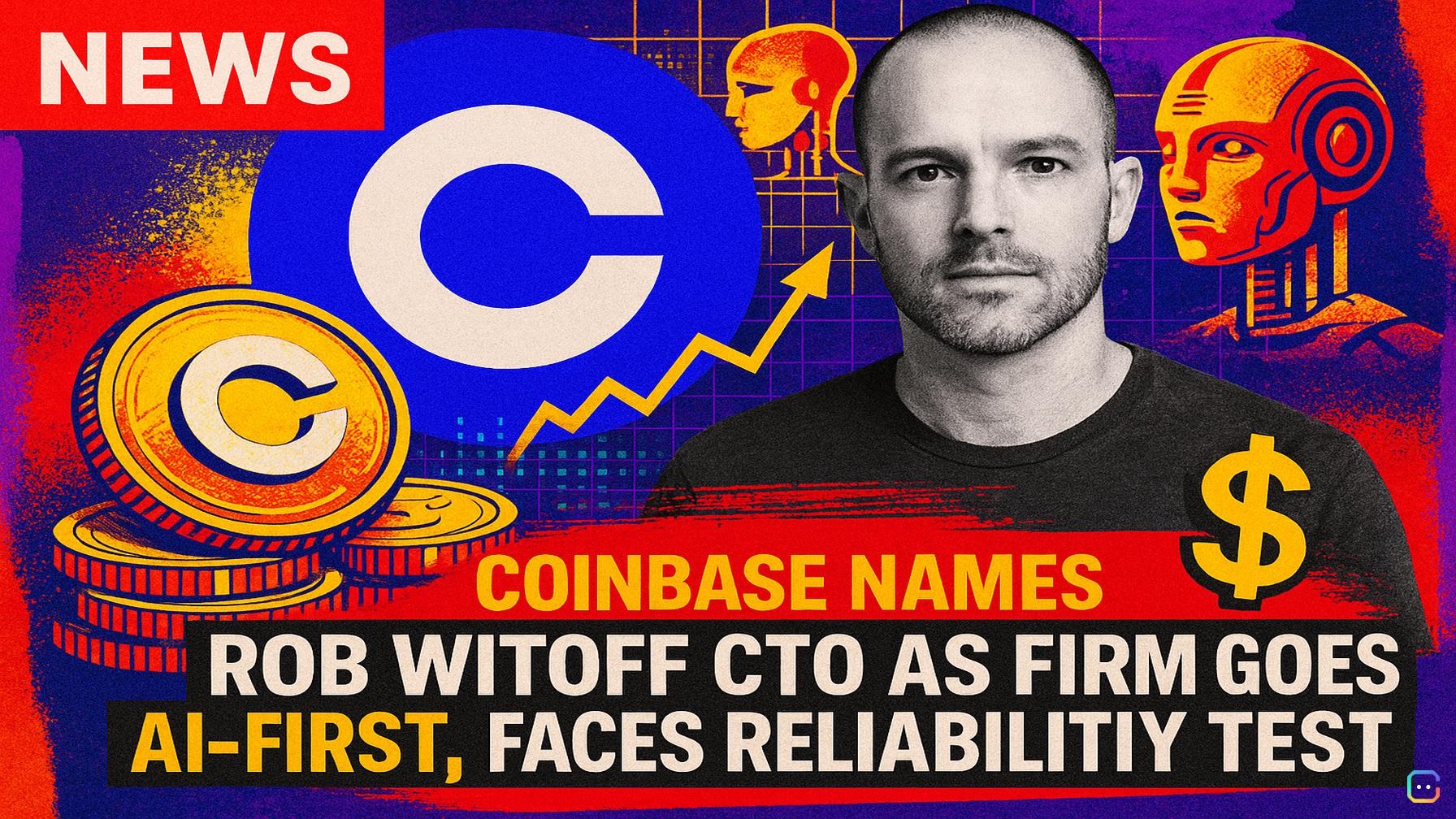
Coinbase Names Rob Witoff CTO as Firm Goes AI-First, Faces Reliability Test
Coinbase has named long-time engineer Rob Witoff as its new chief technology officer, signaling a deeper push into AI-driven product development as the U.S. exchange reshapes its engineering model. The appointment, announced by CEO Brian Armstrong on X and now reflected on Coinbase’s leadership page, brings back a familiar face. Witoff first joined Coinbase in 2014, helped build its early infrastructure and security systems, rose to chief architect, and later founded institutional custody firm Unit 410—acquired by Coinbase. He returned to the company in December 2024 as head of platform and an executive team member; his new CTO role was made official on July 28. Armstrong lauded Witoff for helping make Coinbase “one of the most AI-enabled companies in the world,” a characterization Armstrong provided rather than an independently verified ranking. Witoff’s promotion comes amid a major reorganization at Coinbase that centers AI at the heart of software development. In May the company cut roughly 14% of its workforce—about 700 roles—flattened management and began building smaller, AI-assisted teams. Armstrong has described experiments with “one-person teams” that combine engineering, product and design, and said AI is allowing engineers to finish in days what used to take weeks. Coinbase’s own engineering report reveals the scale of the shift: the share of newly merged code that was AI-generated and human-reviewed reportedly climbed from 5.7% in Q1 2025 to roughly 100% by mid-2026, while preserving human oversight and compliance controls. The company has also instituted quarterly reviews of its AI-focused engineering interview process and 45- and 90-day assessments for new hires. Operational reliability will be central to Witoff’s remit. Coinbase has been expanding into derivatives, stablecoin payments, prediction markets and services for AI agents—products that demand robust infrastructure, security controls and fast incident response. The need for those capabilities was underscored by a roughly 50-minute outage on July 14 caused by a routine configuration update to a shared production cluster; transfers, card payments and some onchain services were interrupted, though Coinbase said customer funds were not at risk. The company later rolled out new deployment safeguards and recovery procedures. Witoff’s background in security, architecture and platform engineering aligns with those priorities, but Coinbase has not published new performance targets, budget changes or a detailed technology roadmap linked specifically to his appointment. His immediate challenge will be sustaining rapid product releases while preserving security, reliability and regulatory compliance as AI becomes more central to development. The CTO transition follows other leadership changes: Chief Legal Officer Paul Grewal notified Coinbase on July 8 that he would depart on July 31; Molly Abraham is expected to become general counsel and corporate secretary, with Grewal serving as an adviser through October. Key takeaways - Rob Witoff named Coinbase CTO (announcement July 28); previously an early Coinbase engineer and founder of Unit 410. - Appointment coincides with Coinbase’s AI-first restructuring and a May workforce reduction of ~14% (~700 roles). - Coinbase reports AI-generated, human-reviewed merged code rose from 5.7% (Q1 2025) to ~100% (mid-2026). - Operational risks highlighted by a 50-minute outage on July 14; company implemented new safeguards. - Immediate priorities for the new CTO: scale AI-enabled development while maintaining security, reliability and regulatory controls. Read more AI-generated news on: undefined/news