Today's Cryptocurrency Prices by Market Caps
The global cryptocurrency market cap today i $2.31T
Market Cap
$2.31T
24h Trading Volume
$70.34B
BTC Dominance
56.22%
|
#
|
Name
|
Price
|
1h %
|
24h %
|
7d %
|
Market Cap
|
Volume (24h)
|
Chart (7d) |
|---|---|---|---|---|---|---|---|---|
|
|
—
|
|||||||
|
No cryptocurrencies found Try adjusting your search query |
||||||||
Latest Crypto News
View All News
BNY Mellon Launches Blockchain Transfer Agency to Put Fund Ownership Onchain
BNY Mellon is pushing deeper into blockchain for institutional finance, rolling out a blockchain-enabled version of its transfer agency business that will record fund ownership and investor transactions on a shared digital ledger. Rather than merely tokenizing products, the New York-based custodian is applying distributed ledger technology to the backbone of fund operations: the books and records that track who owns what. The Financial Times reports the platform will maintain official ownership records onchain while BNY continues to operate its existing transfer agency services. Transfer agents are central to fund mechanics — they log subscriptions and redemptions, update shareholder registers and manage investor communications. Today those records are typically spread across managers’, custodians’ and administrators’ systems, requiring frequent reconciliation. Putting the official register on a shared ledger aims to create a single source of truth, reduce duplicate databases and give authorized participants synchronized access to ownership data. Carolyn Weinberg, BNY’s chief product and innovation officer, told the FT the project modernizes the books and records supporting fund transactions by migrating them onto blockchain infrastructure. BNY’s transfer agency business already supports roughly $8.6 trillion of assets across 7.6 million investor accounts; the bank separately oversees more than $59 trillion in custody and administration. Early adopters include Edinburgh-based asset manager Baillie Gifford, which plans to use the platform for what it describes as the U.K.’s first fully native regulated tokenized fund. “What we have in the blockchain is a shared source of record-keeping between the participants. We agree that this is the source of truth when people are dealing with the asset that this is monitoring,” said Theo Golden, Baillie Gifford’s head of digital assets. Baillie Gifford manages about $261 billion in assets. The FT also says BlackRock and BNY Dreyfus’ money market and cash management business are expected to use the platform for future tokenized fund offerings. BNY has not disclosed which blockchain network will power the platform. Cointelegraph reached out to the bank but did not receive comment before publication. The transfer-agency launch builds on several digital-asset moves BNY has rolled out in recent months. In June the bank added USDC minting, redemption, custody and transfer capabilities to its Digital Asset Custody platform, giving institutional clients direct access to Circle’s stablecoin through BNY’s infrastructure; BNY already serves as the primary custodian for the assets backing USDC. The bank has also partnered with Abu Dhabi’s Finstreet and the ADI Foundation to develop institutional custody services for Bitcoin and Ether, with plans to expand to stablecoins and tokenized real-world assets. Regulatory progress in Europe has followed: the European Securities and Markets Authority recently added BNY SA/NV, the bank’s Belgian unit, to its interim Markets in Crypto-Assets (MiCA) register after authorization from the National Bank of Belgium. That approval lets the subsidiary provide crypto-asset custody and transfer services under MiCA, positioning BNY alongside other financial institutions scaling regulated digital-asset operations across the EU. Taken together, these moves show BNY extending blockchain across multiple layers of institutional infrastructure — from regulated crypto custody and stablecoin plumbing to the operational record-keeping systems that undergird tokenized investment funds. If widely adopted, onchain transfer agency records could streamline administration, speed fund settlements and reduce operational friction as tokenized funds gain traction. Read more AI-generated news on: undefined/news
Cathie Wood's ARK Buys $40M of Tesla, Nvidia & SpaceX; Adds Solana, Warns of Crypto Shakeout
Cathie Wood’s ARK Invest used Tuesday’s tech rout as a buying opportunity, snapping up roughly $40.2 million of Tesla, SpaceX and Nvidia stock on July 28 — moves disclosed across ARK’s actively managed ETFs. What ARK bought (July 28 disclosures) - Tesla: 40,281 shares (~$12.38M at $307.44). Allocated across ARKK (26,920), ARKQ (5,785), ARKW (5,119) and ARKX (2,457). - SpaceX: 105,108 shares (~$12.24M at $116.41). Allocations: ARKK (70,773), ARKQ (15,213), ARKW (9,426) and ARKX (9,696). ARK had already added roughly $14M of SpaceX earlier in the week. - Nvidia: 78,965 shares (~$15.56M at $197.01). Bought across five ETFs: ARKK (42,072), ARKQ (13,639), ARKW (11,984), ARKF (5,471) and ARKX (5,799). Why now: market context The purchases came amid a sharp sell-off in AI- and semiconductor-linked names. Nvidia fell as investors reevaluated the cost and financing needs for AI infrastructure and briefly ceded the title of world’s most valuable public company to Apple. Other chip and data-storage names — Intel, AMD, SanDisk, Western Digital and Seagate — each slid more than 4%. Asian markets suffered steeper losses: South Korea’s Kospi plunged 10.8% (triggering a circuit breaker after an 8% drop), with Samsung Electronics and SK Hynix plunging double digits; Japan’s Nikkei fell nearly 4%. What ARK’s trades signal ARK appears to have used the pullback to expand exposure to themes it favors: autonomous vehicles (Tesla), space and defense (SpaceX) and AI/computing infrastructure (Nvidia). For U.S. investors, ARK’s ETFs provide a pooled way to gain that exposure, but the moves also heighten sensitivity to further weakness in high-valuation tech if AI spending slows or financing costs stay elevated. Crypto angle: Solana exposure and warning on consolidation ARK also modestly increased indirect exposure to Solana via the 3iQ Solana Staking ETF, buying 5,252 shares (ARKW 2,997; ARKF 2,255) valued at about $32,667 (fund price $6.22). This follows larger crypto-related activity on July 24 when ARK invested roughly $251,500 across three ETFs (including the same Solana fund and BitMine Immersion Technologies). Separately, ARK’s director of digital-assets research, Lorenzo Valente, warned the crypto industry is entering a deep consolidation phase. He asserted that two platforms — Hyperliquid and Pump.fun — accounted for 67% of application revenue and that Ethena pushed the top-three share to nearly 80%, forecasting more acquisitions, bankruptcies and shutdowns as capital concentrates. Valente’s post did not disclose the dataset, category definitions or measurement period for those figures. Bottom line ARK’s $40.2M tranche shows Cathie Wood doubling down on core thematic bets during volatility — a bullish signal for long-term believers in autonomous tech, space and AI hardware — while also maintaining selective crypto exposure. At the same time, the firm’s own research flags a tougher environment ahead for parts of the crypto ecosystem. Read more AI-generated news on: undefined/news

Binance Android App Vanishes from Google Play in Some EU Markets — MiCA or Policy Change?
Binance’s Android app has gone missing from Google Play in parts of the European Union, sparking fresh questions about whether the change is connected to the bloc’s new crypto rules under MiCA or to recent Google Play policy updates. What’s happening - Users in Spain and Latvia report they can no longer find the Binance app on Google Play, while checks in Poland still show the app — suggesting the removal is limited to certain EU markets rather than the entire region. - The app remains available in at least one alternative Android app store (Oppo’s App Market), indicating the issue is specific to Google Play distribution in some countries. - A Binance spokesperson told media the company is aware that Google Play has updated its policies and that those updates are affecting crypto app updates “in certain markets.” Binance said it’s working with Google to restore normal availability but did not name the affected countries or specify which policy changes caused the restriction. Regulation and timing - The disruption comes after the EU’s Markets in Crypto-Assets regulation (MiCA) entered into full effect on July 1. MiCA requires crypto-asset service providers to obtain authorization in at least one EU member state before offering regulated services across the bloc. - Public concern about a regulatory link grew after OKX Europe CEO Erald Ghoos posted on X claiming Binance had been removed from Google Play because of MiCA licensing requirements. Binance has not confirmed a direct regulatory cause and has pointed to Google Play policy changes instead. - The timing is notable because Binance withdrew a MiCA license application in Greece shortly before the transitional period expired. Around that deadline the exchange also warned some European users that certain services would be suspended while withdrawals would continue. Service impacts and industry response - Earlier this month Binance suspended several trading services in France and other countries where it lacked MiCA authorization; withdrawals were retained but spot and margin trading were paused in affected markets. Binance reiterated that user assets remain secure and suggested users who need uninterrupted trading move funds to regulated platforms or to self-custody. - Licensed European exchanges have used the regulatory shift to expand their footprint. Coinbase secured Luxembourg authorization and now operates across all 27 EU member states plus Iceland, Liechtenstein and Norway. Ripple likewise obtained full authorization in Luxembourg, extending its regulated payment, custody and stablecoin services across the EEA. - Some licensed platforms have actively targeted customers impacted by Binance’s restrictions: Coinbase offered eligible European users a 5% bonus for transfers from exchanges without MiCA authorization, and OKX promoted its regulated alternatives in eligible markets. Operational risks and customer access - Regulators have warned about operational strain from exchanges exiting markets: Bruna Szego, chair of the EU Authority for Anti-Money Laundering and Countering the Financing of Terrorism, cautioned licensed platforms could face heavy withdrawal flows and operational pressure if users migrate en masse. - Binance has not said whether the Google Play availability issue affects access to existing customer accounts. Users who already have the app installed have not been notified of changed access, and the company’s public comments have focused on working with Google to resolve the distribution problem. Broader context - The episode highlights how regulatory change and platform policy updates can intersect to disrupt app availability and user access in specific jurisdictions. While MiCA has reshaped competition by enabling passporting across the EU for authorized firms, the enforcement tempo and platform-level policies still leave gaps that can affect end users. - Outside Europe, Binance’s affiliated regional businesses continue separate strategies. In the U.S., Binance.US is positioning itself to rebuild market share after regulatory challenges, with CEO Stephen Gregory saying the firm aims to regain a roughly 20% share of the domestic crypto trading market while operating as a standalone, U.S.-only entity. Bottom line For now, the disruption looks limited and potentially tied to Google Play policy updates in selected markets rather than a blanket EU-wide removal tied directly to MiCA. Binance says it is working with Google to restore availability and has reassured users their assets remain safe, while licensed EU competitors continue to use MiCA authorization to attract affected customers. Read more AI-generated news on: undefined/news
Hungary Drops Controversial Crypto Validator Rule, Eyes Alignment With EU MiCA
Hungary scraps controversial crypto validator checks, moves to align with MiCA Hungary’s parliament has voted to abolish a contentious third‑party validator requirement that had added an extra layer of approval to certain crypto transactions — a move the government says will help reboot the local market and bring Hungary’s rules closer to the EU’s Markets in Crypto‑Assets (MiCA) framework. What changed - Lawmakers repealed the 2024 rule that forced some crypto‑to‑fiat and crypto‑to‑crypto conversions to obtain pre‑transaction approval from licensed local validators. - The repeal removes the mandatory compliance certificate and the validation step that required checks on wallet ownership, source of funds, customer identity and transaction histories. - Hungary’s basic licensing and MiCA compliance obligations for crypto service providers remain intact; the change simply eliminates the extra national approval layer. Why the rule was controversial - The validator regime took effect July 1, 2025, after Budapest shortened the EU‑allowed transition window and required firms to comply a year earlier than many other member states. - The 2024 Crypto Act and related criminal code amendments had attached criminal penalties to unauthorized exchange services and transactions conducted outside the validation process — and transactions without a compliance certificate were treated as legally invalid. - Reporting at the time warned the rules created legal uncertainty and dampened activity: Revolut suspended crypto services in Hungary, several firms curtailed operations or considered relocating to Estonia or Lithuania, and trading volumes fell. An estimated 500,000 Hungarians were using crypto when the law was introduced. Political and regulatory context - The repeal follows a change in government after Hungary’s April 2026 election, which ended Viktor Orbán’s 16‑year premiership and installed Peter Magyar’s pro‑European Tisza Party. Officials from the new administration criticized the previous framework as excessive and politically motivated. - Finance Minister Kármán András said the validator requirement had disrupted the domestic market and prompted firms to leave or pause services; he noted the market was beginning to recover after the repeal. Government spokespeople had also indicated plans to remove prison penalties tied to crypto trading. - The European Commission reportedly opened an investigation into whether Hungary’s earlier regime complied with EU law. Criminal penalties under the old rules - Reporting from Forbes documented steep penalties under the earlier framework: individuals faced up to two years in prison for transactions of 5–50 million HUF, up to five years for 50–500 million HUF, and up to eight years for transactions above 500 million HUF. Operators of unauthorized exchange services faced three to eight years depending on volumes. Industry impact and next steps - The validator role had been supervised by Hungary’s Supervisory Authority of Regulated Activities. With the repeal, that extra approval step is gone, but firms still must meet MiCA licensing and compliance requirements. - Budapest‑based CoinCash (operator: Tiwala Solutions) completed its MiCA authorization process and on July 20 received direct authorization from the National Bank of Hungary. CoinCash said it is the first Hungarian company to secure such central bank authorization and plans to gradually restore suspended services and roll out additional MiCA‑regulated products. The approval covers custody, crypto‑to‑fiat and crypto‑to‑crypto trading, transfers, investment advice and portfolio management. CoinCash had voluntarily halted operations in December 2025 to ready itself for MiCA compliance. Bottom line The repeal removes a nationally imposed gatekeeper that had been blamed for chilling crypto activity in Hungary and for potential conflicts with EU law. It signals a shift toward harmonizing Hungary’s rules with MiCA, easing immediate operational friction for crypto firms while leaving the core EU‑level licensing and compliance framework in place. Market participants and watchers will be looking to see how quickly suspended services return and whether the change encourages firms that left to come back. Read more AI-generated news on: undefined/news
OSL Launches SFC-Licensed Retail XRP Trading in Hong Kong, Opens Fiat On-Ramp
OSL Digital Securities has opened the door for Hong Kong retail investors to buy XRP on a licensed local venue, marking a notable expansion of regulated fiat on-ramps for the token as global markets watch regulatory developments. What happened - On July 29 OSL Digital Securities — a subsidiary of publicly listed OSL Group (HKEX: 863) — began offering retail XRP trading, becoming the first exchange licensed by Hong Kong’s Securities and Futures Commission (SFC) to provide direct spot access to XRP for everyday investors. - The platform rolled out an XRP/USD pair via its Flash Trade service. Its OTC desk also supports XRP/USD and XRP/HKD, with trades settled on the XRP Ledger, giving Hong Kong investors a direct fiat route into XRP without relying on offshore venues. Why it matters - XRP now joins Bitcoin, Ethereum and Solana among the four digital assets available to retail clients on OSL, reflecting Hong Kong’s gradual opening of regulated crypto products to a broader audience. - OSL operates under SFC Type 1 and Type 7 licences and is registered under Hong Kong’s Anti-Money Laundering and Counter-Terrorist Financing Ordinance. The firm also says its custody solution carries $1 billion in insurance coverage for client assets. - The retail launch follows OSL’s initial XRP listing in December 2025, which had been limited to professional investors (institutions and qualifying HNW clients). Extending access to retail users is the next phase of the firm’s XRP offering. Broader market context - The move adds another regulated XRP entry point in Asia as institutions build out blockchain-based finance in the region. For example, on July 28 Japan’s SBI Holdings reorganized a subsidiary into SBI Digital Practice to focus on the Canton Network, expanding its institutional on-chain finance work alongside existing projects with Ripple and the XRP Ledger. - Investment flows into XRP products also remain strong: XRP spot ETFs have recorded eight consecutive weeks of inflows, lifting cumulative flows to roughly $1.49 billion. - Activity on the XRP Ledger is diversifying beyond token transfers. RWA.xyz estimated combined distributed and represented real-world assets on the ledger at about $4.37 billion as of July 29 (roughly $313.3 million distributed; $4.06 billion represented). Meanwhile, Ripple’s RLUSD stablecoin grew rapidly, with Messari reporting a 44.9% quarter-over-quarter increase in market cap to $340.3 million at the end of Q1 2026, making it the largest stablecoin on the ledger. Regulatory backdrop and implications - Hong Kong’s licensed rollout contrasts with the slower progress on a US federal framework. Ripple CEO Brad Garlinghouse has publicly urged Congress to pass the Digital Asset Market Clarity Act, echoing Ripple’s legal team in arguing that lawmakers shouldn’t delay while waiting for a perfect compromise. The CLARITY Act remains stalled in the Senate amid debates over consumer protection, ethics, enforcement powers and illicit-finance safeguards; seven Senate Democrats have expressed opposition to the current text while staying open to negotiation. - U.S. retail investors won’t gain access from OSL’s launch unless they meet the platform’s jurisdictional and eligibility rules. Still, OSL’s move illustrates how Hong Kong is actively adding licensed retail venues and fiat rails for crypto, even as other jurisdictions work toward comprehensive regulatory frameworks. Takeaway OSL’s retail rollout of XRP is a clear indicator of Hong Kong’s push to expand regulated crypto access for ordinary investors and adds another regulated channel for XRP in Asia — a trend likely to accelerate institutional and retail adoption as on-ledger activity and investment products continue to grow. Read more AI-generated news on: undefined/news
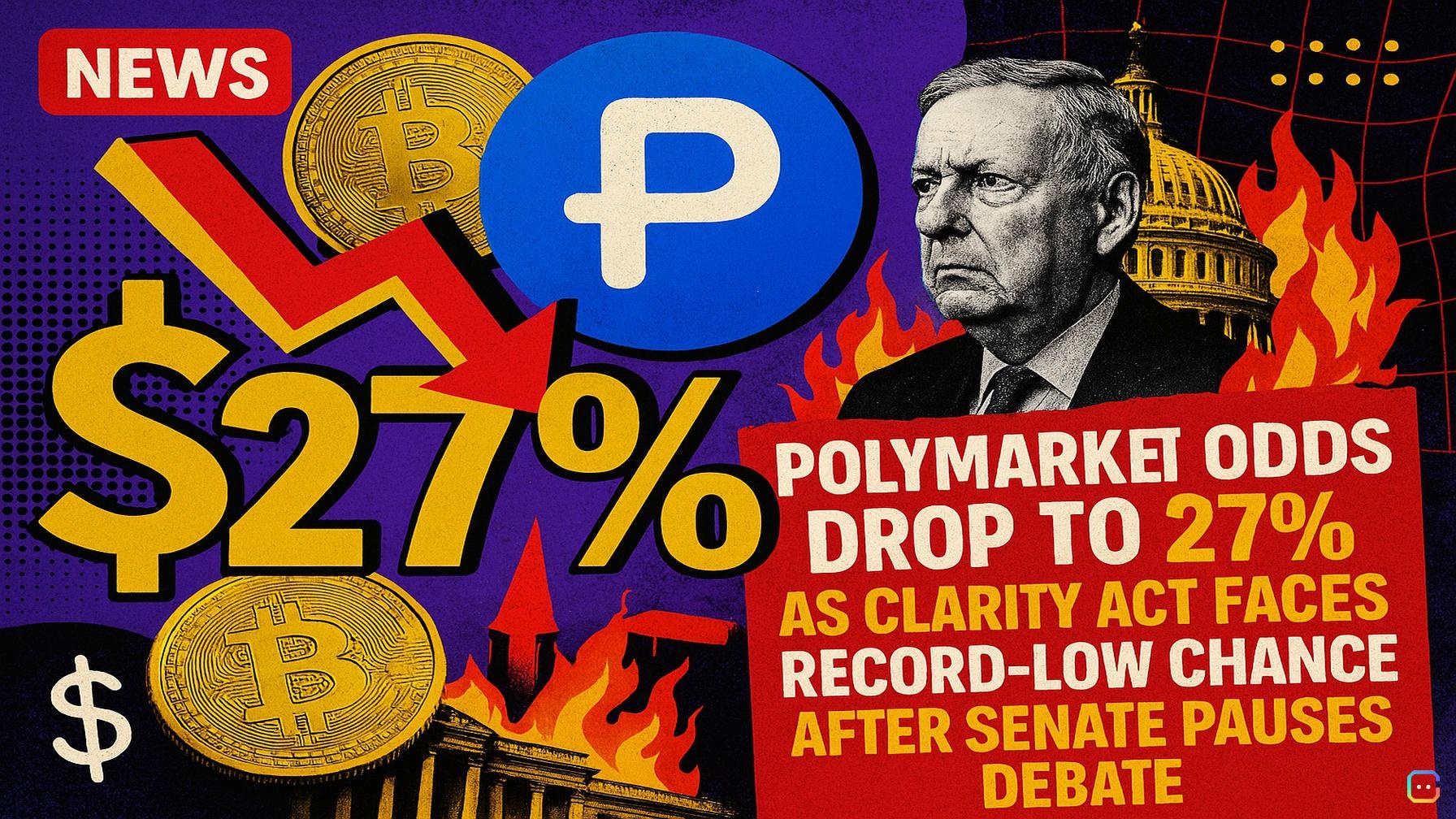
Polymarket Odds Drop to 27% as CLARITY Act Faces Record-Low Chance After Senate Pauses Debate
Headline: CLARITY Act’s chances slump to record-low as Senate pauses debate ahead of August recess Polymarket traders cut the probability that the CLARITY Act becomes law in 2026 to a record-low 27% on July 29, reflecting growing skepticism after the Senate delayed action on the crypto market-structure bill. That price reflects market sentiment rather than an independent forecast, but it underscores how tight the bill’s legislative window has become. Galaxy Digital has likewise trimmed its odds to about 30%. What happened: Senate Majority Leader John Thune postponed consideration of the CLARITY Act to focus on a Russia sanctions package and several federal nominees. The Senate voted on July 28 to advance the sanctions bill, shrinking the number of working days available before the chamber’s Aug. 8 recess. Industry groups have urged Thune to at least start the cloture process before the break—so a procedural vote could reveal whether the measure has enough bipartisan support to move later in the year. Key negotiation flashpoints - Ethics enforcement: Democratic Sen. Ruben Gallego and Republican Sen. Thom Tillis are finalizing a bipartisan counteroffer that tweaks the bill’s ethics restrictions. The pair expect to submit the language to the White House within days. One significant change under discussion would let state attorneys general, not just the Department of Justice, enforce ethics provisions—an issue that’s become central because it governs elected officials’ financial interests in digital assets. - Stablecoin rewards: Separately, disagreement over yield-bearing stablecoin products risks another delay. Banking groups want limits on products that could compete with traditional deposits, while crypto firms warn that broad restrictions would curtail consumer choice and innovation. Why passage looks unlikely before recess Even if negotiators settle ethics language, the CLARITY Act must clear procedural thresholds, pass the full Senate and then reconcile differences with the House version. Those additional steps make enactment before the August recess increasingly improbable. What the CLARITY Act would do The bill aims to split oversight of digital assets between the SEC and the CFTC, giving exchanges, token issuers and blockchain developers clearer rules for operating in the U.S. Supporters argue the framework would reduce regulatory uncertainty and keep investment and jobs stateside. Political and industry backing - Supporters include Florida Rep. Mike Haridopolos, who warned on July 28 that delays could drive capital and jobs to jurisdictions with clearer rules. - Big-name financial firms — BlackRock, Goldman Sachs, Franklin Templeton, Fidelity, Charles Schwab and SoFi — have publicly backed the measure, countering narratives that Wall Street uniformly opposes it. “The Big Bank Lobby is trying to say that all of Wall Street is opposed to the Clarity Act. That’s completely false,” Sen. Cynthia Lummis said. - The Consumer Technology Association has also warned that regulatory uncertainty could push capital and talent offshore. Regulatory fallback: SEC action SEC Chair Paul Atkins said the agency stands ready to use rulemaking to address parts of the crypto market if Congress does not act. He described the SEC as “ready, willing and able” to write rules under existing authority, but emphasized that statutes are preferable because they create a more durable framework than rules a future administration could change. Agency rulemaking might clarify how certain tokens, trading venues and tokenized securities are treated, but it would not resolve the core jurisdictional split between the SEC and CFTC that legislation would. Bottom line The bipartisan ethics counteroffer is the bill’s immediate test—White House approval could keep talks alive after the recess. But with a compressed Senate calendar and unresolved stablecoin disputes, the CLARITY Act faces its weakest outlook yet heading into August. Read more AI-generated news on: undefined/news