Today's Cryptocurrency Prices by Market Caps
The global cryptocurrency market cap today i $2.31T
Market Cap
$2.31T
24h Trading Volume
$70.34B
BTC Dominance
56.22%
|
#
|
Name
|
Price
|
1h %
|
24h %
|
7d %
|
Market Cap
|
Volume (24h)
|
Chart (7d) |
|---|---|---|---|---|---|---|---|---|
|
|
—
|
|||||||
|
No cryptocurrencies found Try adjusting your search query |
||||||||
Latest Crypto News
View All News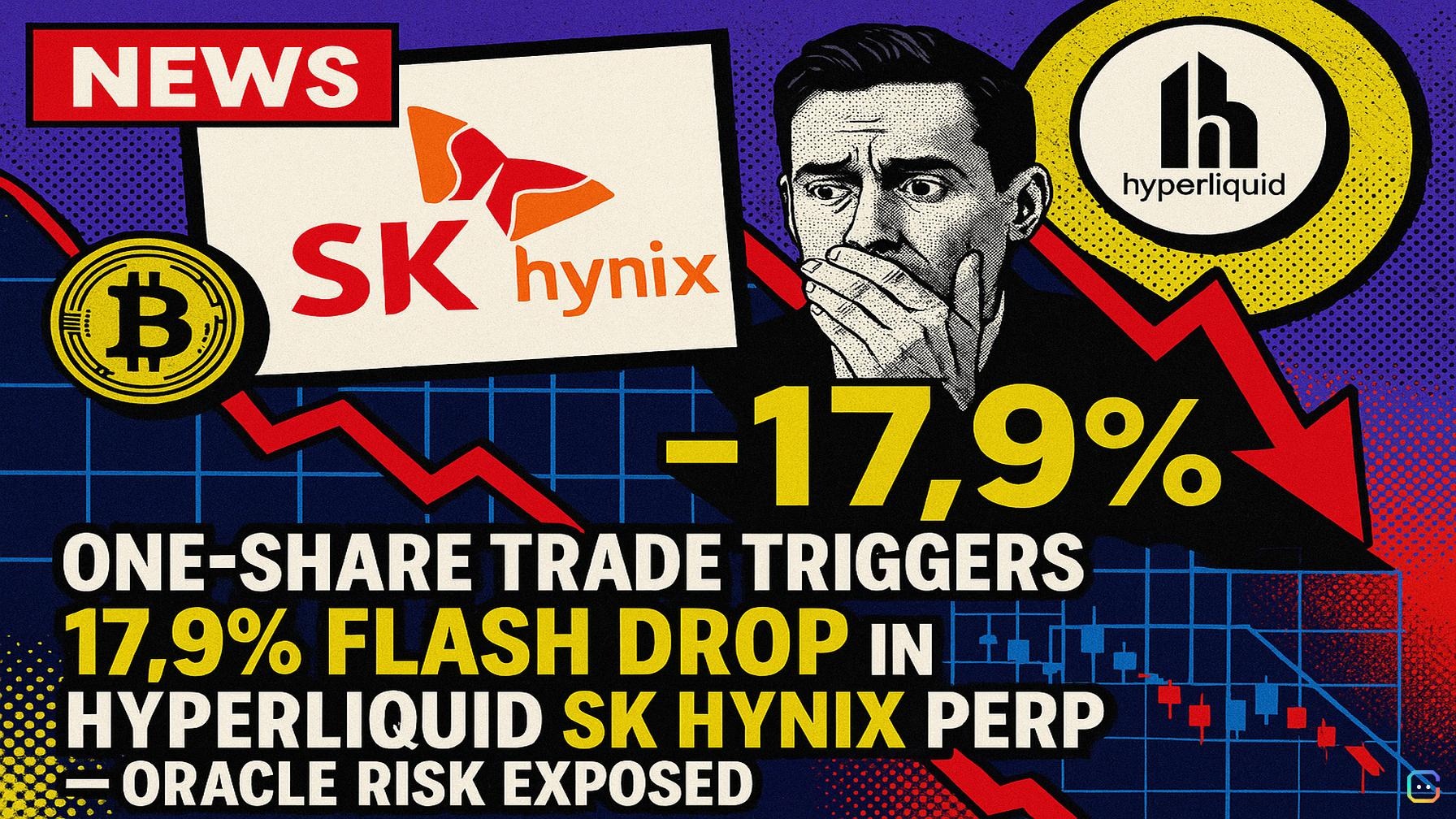
One-Share Trade Triggers 17.9% Flash Drop in Hyperliquid SK Hynix Perp — Oracle Risk Exposed
Hyperliquid’s SK Hynix perpetual contract plunged as much as 17.9% on July 28 after an anomalous one-share trade in South Korea fed into the contract’s oracle pricing, highlighting how thin local markets can ripple through continuously running crypto derivatives. What happened - During NextTrade’s pre-market session in Seoul, a single SK Hynix share printed at KRW 1.272 million — roughly 29.96% below the prior close of KRW 1.816 million. That isolated print briefly pushed the stock to its daily lower limit. - The off-market print passed into the external price feed used by the Hyperliquid perpetual (listed on-chain as xyz:SKHX and shown in the UI as SKHYNIX-USDC), causing the contract mark price to fall from roughly $1,128.20 to about $927 before recovering above $1,100. - The contract allows up to 10x leverage. As the mark price moved lower, levered positions faced the risk of liquidations or automatic deleveraging. Who runs the market and why it mattered - Hyperliquid says the SKHX market was deployed and is operated by Trade.xyz under the protocol’s HIP-3 framework, which lets independent teams launch perpetual markets on Hyperliquid while using the network’s infrastructure (order books, margin system, liquidation engine). - Trade.xyz is investigating the incident and told ChainThink it will publish an update once the probe is complete. Hyperliquid’s documentation shows deployers select oracles and other price inputs and must stake 500,000 HYPE, with potential slashing for misconduct — making each deployer’s price methodology central to risk controls. Market impact and metrics - SK Hynix’s regular Seoul session later closed at KRW 1.55 million, down 14.65% — less severe than the one-share pre-market print that drove the perp’s flash move. - On-chain trackers and aggregators captured the event: HyperInsight recorded the mark-price drop noted above; DeFiLlama later logged SKHX near $1,067 (about -13.7% over 24 hours), open interest around $406 million after a ~20% decline, and daily volume above $1 billion. These figures remain fluid as positions adjust. - Importantly, there’s no verified evidence of any on-chain compromise or smart contract exploit. The available data points to an external market print being absorbed by Trade.xyz’s pricing pipeline. Open questions and next steps - Key unresolved items include which specific NXT inputs entered the oracle, whether configured filters or sanity checks functioned as intended, and whether any safeguard settings will be changed. - Hyperliquid allows deployers to halt trading, change open-interest limits, or settle a contract; as of the latest reports, the SKHX market remained active and no permanent suspension had been announced. Why this matters The incident underscores a recurring risk for crypto derivatives that reference thinly traded, time-zone-limited assets: a single outlier trade on a local exchange can move an oracle-fed perpetual markedly, triggering liquidations in a continuously operating market. Multiple DEXs have launched Korean-stock perps recently, increasing the exposure of crypto derivatives to such cross-market quirks. Trade.xyz’s forthcoming report will be the next authoritative update; it should clarify whether the contract behaved per published rules or whether oracle methodology and deployer safeguards need revision. Read more AI-generated news on: undefined/news
Paradigm Leads $470M into Antares Nuclear as Crypto Capital Backs SMRs to Power AI
Headline: Crypto-native Paradigm leads $470M round into Antares Nuclear as firm expands into AI and power infrastructure Paradigm — the high-profile venture firm best known for backing crypto projects — is leading a $470 million Series C for Antares Nuclear, signaling a push into military-focused small modular reactors (SMRs) as the firm broadens beyond blockchain into frontier infrastructure that supports AI and heavy computing. Deal specifics - Total raise: $470 million (reported as $370 million in equity + $100 million in debt). - Lead investor: Paradigm. - Co-lead: Caffeinated Capital. - Other participants: Industrious Ventures, Point72 Ventures, Shine Capital. This investment arrives shortly after Paradigm closed a $1.2 billion fourth fund on July 8, which the firm said will keep crypto “first” while expanding allocations into AI, robotics, aerospace, manufacturing and other emerging tech. Why it matters to crypto and AI communities Paradigm’s backing of Antares is a clear example of crypto capital flowing into physical infrastructure that underpins large-scale computing. As AI models scale and hyperscale data centers proliferate, demand for steady, high-density power is rising. Advanced nuclear — including compact SMRs — is increasingly viewed by investors as a dependable option to power data centers, government sites and industry where continuous baseload power is required. Antares and the Mark-0 milestone Antares develops compact reactors in the 100 kW to 1 MW range — roughly enough to power about 750 homes at the upper end. Its demonstration reactor, Mark-0, reached criticality on June 4 at Idaho National Laboratory, meaning it sustained a controlled nuclear chain reaction — a major technical milestone. Market focus and timeline Rather than selling first into commercial utility markets, Antares is targeting U.S. government customers. The company is one of three finalists in the Pentagon’s Advanced Nuclear Power for Installations program, which plans SMR evaluations at Air Force bases in Colorado and Montana. If timelines hold, Antares expects to bring its first electricity-producing reactor online next year, then begin deployments at military installations in 2028. Technology notes Antares uses TRISO fuel — uranium particles coated in multiple carbon and ceramic layers designed to contain radioactivity at high temperatures — a choice shared by several advanced-nuclear developers. TRISO can pair with non-water coolants such as helium gas or molten salts, diverging from conventional water-cooled reactor designs. Bigger VC trend and headwinds The Antares round comes amid a surge of investor interest in advanced nuclear: X-energy completed a $1 billion IPO in April, and startups like Radiant Energy, Standard Nuclear and Last Energy have each raised north of $100 million since last December. Much of this momentum is driven by AI-related power demand. That said, commercial deployment faces hurdles: constrained domestic supply chains, manufacturing scale-up challenges, and near-term costs. Lazard analysis cited in reporting estimates first-generation SMR-generated electricity could cost around $214/MWh — higher than most newly built plants except the costliest gas turbines — though proponents argue factory-built reactors will cut costs over time. How this fits Paradigm’s strategy Paradigm has said it will remain “first in crypto” while also deploying capital to technologies that sit alongside advances in software and hardware. The firm points to non-blockchain investments such as Zipline, SendCutSend, True Anomaly and Nous Research, and continues internal work combining blockchain and AI — for example EVMbench (with OpenAI) for smart contract security testing and ongoing open-source projects like Foundry and Reth. Antares slots into that thesis by tying energy infrastructure to the compute demands of modern AI and future blockchain systems. Bottom line Paradigm’s lead in Antares’ $470 million round underscores a broader shift: crypto-focused capital is increasingly flowing into physical infrastructure bets — from AI and robotics to power generation — that aim to support the next wave of large-scale computing. Antares’ Mark-0 milestone and Pentagon program placement make it a high-profile entry in the advanced-nuclear cohort, but commercial economics and manufacturing scale remain the key tests ahead. Read more AI-generated news on: undefined/news
OKX Restored on South Korea’s Google Play After 4-Day Removal; Bybit Still Blocked
Headline: OKX Android app back on South Korea’s Google Play after four-day removal; Bybit still blocked OKX’s Android app reappeared on South Korea’s Google Play Store on July 28, restoring downloads and updates roughly four days after it disappeared from the platform, according to a Digital Asset report. The exchange’s listing was verified as available at 8:00 a.m. KST, making OKX the first of several recently restricted overseas exchanges to return to the Korean Play Store. Timeline and current status - OKX: Removed from the Korean Google Play Store on July 24; restored and searchable again on July 28. - Bybit: Still blocked and unavailable for installation in South Korea since July 10. - Other large overseas exchanges such as Binance and Bitget continued to appear normally in searches during the initial removals. What’s behind the removals Digital Asset’s July 24 investigation found that at least 29 overseas crypto derivatives exchange apps had become unavailable on the Korean version of Google Play. The report broke those apps into three visibility outcomes: 17 could not be found via search, six displayed an “Unavailable” notice, and six showed a message that the service was not available in the user’s region. The affected exchanges split into two groups: - 14 platforms had been identified by South Korea’s Financial Intelligence Unit (FIU) as unreported virtual asset service providers (VASPs) and referred to law enforcement — examples include KuCoin, MEXC, BingX, XT.COM, LBank and CoinW. - 15 platforms — including OKX, Bybit, Gemini, WhiteBIT and BitMEX — had not been referred to law enforcement by the FIU but were nevertheless unavailable on Google Play. Google has indicated these distribution limits were applied under its own policies rather than as a direct government mandate, suggesting its enforcement extends beyond the FIU’s published list. Despite Google Play restrictions, affected users could still access exchange services via web browsers and, in many cases, Apple’s App Store. Regulatory backdrop The removals come amid heightened South Korean scrutiny of overseas crypto firms that have not registered under the country’s Special Financial Information Act. Earlier this year the FIU classified non-registered overseas firms as unreported VASPs, and Google introduced a policy to restrict downloads and updates for such apps. Although the policy was announced earlier, enforcement appears to have rolled out gradually across 2026. South Korean authorities have also amplified broader market oversight. Financial Services Commission Chair Lee Eog-won said regulators probed more than 40 suspected cases of unfair crypto trading during the first two years of the Virtual Asset User Protection Act, referring over 30 cases to investigative agencies and expanding AI-based market surveillance. OKX’s global expansion and compliance moves OKX’s app restoration in Korea comes as the exchange expands regulated services elsewhere. In July, OKX Europe launched a one-way conversion allowing users in 30 EU/EEA countries to convert USDT into MiCA-compliant USDC. On July 20, former New York Governor Andrew Cuomo joined OKX’s board after advising the company on U.S. regulatory and institutional strategy. OKX has also continued scaling its U.S. operations following the 2025 relaunch of its American exchange and self-custody wallet. What to watch next Monitor whether other restricted exchanges regain Google Play availability in South Korea and whether Google clarifies the policy criteria for app restrictions. Separately, keep an eye on enforcement actions from the FIU and the Financial Services Commission as regulators continue to press overseas platforms on local registration and compliance. Read more AI-generated news on: undefined/news

Argentine banks' crypto arms build peso stablecoins for corporates, sidestepping central bank ban
Argentina’s peso stablecoin scene is taking shape as two banking groups push forward institutional-focused projects — and they’re doing it from the sidelines of the country’s regulated banks. What’s happening Two financial holding groups with banking operations are developing Argentine peso–pegged stablecoins through their virtual-asset subsidiaries, targeting corporate treasuries and programmable payments rather than retail users, Iproup reports. The moves keep the initiatives outside Argentina’s banks because the Central Bank has barred private banks from offering crypto services since May 2022. The players - BIND Group — which owns BIND Banco Industrial and manages more than $2 billion in assets — is building a peso-backed token through its virtual-asset service provider BEN. Earlier this year BEN teamed up with Circle to give institutional clients access to USDC for treasury and payments use cases under local rules. - Petersen Group is preparing a peso stablecoin called DIPE through a subsidiary, with technical support from crypto infrastructure provider Lirium. DIPE already has a whitepaper, suggesting the project has moved beyond ideation. What the tokens aim to do Both projects are designed for institutional use cases: programmable payment conditions, automated transactions triggered by on-chain events, collateral management and collateral-backed lending arrangements, and streamlined treasury settlement on blockchain rails. These are aimed at corporates and financial operations rather than consumer remittances or retail payments. Why they’re different Argentina has long seen US dollar–pegged stablecoins such as USDT and USDC used by individuals and businesses to hedge against peso depreciation. By contrast, these initiatives seek to digitize the peso itself for enterprise financial infrastructure — and to do so through licensed virtual asset subsidiaries so they’re not directly constrained by the central bank’s ban on banks offering crypto services. Regulatory backdrop and risks Regulators are watching. Argentina’s national securities regulator raised concerns in March about an earlier peso-linked project — the “argt” stablecoin — saying it may constitute a security being offered without proper compliance. Authorities are reportedly discussing whether to relax the current ban on banks providing digital-asset services, but no formal policy changes have been announced. If bank-led ownership of stablecoins becomes permissible, that could expand adoption for banking-backed tokens. Not the first peso token This isn’t Argentina’s first experiment with tokenizing the peso. In December 2022, the province of San Luis passed legislation authorizing a provincial stablecoin (Activo Digital San Luis de Ahorro, aka CityCoin) backed by government liquid assets to support blockchain-based public services and administrative efficiency. The San Luis project is a public-sector, resident-focused effort, while the new initiatives are private-sector and enterprise-oriented. Regional and market context The projects arrive as stablecoin activity climbs in Latin America’s banking ecosystem. Tether recently invested $20 million in Argentine digital bank Ualá as part of a $197 million round and has backed other regional players, while Brazil’s Mercado Bitcoin and Argentina’s Belo have also received support. Internationally, the Bank of the Philippine Islands launched a pilot using stablecoins for cross-border remittance settlement, converting settled funds into pesos within the regulated banking system. Market snapshot Despite a slight dip in supply, stablecoin usage remains robust. CoinDesk Data showed the global stablecoin market contracted 2.39% in June to roughly $312 billion — the first monthly decline in five months — yet Visa’s adjusted dataset recorded a record $1.79 trillion in stablecoin transaction volume for June, indicating strong on-chain and institutional activity even amid a modest pullback in circulating supply. Bottom line BIND and Petersen’s peso stablecoin efforts reflect a pragmatic path for Argentine banks to enter tokenized payments: build through licensed virtual-asset arms, prioritize business-grade use cases, and position for broader adoption if the regulatory environment loosens. The projects are still private and unlaunched, but their institutional focus signals how stablecoins could be used to modernize corporate treasury and settlement in Argentina. Read more AI-generated news on: undefined/news
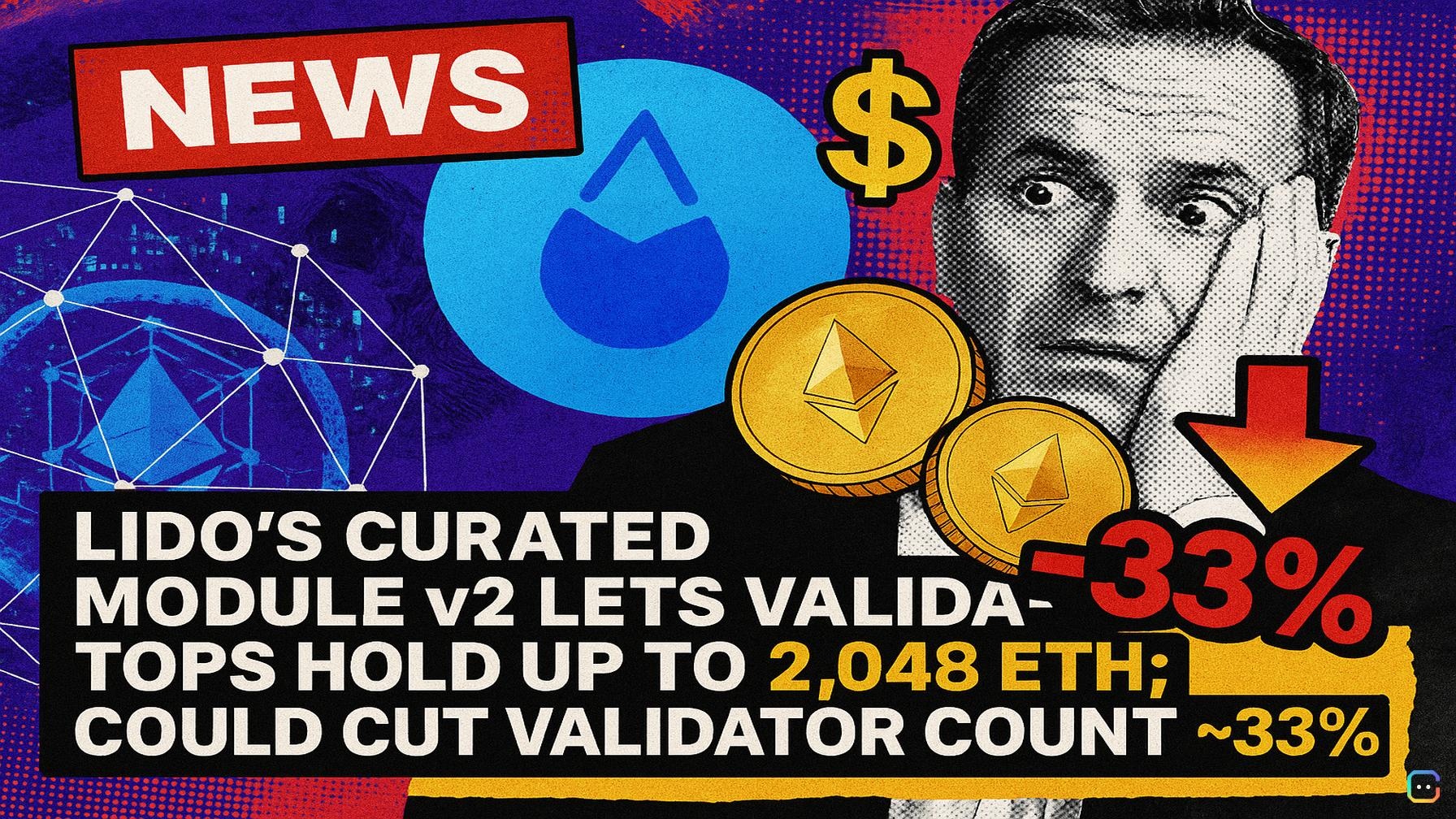
Lido's Curated Module v2 lets validators hold up to 2,048 ETH; could cut validator count ~33%
Lido launches major Ethereum staking overhaul, aims to consolidate validators and boost efficiency Lido has rolled out a major upgrade to its Ethereum staking stack — Curated Module v2 — that lets protocol-managed validators hold much larger effective balances and could shrink the total validator count by roughly one-third, the team said Monday. What changed - Curated Module v2 adds support for Ethereum’s 0x02 withdrawal credentials, enabling validators to raise their effective balance from the base 32 ETH up to as much as 2,048 ETH. - By consolidating stake into larger validators, Lido estimates the total number of Ethereum validators could fall from about 880,000 today to roughly 628,000. The protocol cautioned the migration has not started and those figures are projections from internal modeling, not live network data. Why it matters Lido says the change is designed to make validator operations more efficient by reducing the volume of validator messages on Ethereum’s consensus layer. That should simplify validator management without affecting execution-layer activity — transaction processing, gas fees and user-facing costs are not expected to change as a result. Lido also emphasizes this remains a validator-management change and does not alter Ethereum’s core staking rules. User impact stETH holders do not need to take any action; the migration will be executed at the protocol level. New accountability for node operators Curated Module v2 also introduces stronger accountability for node operators in Lido’s curated staking arm. New bond requirements and penalty mechanisms are intended to tighten operator incentives, and future stake allocation may factor in operator performance, fee structures and contributions to the Ethereum ecosystem — rather than relying solely on previous allocation methods. Lido describes the upgrade as combining operator incentives, bond-backed security and governance refinements to improve validator set operations over time. Security, distribution and institutional traction Lido framed the release as part of a broader push to harden its platform and expand institutional access: - The protocol distributes staked Ether across more than 900 node operators, with no single operator controlling more than 1% of Lido’s network, the team said. - Lido has spent over $4 million on smart contract audits, claims an A+ security rating from firms including Credora, and notes it has operated without a smart contract exploit since its 2020 launch. - Earlier this month Anchorage Digital integrated Lido into its institutional platform, enabling clients to mint and burn wrapped staked Ether (wstETH) while keeping assets inside Anchorage’s regulated custody systems. Anchorage’s leadership has argued liquid staking eases operational complexity for institutions while maintaining custody and reporting controls. Recent governance and financial context The Curated Module v2 rollout arrives amid other governance moves and financial headwinds at Lido: - In March, Lido DAO proposed using up to 10,000 stETH from its treasury for a one-time buyback of LDO tokens, structured as 1,000-stETH tranches that would require token-holder votes before proceeding. The proposal followed concerns that LDO was trading below what the DAO considered its intrinsic fundamentals. - At the time, Lido remained the largest liquid staking protocol on Ethereum with around 23% market share. Financials published with the buyback showed protocol revenue dipped 23% to $40.5 million for 2025, operating costs improved 13% year-over-year, and the protocol’s take rate rose from 5% to 6.11%. Bottom line Curated Module v2 is another step in Lido’s effort to refine staking infrastructure, tighten operator controls, and expand institutional integration — all while preparing for migration to Ethereum’s updated validator credential framework. If the projected consolidation occurs, the change could materially reduce consensus-layer messaging overhead and streamline validator operations, without changing user-facing execution-layer behavior or requiring action from stETH holders. Read more AI-generated news on: undefined/news
Nexo Keeps EU Services Live by Outsourcing Custody & Trading to MiCA-Licensed German Partners
Nexo says its EU services stay live by leaning on two licensed German partners Nexo announced on July 28 that customers across the European Economic Area can continue to use its products thanks to an operating setup that pushes custody and brokerage functions to two MiCA-authorised German firms. How the arrangement works - Tangany (Munich) handles custody. It holds EEA client crypto-assets on behalf of Nexo users through its Munich-based custody infrastructure. Tangany received its MiCA licence in September 2025 covering custody, transfers and staking, and can passport those services across the EU. - DLT Finance (the operating name of DLT Securities GmbH) supplies brokerage and execution infrastructure. Public licence records show DLT Securities is MiCA-authorised for exchanging crypto-assets, executing orders and placing crypto-assets, and it also operates as an investment firm under MiFID II. Nexo itself is not listed as a MiCA-authorised crypto-asset service provider. Instead, the platform says it retains the client-facing wealth platform and user experience while Tangany and DLT Finance perform the regulated custody and trading functions under their own permissions. Nexo says the partner-led setup completed testing without disrupting customer access. Why this matters now - MiCA (the EU’s Markets in Crypto-assets Regulation) became law in 2023 with a staged application: stablecoin rules took effect on June 30, 2024, other rules on December 30, 2024, and the final EU-wide transition period ended on July 1, 2026. From that date, ESMA requires firms providing covered crypto services to hold MiCA authorisation or stop those activities. - Many unlicensed platforms had to wind down or move customers; Nexo’s model allowed it to keep services available across the EEA by outsourcing regulated functions to authorised providers rather than suspending operations. What’s in and out of scope - On Nexo’s EEA site, custody, trading and futures are listed as being provided through Tangany and DLT Finance under their MiCA and MiFID authorisations. - However, Earn rewards and crypto-backed loans are offered under separate terms and lie outside the partner permissions. That distinction is important because MiCA does not fully regulate crypto lending and other activities such as decentralised finance, staking and some lending practices remain under scrutiny by European lawmakers. Practical takeaways for customers - Nexo states its services remain available in the EEA, but users should verify which legal entity and licence govern each product — protections and rules can differ between custody, trading, rewards and credit services. - ESMA advises customers to check the MiCA register to confirm the exact legal entity that is authorised for a given service; authorisation applies to named entities, not wholesale brand names or every product shown in a single app. Wider context - This partner-led approach echoes earlier moves by other exchanges (Kraken previously used DLT Finance in Germany) and may become more common as MiCA raises compliance, capital and staffing costs. Industry observers expect more partnerships, acquisitions and consolidation across Europe’s digital-asset sector as firms adapt. Next steps - Nexo did not announce any new launch date or product migrations. For now, Tangany and DLT Finance will continue to operate their authorised functions while Nexo runs the customer-facing platform. Read more AI-generated news on: undefined/news