As AI agents move from novelty to everyday utility—booking reservations, hunting for deals, and even making purchases on behalf of users—the crypto and web-infrastructure worlds are racing to solve a critical question: how do you prove that an autonomous agent truly represents a unique human and not a fleet of bots?
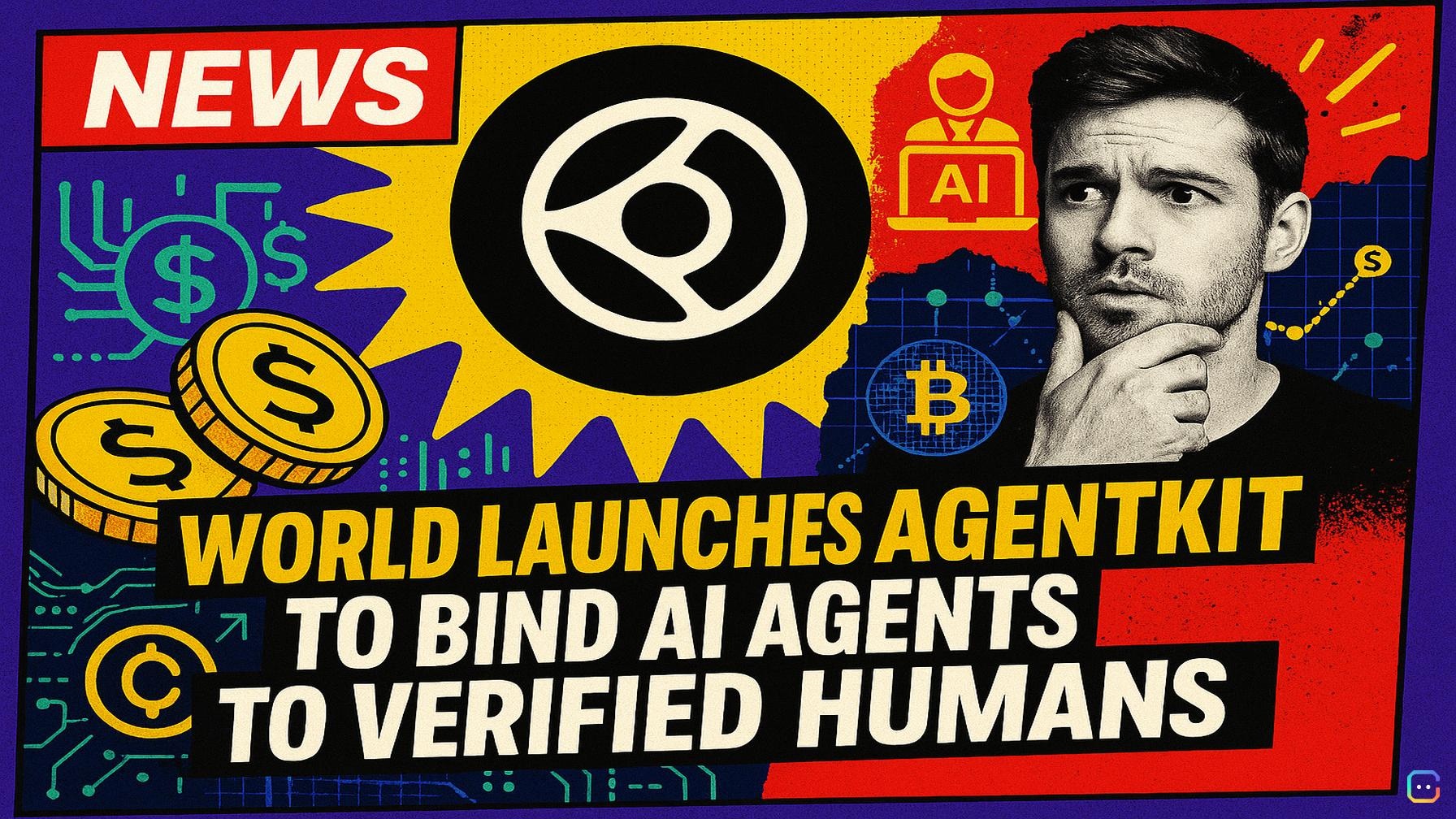
Sam Altman–backed identity project World (formerly WorldCoin) says it has one answer. This week the company launched AgentKit, a developer toolkit designed to let AI agents carry cryptographic proof that they’re backed by a single, verified person using World’s World ID system.
Why identity matters for “agentic commerce”
Payments are already being addressed by new protocols. Coinbase and Cloudflare’s x402 embeds stablecoin micropayments into the internet’s communication layer, enabling “agentic payments” so software agents can pay each other without human intervention. But as Erik Reppel, head of engineering at Coinbase Developer Platform and founder of x402, put it: “Payments are the ‘how’ of agentic commerce, but identity is the ‘who.’” He called the integration “a massive step” toward recognizing agents as legitimate economic participants rather than automated traffic.
Estimates cited by World suggest agentic commerce could hit $3 trillion–$5 trillion by 2030, with agents potentially handling up to 25% of U.S. e-commerce. Coinbase founder Brian Armstrong has predicted that “very soon” more AI agents than humans will make transactions. Binance founder Changpeng Zhao went further, forecasting agents will make exponentially more payments than people—and will use crypto to do so.
AgentKit: linking agents to people, preserving privacy
AgentKit’s core function is simple but consequential: it lets developers link multiple agents to the same World ID (a privacy-preserving proof of personhood). That linkage enables platforms to enforce identity-level policies—limits on free trials, daily booking caps, or per-person fee structures—even if one person runs many agents.
World says AgentKit uses zero-knowledge proofs so platforms can verify an agent represents a real, unique human without needing to collect or store personally identifying data. In practice, users delegate their World ID to agents acting on their behalf, allowing those agents to prove they’re acting for a verified human while preserving privacy.
World is careful to position World ID as a foundational “proof of human” layer that can be used alongside other identity systems, not necessarily replacing them. “This isn’t necessarily an either-or choice,” a World spokesperson told CoinDesk.
Current tradeoffs and the roadmap
AgentKit is currently in beta and relies on World’s Orb-based biometric verification—World’s most controversial component—to mint World IDs. The company says it plans to broaden credentialing options in future releases, adding NFC-enabled passports and government IDs via “World ID Credentials” so users can prove attributes about themselves without exposing raw personal data.
At the time of writing, World’s verification network lists 17,912,203 unique humans—making it one of the largest proof-of-personhood networks globally and underscoring the company’s ambition to serve as the identity layer for an internet increasingly populated by AI agents acting on behalf of humans.
Why this matters for crypto and web infra
As AI agents proliferate, treating all automated traffic as malicious will clash with real user intent. AgentKit—and its interoperability with payment rails like x402—tries to offer a middle road: let legitimate agents transact and interact while giving platforms tools to prevent abuse at the person level. As one World Foundation research engineer put it, proof of humanhood closes the loophole where “one person could run thousands of agents that all pay small fees.”
Taken together, these developments show how crypto-native payments and emerging identity tech are converging to enable a new category of agentic commerce. Whether developers, platforms, and users accept biometric-backed identity as the right answer remains to be seen—but for now, World and Coinbase’s stacks are positioning themselves to be central infrastructure in that next wave.
Read more AI-generated news on: undefined/news