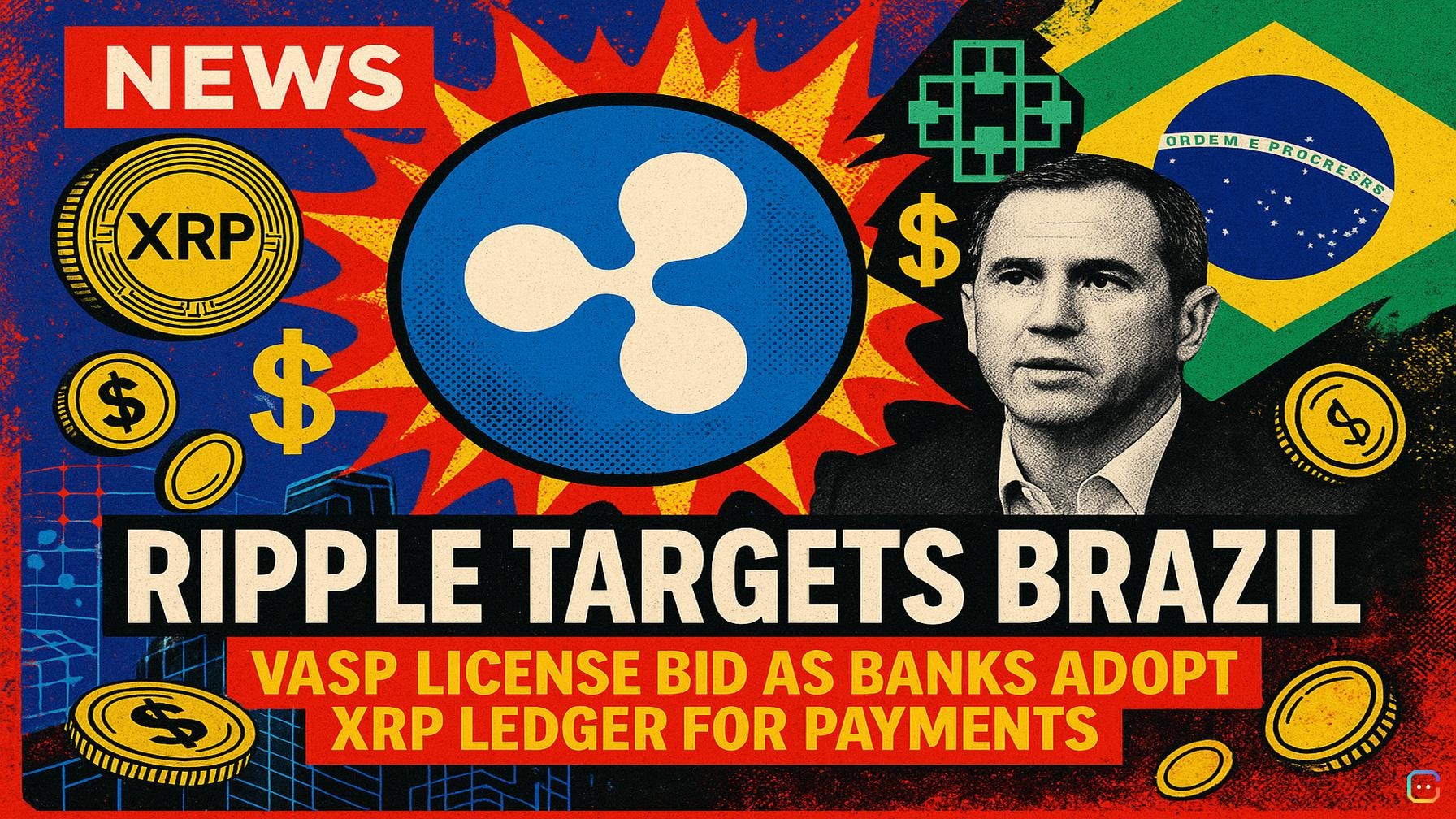
Ripple is stepping up its Latin America push — and Brazil is front and center.
The company told regulators it intends to apply for a Virtual Asset Service Provider (VASP) license from the Central Bank of Brazil, a move that would formally bring Ripple’s local operations under the country’s developing crypto rulebook. Behind the scenes, Ripple has already been building real‑world payments and tokenization rails across Brazil’s financial system.
Several Brazilian institutions are now using Ripple’s infrastructure to speed up cross‑border and on‑chain settlement. Investment bank Banco Genial leverages Ripple’s network to execute same‑day dollar transfers, effectively using the XRP Ledger as back‑end plumbing for faster FX and remittance flows. Braza Bank has gone further by launching a real‑backed stablecoin on the XRP Ledger, using Ripple’s tech stack to tokenize local fiat and simplify both domestic and international settlements.
Fintech Nomad routes stablecoin‑based fund flows between Brazil and the U.S. over Ripple’s rails, positioning the ledger as a low‑friction alternative to traditional correspondent banking in a corridor known for high fees. Meanwhile, partners such as CRX and Justoken are issuing tokenized commodities and other real‑world assets through Ripple custody products — assets that fit more easily into existing regulatory frameworks and that local investors understand.
If the Central Bank grants a VASP license, Ripple would move from a quasi‑grey “technology vendor” role into a regulated, supervised participant in Brazil’s digital asset ecosystem. That distinction matters for banks and institutional players that want exposure to crypto‑adjacent yield, more efficient remittances, or tokenization benefits — but only if the infrastructure is licensed and compliant.
Brazil offers several advantages for Ripple: large remittance corridors, a sophisticated banking sector, and regulators who have so far taken a tough but pragmatic stance on stablecoins and tokenized assets. For XRP and market observers, the Brazilian push underscores Ripple’s post‑U.S. litigation pivot toward jurisdictions where payments and tokenization — not speculative trading — are the primary use cases. If Ripple secures the VASP license and scales flows through partners like Genial and Braza, Brazil could become a key proving ground for whether XRP Ledger infrastructure can deliver real‑world utility beyond courtroom headlines and secondary‑market narratives.
Read more AI-generated news on: undefined/news