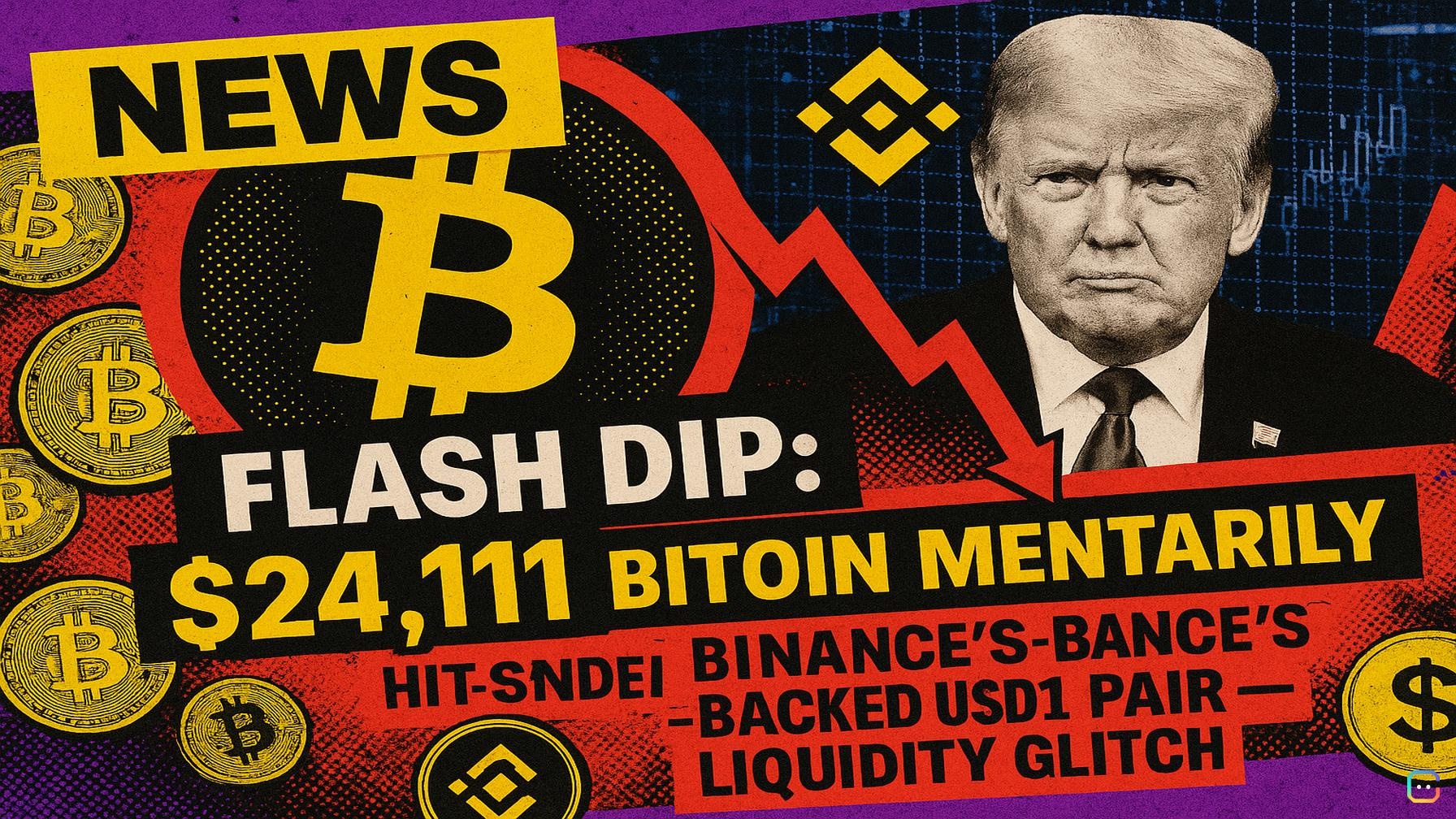
Bitcoin briefly printed at $24,111 on Binance’s BTC/USD1 pair in a dramatic, lightning-fast wick late Wednesday before rebounding to roughly the prevailing market level above $87,000 within seconds, according to exchange data. The abnormal print was isolated to the USD1 pair and did not appear on other major BTC markets.
USD1 is a new stablecoin launched by World Liberty Financial, a firm backed by the Trump family. The USD1 pair on Binance later normalized, with bitcoin trading back in line with broader market prices. The sudden dip looked dramatic on charts but behaved like a microstructure glitch rather than a genuine market crash.
These kinds of flash wicks are often caused by very thin liquidity rather than shifts in bitcoin’s fundamentals. New or lightly traded stablecoin pairs typically have fewer market makers and shallower order books. That makes them vulnerable: a single large market sell, a liquidation cascade, or an automated trade routed through the pair can “sweep” available bids and force the displayed price far below the true market level until new buy orders fill in.
Other technical factors can produce similar dislocations — widened spreads, a faulty quote from a market maker, or trading bots chasing abnormal prints. The effect is magnified during quieter trading hours, when fewer participants are around to absorb flow and restore parity across venues.
Traders generally treat these isolated prints as exchange microstructure events rather than signals about bitcoin’s underlying direction. Still, the episode is a useful reminder of the execution risks when using thinly traded pairs: slippage, misleading price prints, and rapid, temporary distortions can produce costly surprises.
Practical takeaways for traders: prefer high-liquidity pairs and venues for large orders, use limit orders or set slippage caps on market orders, check the order book depth before executing, and cross-reference prices across multiple exchanges to avoid getting caught by a lone anomalous print.
Read more AI-generated news on: undefined/news