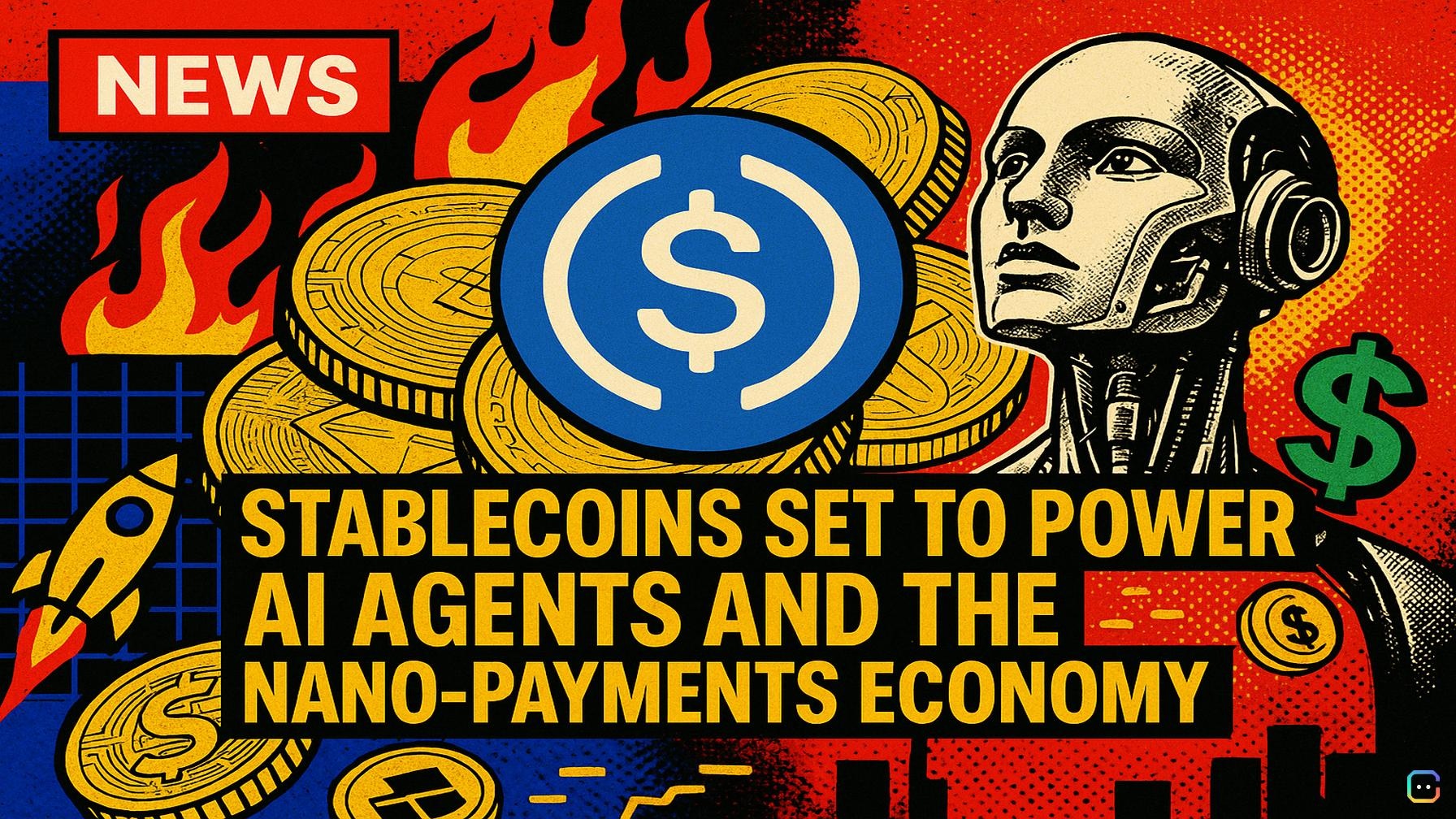
AI agents will need money — and crypto insiders say stablecoins are best placed to supply it.
As autonomous, commerce-driving AI “agents” move from experiments to real-world use, entrepreneurs and engineers in the digital-asset world increasingly argue that dollar-pegged stablecoins on public blockchains are the natural payment layer for what’s becoming known as agentic finance.
Why stablecoins?
- Programmability and composability: Stablecoins can be coded to transfer only when specified conditions are met and to trigger chained actions when received — features agents will rely on to automate services and settlements.
- Always-on, cross-border rails: Blockchains provide a shared, tamper-evident ledger agents can reference 24/7, enabling high-frequency microtransactions that traditional card rails weren’t built to handle.
Those are the arguments from people like Dante Disparte, chief strategy officer at Circle Internet (CRCL), issuer of the second-largest stablecoin, and developers at Coinbase (COIN), who have been working on x402 — a payments protocol designed with autonomous agents in mind.
What agentic finance looks like
Agentic finance anticipates a web of tiny, frequent payments: agents negotiating, paying for data, calling APIs, or buying microservices with transactions at fractions of a cent. That kind of “nano-payments” economy strains credit-card networks and legacy rails but fits naturally with programmable stablecoins and blockchain settlement.
“Firstly, you have to be able to exploit the otherwise really innocuous features of stablecoins, which is programmability and composability,” Disparte said, adding that the blockchain ledger itself becomes the common reference point agents use.
Not everyone in AI loves crypto
Still, crypto has its skeptics in AI. Some developers distrust the space because of memecoins, scams and regulatory uncertainty. Peter Steinberger, creator of the AI agent OpenClaw, is a vocal critic and declined to comment for the story. Sean Neville, co-founder of Catana Labs (and a Circle co-founder), acknowledges the sentiment: “The AI developer community in particular has a negative view of crypto,” he said, even as he argues stablecoins have “achieved some escape velocity.”
Cards, wallets and isolated agent funds
In the short term, agentic systems will likely use a mix of payments — cards and crypto. But there are important differences. Developers can technically spin up virtual cards to simulate agent payments if they have those relationships with card networks. The alternative — issuing each agent its own wallet funded with programmable stablecoins — offers stronger isolation and control: agents can be prevented from accessing a user’s credit card limit and can only spend within policy constraints.
“Anyone can program stablecoins,” said Erik Reppel, head of engineering for Coinbase Developer Platform and an x402 founder. Wallets make it easy to isolate funds per agent, he added, a crucial safety and design element as agents act autonomously.
Standards, fragmentation and identity
One growing worry among those building agentic rails is fragmentation. Multiple competing protocols and standards could make it hard for agents to interoperate and for marketplaces to bootstrap. Sean Neville says what’s needed is a widely adopted, neutral standard — an “SSL equivalent” for agent payments — so different systems can agree on how to transact securely and interoperably.
Regulatory clarity — at least in the U.S. — is improving around stablecoins, but technical and governance fragmentation, plus how to handle bots with no clear financial identity, remain key operational challenges. Catana Labs is focused on reconciling regulated money-transmission requirements with a world of autonomous bots: allowing legitimate agents while keeping bad actors out. Programmable money paired with cryptographic identity and auditability, they argue, is the path forward.
Bigger implications: remaking the internet’s economics
Beyond payments, proponents say agentic finance could upend the internet’s ad-supported economic model. Reppel predicts a shift from human-driven browsing to consumption mediated by agents and chat interfaces, where tiny fees replace traditional ad impressions. That could transform how content is monetized and how value flows on the web.
Bottom line
Stablecoins and blockchain rails offer technical features — programmability, composability, always-on ledgers and global reach — that line up closely with the needs of autonomous AI agents handling massive numbers of tiny transactions. The main obstacles now are perception among AI developers, protocol fragmentation, and matching regulatory responsibilities to a new class of non-human economic actors. For crypto builders, stablecoins are no longer just a payments innovation — they may be the monetary backbone for a future economy run by machines.
Read more AI-generated news on: undefined/news