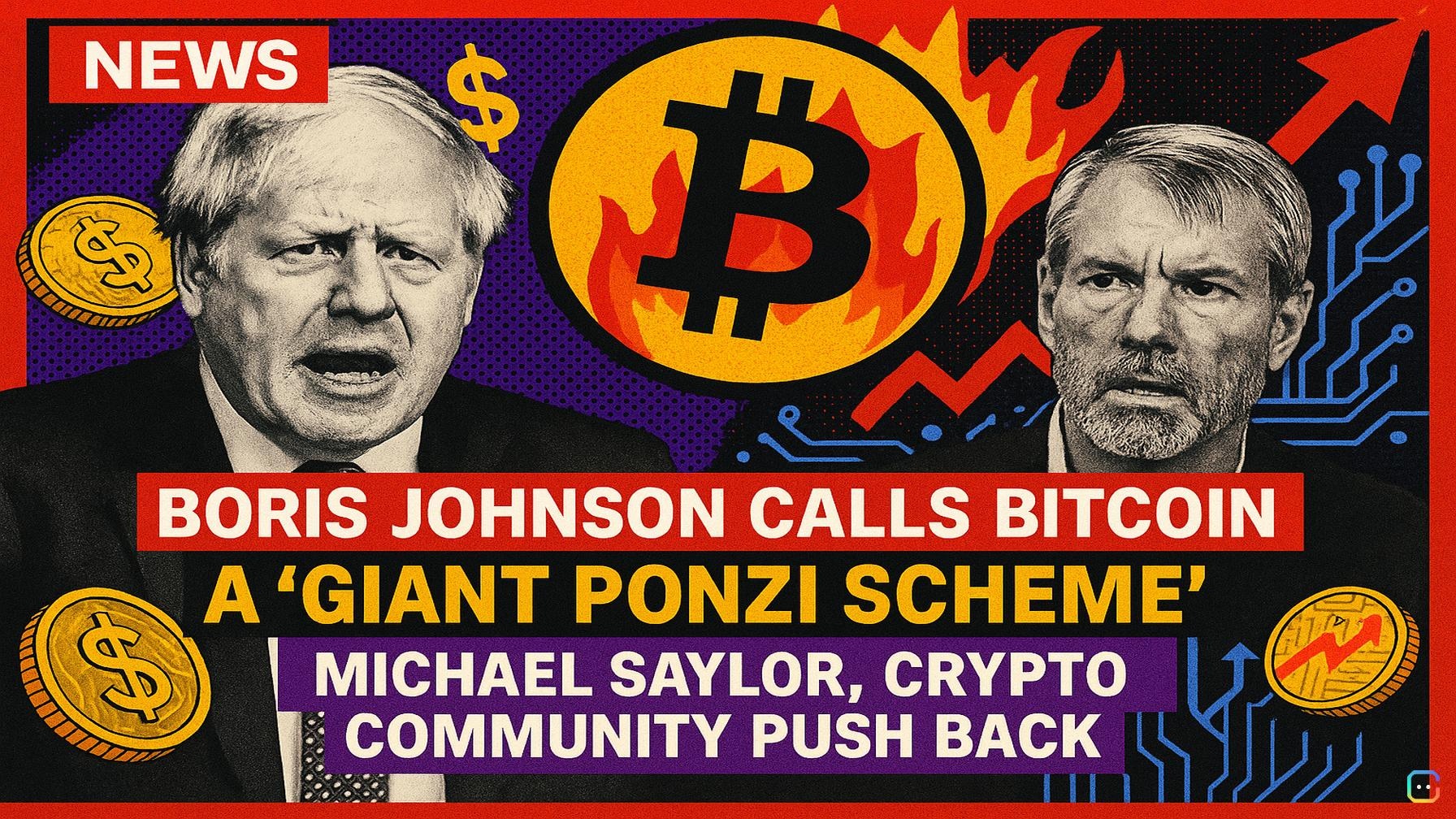
Former U.K. prime minister Boris Johnson labeled bitcoin a “giant Ponzi scheme” in a Daily Mail column and on X, provoking a rapid pushback from Michael Saylor and the crypto community.
Johnson wrote that cryptocurrencies depend on “a supply of new and credulous investors” rather than intrinsic value, illustrating his point with a story from his Oxfordshire village: a retired man who handed £500 to someone in a pub who promised to double it through bitcoin. According to Johnson, the man spent three and a half years paying fees and trying to withdraw funds, ultimately losing roughly £20,000 — what Johnson called “some kind of scam.”
Johnson dismissed bitcoin as “just a string of numbers stored in a series of computers,” and questioned why people should trust a monetary system created by a pseudonymous figure. “Who do we talk to if they decrypt the crypto?” he wrote. “There’s no one except this Nakamoto, who may be no more real than Pikachu or Charmander themselves.”
That characterization drew immediate rebuttals. Michael Saylor, executive chairman of MicroStrategy (MSTR), the world’s largest corporate bitcoin holder, rejected the Ponzi label: “A Ponzi requires a central operator promising returns and paying early investors with funds from later ones,” he said. “Bitcoin has no issuer, no promoter, and no guaranteed return—just an open, decentralized monetary network driven by code and market demand.”
On X’s Community Notes, contributors pointed out that classic Ponzi schemes promise artificially high, virtually risk-free returns — something bitcoin does not. “Bitcoin has no issuer and its value is purely determined by the free market. The code is totally public and opt-in. Nobody can force you to run any particular version,” one note read.
Responses across the crypto ecosystem ranged from technical defenses to political critique. Supporters highlighted bitcoin’s fixed supply and decentralized network as fundamental differences from Ponzi structures, while others used memes to pivot the conversation toward criticisms of central-bank money printing during the pandemic. BitMEX Research summed up a common theme: “nobody is in charge.”
The exchange underscores the larger debate at play: critics see fraud risks and a lack of institutional safeguards, while proponents point to open-source code, market-determined value, and decentralization as core safeguards. Johnson’s comments have reignited that conversation, with crypto advocates and skeptics alike staking out familiar positions on trust, governance, and what gives money its value.
Read more AI-generated news on: undefined/news