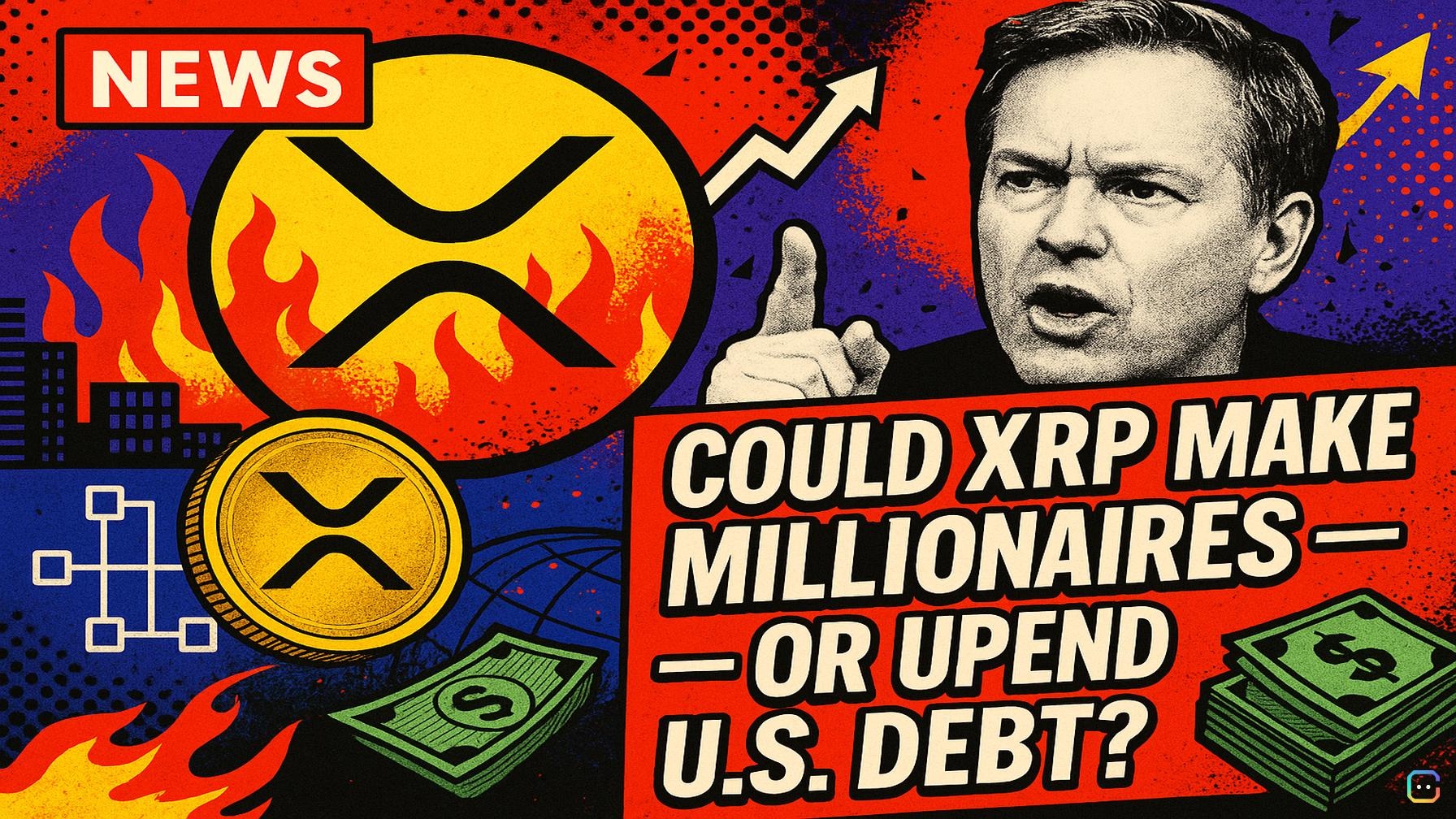
Headline: Could XRP Make Holders Millionaires — or Worse, Upend the U.S. Balance Sheet? Dalton’s Math Sparks Debate
Joshua Dalton, founder of crypto firm Triblu, has put forward a provocative scenario: if the U.S. were to use XRP as part of a strategic crypto reserve, holders could see eye-popping gains — potentially becoming millionaires, billionaires or more. Dalton argues XRP is a more politically palatable choice than Bitcoin because of its ties to a U.S.-based company, a claim that has energized parts of the crypto community while also drawing sharp skepticism.
The arithmetic behind the headline
Dalton’s case is rooted in simple — though dramatic — arithmetic. Using an estimated U.S. national debt of about $38 trillion and Ripple’s reported escrow of roughly 34.4 billion XRP, Dalton and others calculate that XRP would need to trade near $883 to offset roughly 80% of the debt. At today’s price (about $1.91), that implies a surge of more than 46,000%.
For context, proponents who once discussed using 1 million BTC to back fiscal needs would require Bitcoin to hit roughly $30 million per coin from current levels (Bitcoin trading near $89,000), a rise on the order of 33,000% — numerically comparable, but practically implausible for market-structure reasons.
Legal, political and market realities
Even as the math excites headlines, practical hurdles loom large:
- Policy focus: An executive order signed earlier this year established a national Bitcoin reserve and a broader crypto stockpile framework, and policymakers have largely treated Bitcoin as the primary candidate for reserve status. Other tokens are more likely to be categorized as seizure assets or general holdings.
- Escrow control: Ripple’s escrow is privately controlled and governed by contractual arrangements. The government could not simply seize those XRP without protracted legal action — and even a court victory wouldn’t erase the political and logistical complications.
- Market impact: Dumping billions or trillions of dollars worth of any token into global markets would likely depress prices, not inflate them. Markets aren’t built to absorb that scale of selling without heavy distortion.
Who would actually benefit?
Wallet data shows that some retail holders would see dramatic paper gains if XRP reached Dalton’s target. For example, a holder of 10,000 XRP (about $19,100 today) would be sitting on nearly $9 million on paper at an $880 price. Distribution stats cited in the reports:
- 179,546 wallets hold between 5,000 and 10,000 XRP.
- About 2,006 addresses hold between 500,000 and 1 million XRP.
- The largest stakes are concentrated: only 20 wallets hold between 500 million and 1 billion XRP, and six addresses hold more than 1 billion. Large positions are mainly held by Ripple, its founders, or exchanges.
Expert skepticism and the outlook
Market analysts remain wary. Matthew Sigel of VanEck has publicly argued Bitcoin is a more credible path for large-scale fiscal applications, and many observers say no single token should be expected to “solve” national debt. Commentators in the XRP community have shifted attention to 2026 as a potential inflection point for the token, but those views are speculative and hinge on market demand, regulatory clarity, and geopolitics.
Bottom line
Dalton’s scenario is a headline-grabber and an interesting thought experiment, but converting the math into reality faces steep legal, political and market obstacles. While the numbers highlight just how concentrated value creation would be if a major government adopted a single token, the practical path to that outcome remains highly uncertain.
Read more AI-generated news on: undefined/news