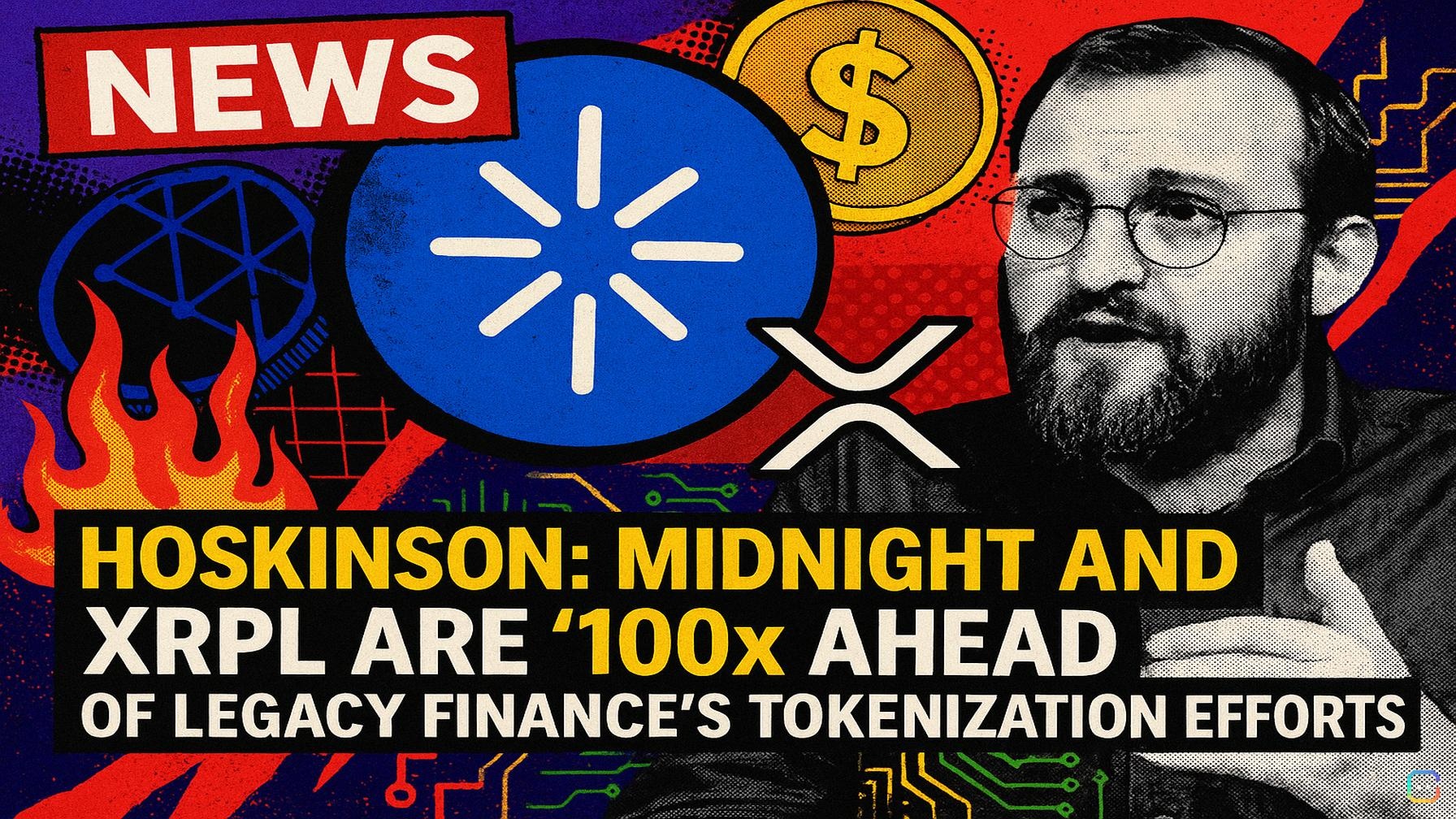
Cardano founder Charles Hoskinson has taken aim at efforts by legacy finance to graft blockchain features onto traditional systems, arguing that purpose-built networks like his own Midnight and the XRP Ledger are already operating “100x” beyond what those institutional initiatives aim to achieve.
In a post on X, Hoskinson framed the debate as one of architecture and scale rather than market timing or price momentum. He contrasted truly Web3-native designs — which prioritize decentralization and global scalability — with attempts by legacy firms to retrofit blockchain ideas inside tightly controlled environments such as Canton, a privacy-focused interoperable Layer‑1. According to Hoskinson, those constraints prevent legacy projects from realizing the full promise of tokenization and programmable digital assets.
Midnight, the Layer‑1 Hoskinson helped build, was presented as a concrete example. Designed for programmable privacy, Midnight aims to address persistent data-protection and compliance challenges that have held back many real‑world use cases. It implements a dual economic model: NIGHT serves as the network’s native token while a separate resource, DUST, is used for transaction execution and to keep costs predictable. Hoskinson argues Midnight shows that Web3‑native systems can meet real‑world requirements at meaningful scale.
XRP and the XRP Ledger (XRPL) form the other pillar of his comparison. Launched in 2012, XRPL was engineered for fast, low-cost settlement of digital assets across borders. Its long operational history and technical stability — and what many in the industry saw as a favorable regulatory turn in Ripple’s legal battle with the U.S. SEC — are cited by Hoskinson as evidence that XRPL is a mature, battle-tested payment rail capable of operating at far greater scale than legacy finance experiments.
A central theme in Hoskinson’s remarks is the sheer size and complexity of the opportunity: he pointed to the $10 trillion Real‑World Asset (RWA) market and argued that capturing meaningful share will require comprehensive, end‑to‑end technological strategies backed by committed partners and active communities. In his view, partially adapted or permissioned systems linked to legacy finance lack the architectural breadth and open ecosystems to compete.
Bottom line: Hoskinson’s critique isn’t about short‑term market moves but about design philosophy. He’s betting that networks built from the ground up for decentralization, interoperability and scalability — and supported by engaged communities — will outpace institutional imitations as real‑world tokenization accelerates.
Read more AI-generated news on: undefined/news