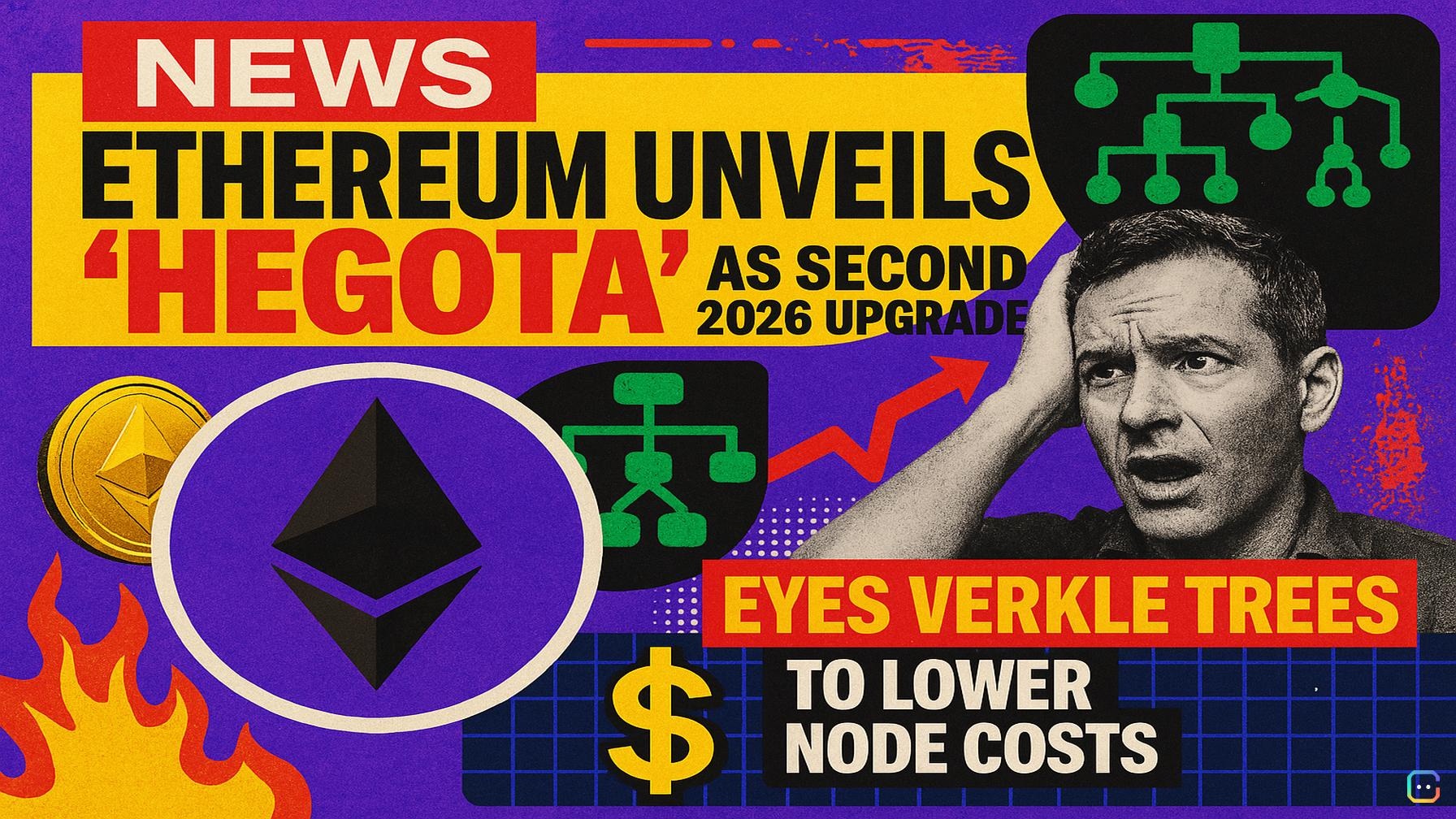
Ethereum developers have settled on the name and tentative timing for the network’s second major 2026 upgrade: Hegota, currently penciled in for the second half of the year. Hegota will follow Glamsterdam, which is still expected to land in the first half of 2026 — marking a faster cadence of protocol updates than Ethereum has historically maintained.
Why it matters
- Hegota reflects Ethereum’s shift toward more frequent, smaller releases rather than annual, monolithic upgrades — a change driven in part by community criticism that development was not keeping pace with the chain’s growth.
- Early candidate features aim to improve node efficiency and decentralization, with deferred items from Glamsterdam likely to spill into Hegota if they miss the earlier release window.
Timing and process
Core developers will finalize Glamsterdam’s scope at their next meeting in early January, so major Ethereum Improvement Proposals (EIPs) intended specifically for Hegota are not expected to be announced until at least February. Historically, EIPs that don’t make one release are often pushed into the next, so Hegota may inherit leftover Glamsterdam work.
Potential features to watch
One of the most discussed possibilities for Hegota is implementation of Verkle Trees, a newer cryptographic data structure that can shrink the size of proofs and dramatically reduce on-disk and memory requirements for nodes. If adopted, Verkle Trees could lower hardware barriers for running a node and help improve network decentralization. Other candidates may include items deferred from Glamsterdam’s final scope.
Naming convention
As with prior upgrades, the name “Hegota” follows Ethereum’s tradition of blending a Devcon host city with a star name. In this instance it combines “Bogota” (execution-layer) and “Heze” (consensus-layer) to produce “Hegota.”
Context
The Ethereum Foundation points to a sequence of recent upgrades — such as Fusaka, which shipped PeerDAS along with smaller enhancements — and says Glamsterdam’s headline features will include Block-level Access Lists and an enshrined Proposer-Builder Separation (PBS). Hegota begins the planning cycle for the following set of changes.
What to watch next
- Early January: developers finalize Glamsterdam’s scope.
- February and beyond: EIP proposals for Hegota may begin to surface.
- Watch for Verkle Trees and other node-efficiency proposals that could shape Hegota’s impact on decentralization and node operator costs.
Further reading: Glamsterdam also aims to address MEV fairness as part of its agenda.
Read more AI-generated news on: undefined/news