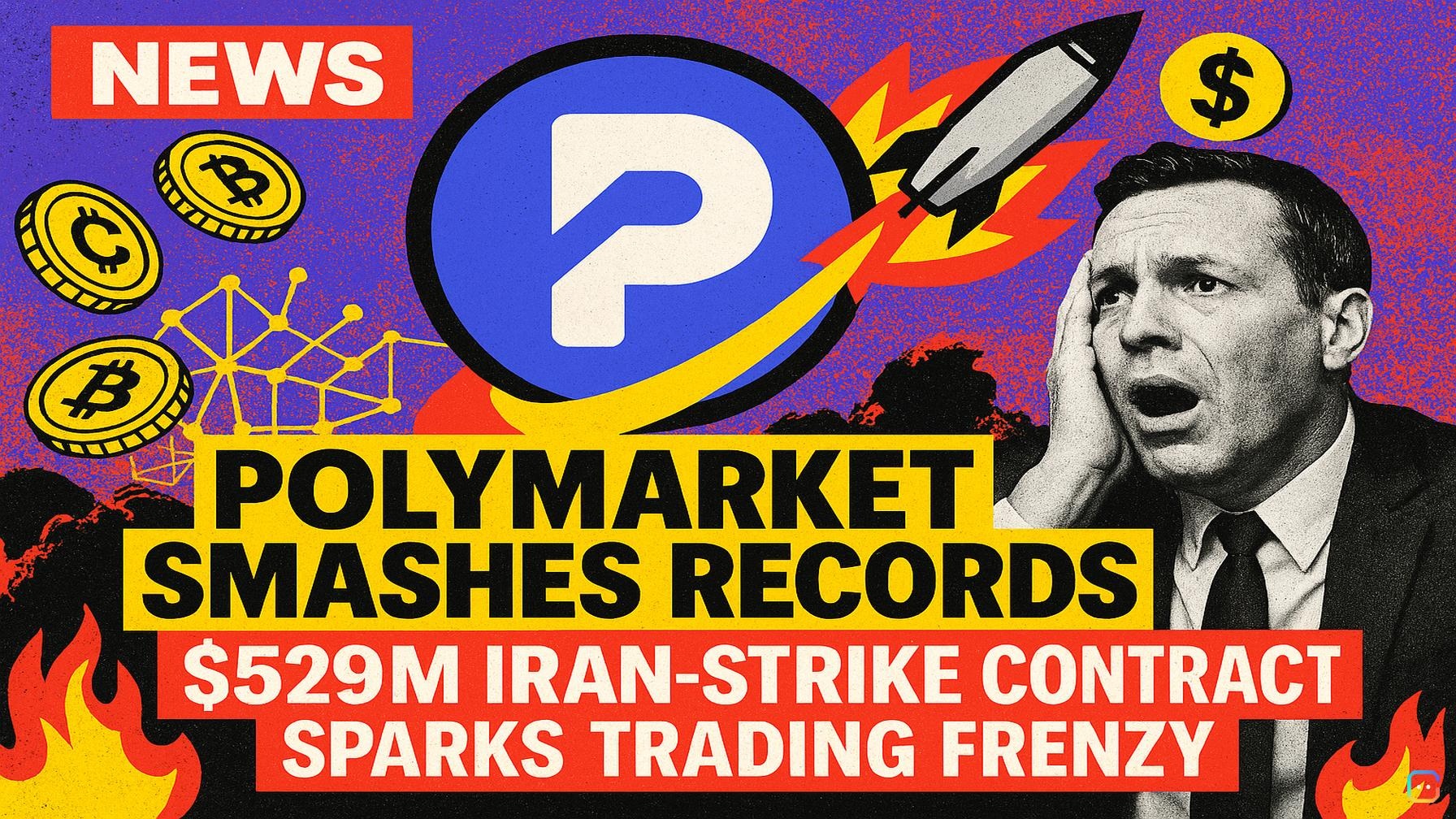
Polymarket smashed platform records this weekend as bettors poured into prediction markets tied to the escalating U.S.-Iran conflict, with one single contract amassing $529 million in trading volume.
Less than 24 hours after U.S. and Israeli strikes on Iran began, the crypto-native prediction exchange became an intense real‑time betting floor for geopolitics. Traders created and priced highly specific outcomes — from the exact week a ceasefire might occur to whether the Iranian regime collapses by June, who will replace Supreme Leader Ayatollah Ali Khamenei, and whether U.S. ground forces will enter Iran by early March.
The biggest story: the “US strikes Iran by...?” market, live since December 22, has now pulled $529 million in total volume, making it one of Polymarket’s largest-ever single markets. That volume places it atop the platform’s “World” and “Geopolitics” categories and fourth in the broader “Politics” category, trailing only a few high-volume Trump-related election markets. The February 28 contract alone attracted $89.6 million of that trading. Polymarket’s resolution rules for the market were tight: a qualifying “yes” required drone, missile, or air strikes on Iranian soil by U.S. forces — interceptions, cyberattacks, and ground operations did not count. After strikes began, every daily contract from February 28 through early March resolved to “yes,” so traders who purchased those specific-date shares beforehand collected on their bets.
Another major completed market was “Khamenei out as Supreme Leader of Iran by March 31?” which resolved to 100% after Iranian state TV confirmed his death. That contract drew roughly $45 million in volume, making it one of the most-traded geopolitical markets of the week. The top account on that market — identified on Polymarket as “Curseaaaaaaa” — turned a winning “yes” position into $757,000 in profit; four other traders on the market cleared six-figure gains. The contract’s probability price had bounced in the 25–50% range through January and February before spiking to certainty on the confirmation.
With the initial strikes resolved, attention has shifted to what comes next. Current market-implied probabilities show traders expecting a relatively quick resolution: a U.S.-Iran ceasefire is priced at just 4% by March 2 and 15% by March 6, but the odds jump to 61% by March 31 and 78% by April 30. The “Will the Iranian regime fall by June 30?” market sits at 54%, up sharply from the low‑20s it traded at for months. In the “Next Supreme Leader of Iran” market, 30% of traders currently back “position abolished,” implying nearly a one-in-three chance that bettors see theocratic structures being dismantled; former parliament speaker Ali Larijani leads the named candidates with 21%.
Ground invasion and boots-on-the-ground questions are also drawing real money: “Will the U.S. invade Iran before 2027?” trades around 19% with $207,000 in volume, while “US forces enter Iran by March 7” sits near 28% with about $2 million traded.
Polymarket’s weekend activity highlights a structural difference from traditional markets: equity and commodity futures were still closed until Sunday evening, but anyone with a crypto wallet could open positions, see live market pricing, and trade around geopolitical shocks in real time.
That speed and precision also created profit opportunities that unfolded before the first missiles were launched. Onchain analytics firm Bubblemaps flagged six wallets that collectively netted about $1.2 million by betting on a U.S. strike on Iran on February 28 — many accounts were funded within 24 hours of the attack, purchased “yes” shares for the February 28 contract specifically, and bought hours before the operation. The largest wallet converted roughly $61,000 into more than $493,000 in profit; another turned a $30,000 stake into around $150,000.
Polymarket responded to the surge and optics with a note on its Middle East markets, arguing that prediction markets “harness the wisdom of the crowd to create accurate, unbiased forecasts for the most important events to society.” After speaking with people directly affected by the strikes, the platform said prediction markets “could give them the answers they needed in ways TV news and X could not.” The site also launched a dedicated Iran markets section as trading concentrated there.
UPDATE (March 1, 2026, 06:30 UTC): Adds additional detail.
UPDATE (March 1, 2026, 07:15 UTC): Confirms Polymarket bets set a new record for the platform.
Read more AI-generated news on: undefined/news