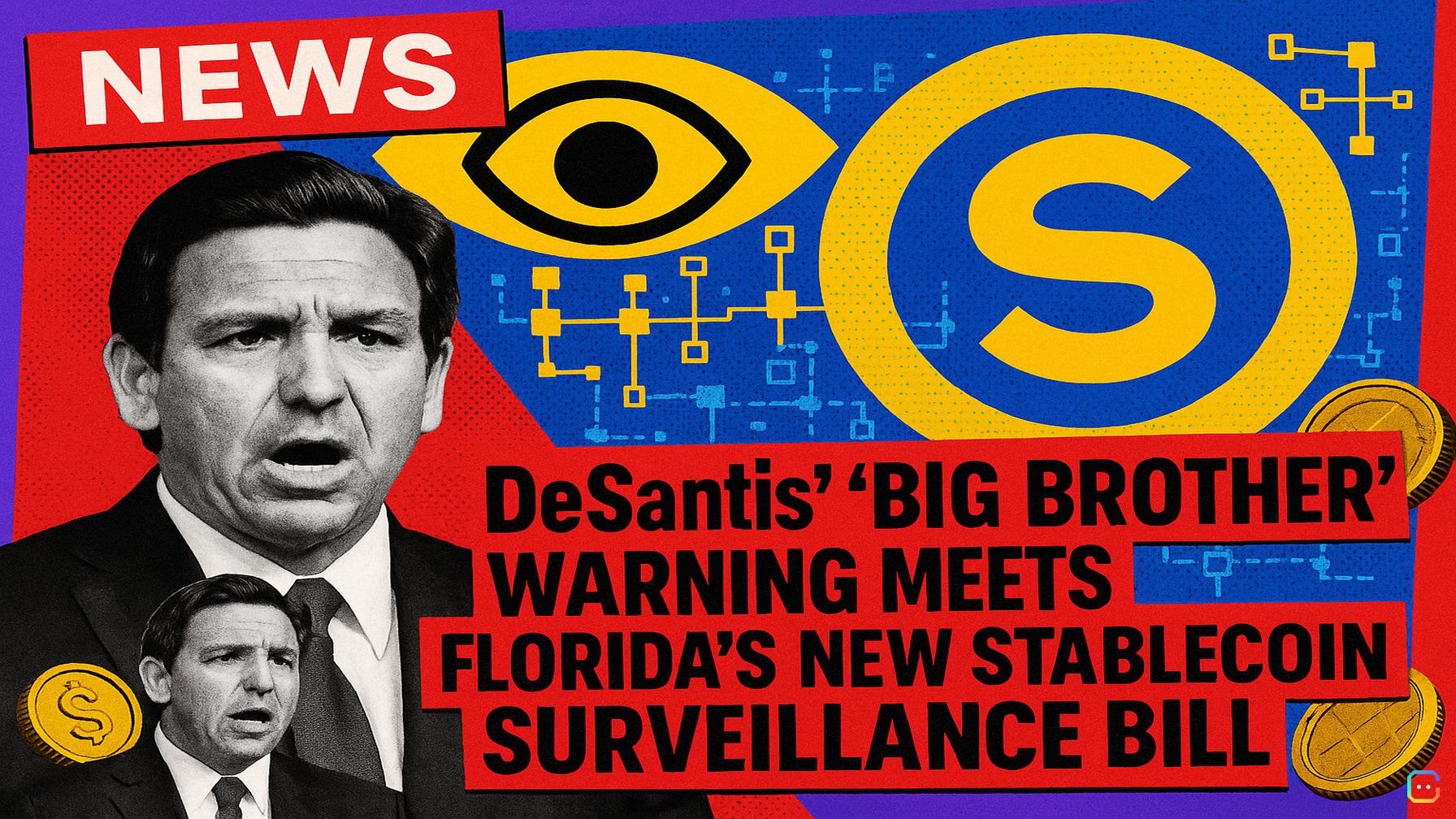
Headline: DeSantis’ “Big Brother” Warning Meets Florida’s Stablecoin Rule — A New Layer of State Crypto Oversight
Florida’s long-running fight against a federal central bank digital currency (CBDC) has taken a twist: Governor Ron DeSantis, who famously warned that a “Big Brother’s Digital Dollar” could let Washington police purchases, now presides over a state that looks set to impose detailed rules on private stablecoins.
What passed
- On March 6 the Florida State Senate unanimously approved Bill 314, a regulatory framework for stablecoins issued in the state. The bill would require stablecoin issuers operating in Florida to record transactions greater than $10,000—mirroring anti-money-laundering (AML) reporting thresholds—and give the Florida Office of Financial Regulation (OFR) new supervisory powers, including license revocation for compliance, reporting, or criminal issues.
- Sponsor Sen. Colleen Burton told Decrypt lawmakers moved fast to meet a July deadline for states that want to apply to regulate certain stablecoins independently. The bill was drafted with federal coordination in mind, she said.
Why it matters
- Stablecoins are private, dollar-pegged tokens issued by companies like Circle and typically run on public blockchains such as Ethereum. By contrast, a CBDC would be a centrally issued, government-backed digital cash carrying the federal government’s “full faith and credit.”
- DeSantis has actively campaigned against CBDCs—he signed a 2023 Florida bill banning a “centralized digital dollar” and has publicly warned of federal overreach. Yet Bill 314 creates state-level surveillance and control tools that critics say echo the kinds of mechanisms DeSantis singled out as dangers of a CBDC.
Reactions and concerns
- Nicholas Anthony, a policy analyst at the libertarian Cato Institute, told Decrypt the bill is hard to square with DeSantis’ anti–“Big Brother” rhetoric: “He built a campaign on standing up to ‘Big Brother’ and the federal government, but he’s kind of handing them the keys to the castle in this sense.”
- Anthony also noted that CBDCs aren’t the only route to financial surveillance: private-sector controls and regulatory mandates already create avenues for monitoring and restricting transactions.
Enforcement mechanics and precedents
- Florida’s OFR published a 2022 paper noting the technical difficulty of seizing self-custodied crypto. But stablecoin issuers have previously worked with law enforcement: firms such as Circle have used blacklist and freeze mechanisms to block addresses tied to illicit activity, and have cooperated to limit bad actors.
Federal backdrop and political theater
- At the national level, the U.S. Senate recently passed a housing bill that would block creation of a CBDC until 2030 if it becomes law—pending a presidential signature—and members of Congress are loudly contesting how to handle CBDCs.
- Conservative voices including DeSantis, former Rep. Marjorie Taylor Greene, Sen. Ted Cruz and Rep. Tom Emmer have campaigned against CBDCs. Greene has warned that federal legislation (she referenced the GENIUS Act) could allow a CBDC “through a back door.” Emmer reintroduced a bill last year to outlaw CBDCs, and Cruz criticized the Senate’s 2030 pause as temporary, pushing instead for a permanent ban.
What’s next
- DeSantis has not publicly reviewed the final text of Bill 314 and has not announced whether he will sign it. If signed, the OFR would gain new powers to oversee stablecoin issuers in Florida and enforce compliance. Advocates say the framework aims to give Florida control and align with federal standards; critics say it undercuts anti-CBDC rhetoric by enabling similar surveillance mechanics at the state level.
Bottom line
Florida’s move highlights a broader paradox in crypto policy: politicians can oppose a government-run digital currency on civil-liberty grounds while simultaneously authorizing state and private mechanisms that produce similar monitoring and control. Whether Bill 314 will be signed into law remains to be seen, but it already tightens state-level oversight at a moment of heated national debate over the future of digital money.
Read more AI-generated news on: undefined/news