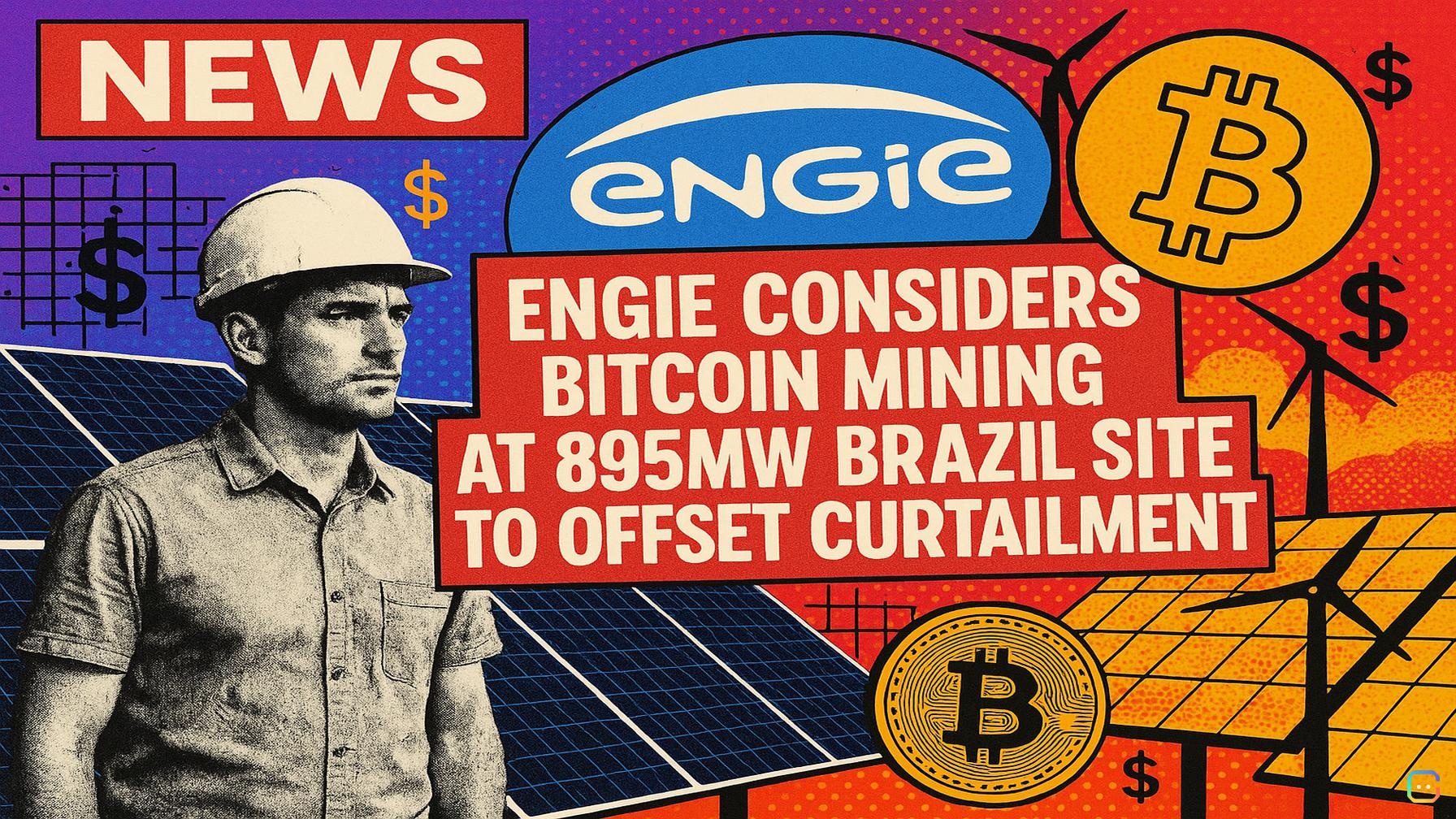
Engie, one of Europe’s biggest utilities—and a company in which the French government holds 23.64% ownership and 33.20% control—is exploring an option that could change how large power producers view bitcoin mining. Reuters reports Engie’s Brazil unit is studying whether to add battery storage or bitcoin-mining data centers to its new Assu Sol solar complex, not as a pure crypto play but as a way to stabilize revenues and manage grid constraints.
Assu Sol, in northeast Brazil, is Engie’s largest solar project to date with 895 MWp of installed capacity and it reached full commercial operation this month. But like other Brazilian renewables, Assu Sol has been hit by output curtailments—forced reductions in generation when the grid cannot absorb all available power. Engie Brazil country manager Eduardo Sattamini told Reuters the company is “assessing local demand solutions” to reduce the economic drag from those curtailments, though he did not quantify how much power the plant is currently losing.
The logic is simple and increasingly familiar: when a grid can’t take all the clean energy being produced, the producer can create on-site demand. Engie is weighing two main options—battery-storage systems or data centers that could be used for bitcoin mining—so the plant can either store excess generation or consume it flexibly. Reuters summarized the plan as considering “data centers for bitcoin mining or storage” to improve the site’s profitability.
Importantly, this is an infrastructure feasibility process, not an imminent mining rollout. “We are looking at some possible offtakers,” Sattamini said. “That’s not coming next month. It will take a couple of years for us to implement.” That timeline matters: for crypto markets, this should be read as a long-term grid strategy rather than a near-term spike in hash rate.
Curtailment has become a major pain point for Brazil’s renewables since 2023, Reuters notes, costing operators billions of reais. The drivers are a fast buildout of wind and solar capacity, sluggish demand growth, transmission bottlenecks and a boom in distributed generation such as rooftop solar—factors that leave some large plants with intermittent or stranded output.
For bitcoin miners and crypto investors, the Engie story reinforces a trend: mining is increasingly discussed in power-market terms, as a flexible, dispatchable load that can monetize excess or stranded generation. If Engie ultimately opts for mining at Assu Sol, the biggest takeaway may be strategic rather than immediate—utilities treating bitcoin mining as a grid-adjacent industrial tool to balance supply, manage curtailment risk and recover revenue.
At press time, Bitcoin traded at $63,123.
Read more AI-generated news on: undefined/news