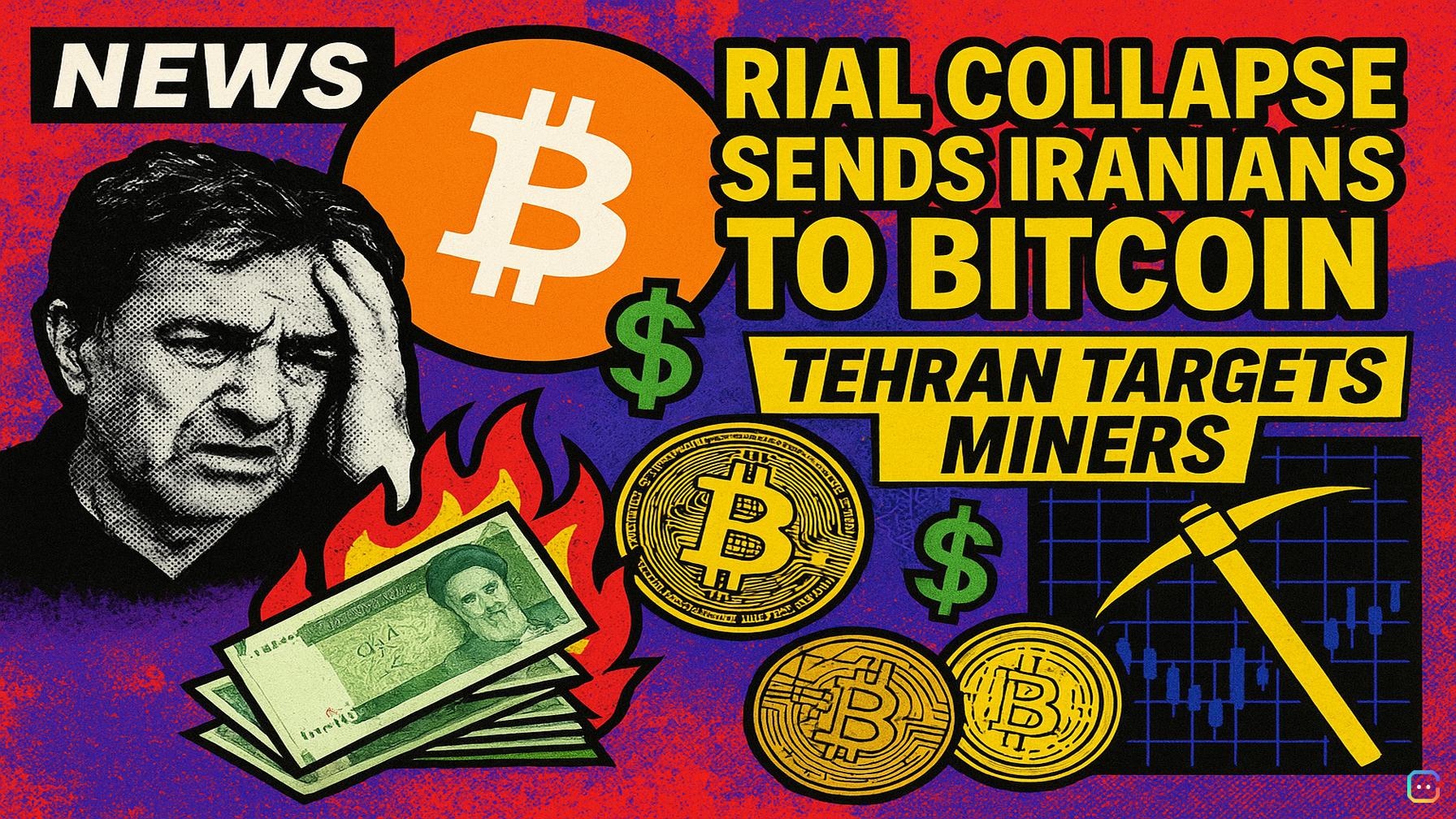
Tehran’s latest currency collapse has thrust Bitcoin into the spotlight — and put miners in the crosshairs.
On the evening of December 29, the Grand Bazaar’s shutters came down as the Iranian rial plunged to a record 1.42 million per U.S. dollar. Street protests met tear gas, and the scene underscored a simple fact: when a government-controlled currency fails, ordinary people lose savings and options fast. The rial’s latest freefall follows decades of decline and has accelerated since June 2025, when a brief conflict with Israel coincided with a more than 40% drop in the currency’s value.
The banking system is creaking under the strain. Bank Melli — which serves roughly 42 million Iranians and had already absorbed a failed bank — began showing instability in October. Rather than stabilizing the system, the Central Bank spent months issuing warnings to weaker banks; this week the central bank governor resigned as the rial hit fresh lows.
Against that backdrop, Bitcoin has become a survival tactic for many Iranians. Iran offers some of the world’s cheapest electricity, pushing the estimated cost to mine one bitcoin to roughly $1,300 — while BTC trades near $87,600 — creating an outsized profit incentive for miners who can convert to hard, borderless value. Bitwise CEO Hunter Horsley captured the sentiment succinctly: “Economic mismanagement — The story of the past, present, and future. Bitcoin is a new way for the people to protect themselves.”
And yet Tehran is moving to criminalize mining. That apparent paradox — a state presiding over a collapsing currency while clamping down on an exit valve — reflects competing priorities. Analysts say motivations likely include preventing capital flight, protecting energy supplies (mining is power-hungry even with cheap electricity), curbing sanctions circumvention, and maintaining political control over finance. For ordinary Iranians, however, mining is less ideological than practical: a way to preserve wealth when banks and the currency fail.
The Iranian story plays into a broader market narrative. 2025 has been a rough “red year” for bitcoin after a turbulent stretch that observers describe as defined by a “metal war” with China, U.S. tariff tensions, and pressure on liquidity. Looking ahead to 2026, proponents point to two structural forces that could support higher prices: a sustained drop in new BTC issuance and rising institutional demand from ETFs and sovereign reserves. That confluence is the basis for some price projections ranging from roughly $170,000 to $250,000 — though those outcomes depend on macro tailwinds holding steady.
Bottom line: for Iranians, bitcoin is an urgent, practical escape from a failing domestic system; for global investors, it’s increasingly framed as a hedge against recurring fiat debasement. How those two dynamics interact — and how Tehran responds to mining and capital flows — will be a critical subplot for both crypto markets and Iranian citizens in 2026.
Disclaimer: AMBCrypto's content is informational and not investment advice. Cryptocurrency trading carries high risk; readers should do their own research before acting. © 2025 AMBCrypto
Read more AI-generated news on: undefined/news