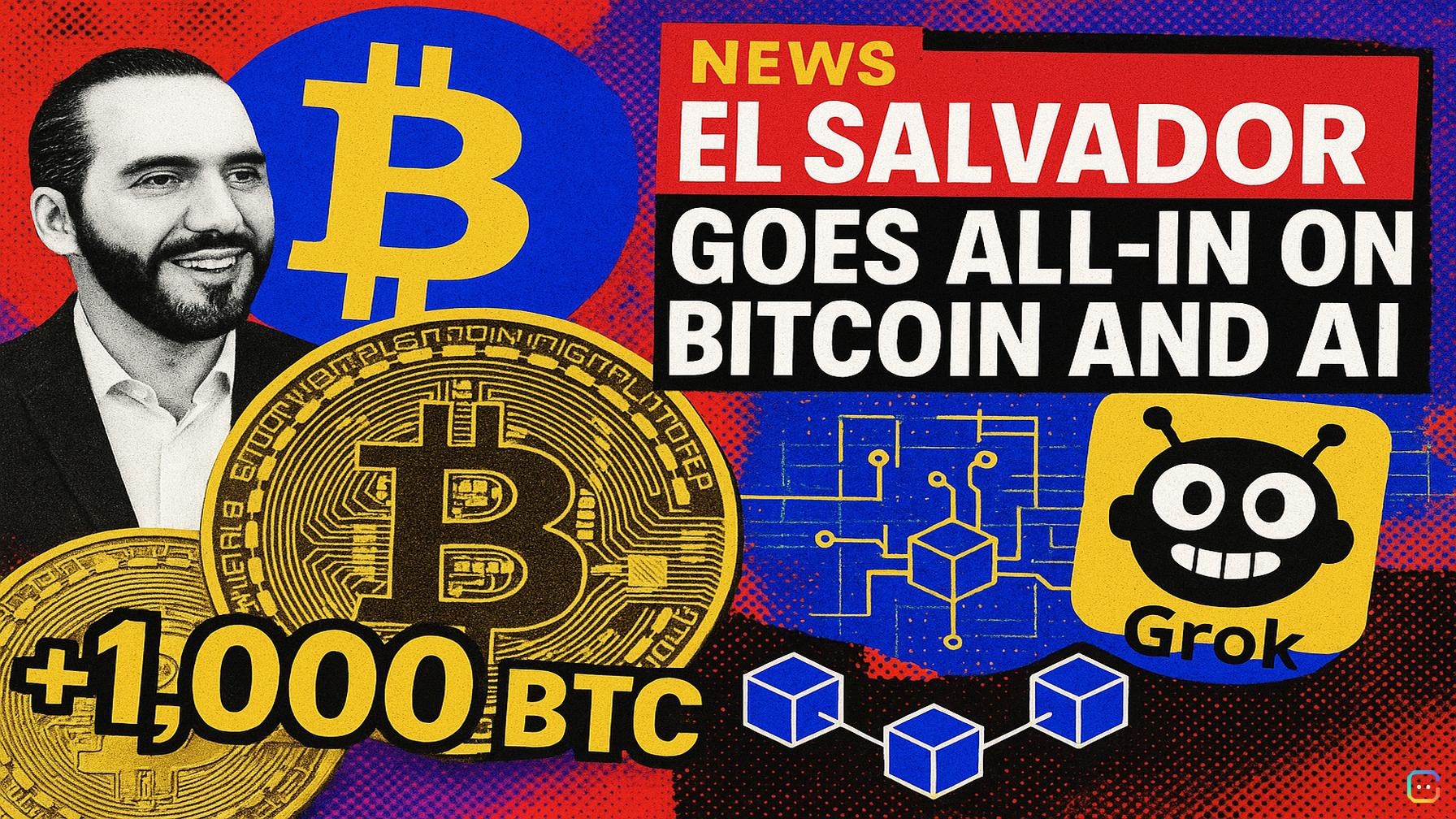
El Salvador has doubled down on a bold, tech-first national strategy — officially going “all‑in” on Bitcoin and artificial intelligence for 2026, according to a New Year statement from the country’s National Bitcoin Office. The move frames the country’s long-running embrace of crypto not as a headline-grabbing stunt but as a sustained, strategic shift from a scarcity-focused economic mindset to one centered on technology-driven abundance.
What the numbers say
- El Salvador made Bitcoin legal tender in 2021 and has steadily accumulated BTC through multiple market cycles.
- By late December 2025 the nation held roughly 7,500 BTC (around $660 million), per market reporting.
- Notably, during November 2025’s market weakness the government purchased more than 1,000 BTC in a tactical acquisition that departed from its usual daily-buy approach.
Policy continuity, not a knee-jerk bet
Officials portray these holdings as long-term national assets intended to bolster monetary sovereignty and innovation, treating price volatility as operational risk rather than policy failure. The November accumulation — a concentrated buy during weakness — suggests El Salvador is willing to tactically increase reserves rather than only stick to passive, dollar-cost-averaging purchases.
Economic backdrop and IMF tone
The International Monetary Fund has acknowledged stronger-than-expected economic growth in El Salvador while maintaining dialogue on transparency and fiscal risk management. Significantly, recent IMF commentary stopped explicitly discouraging Bitcoin accumulation. With rising remittances, steady investment, and projected GDP growth near 4% into 2026, the government argues its Bitcoin strategy is being integrated into broader macroeconomic planning rather than pure speculation.
AI as a second pillar
Bitcoin isn’t the only pillar of the plan. In December 2025 El Salvador struck a partnership with Elon Musk’s xAI to roll out Grok — an adaptive AI tutoring system — across 5,000 public schools. The program aims to support over one million students and thousands of teachers, align digital learning with national curricula, build localized datasets, and promote responsible AI frameworks. Authorities say the initiative is part of diversifying the economy beyond remittances and tourism.
Bigger-picture implications
By embedding Bitcoin alongside AI in national infrastructure, El Salvador is recasting BTC as reserve infrastructure rather than short-term exposure. Sovereign accumulation introduces patience, scale, and policy continuity into Bitcoin demand dynamics — factors that could, over time, tighten effective circulating supply and strengthen the “reserve narrative” if other countries take similar paths. Meanwhile, AI-enabled governance and public services might make rule-based, fixed-supply monetary systems more attractive to policymakers.
Bottom line
El Salvador’s 2026 posture reads as long-term positioning: sustained Bitcoin accumulation, a tactical purchase during market stress, and a major AI education push. Whether other states will follow remains uncertain, but the experiment signals a new model for how nation-states might marry crypto and AI as parts of economic strategy.
Disclaimer: This article is informational and not investment advice. Cryptocurrency investments carry high risk; do your own research before making decisions.
Read more AI-generated news on: undefined/news