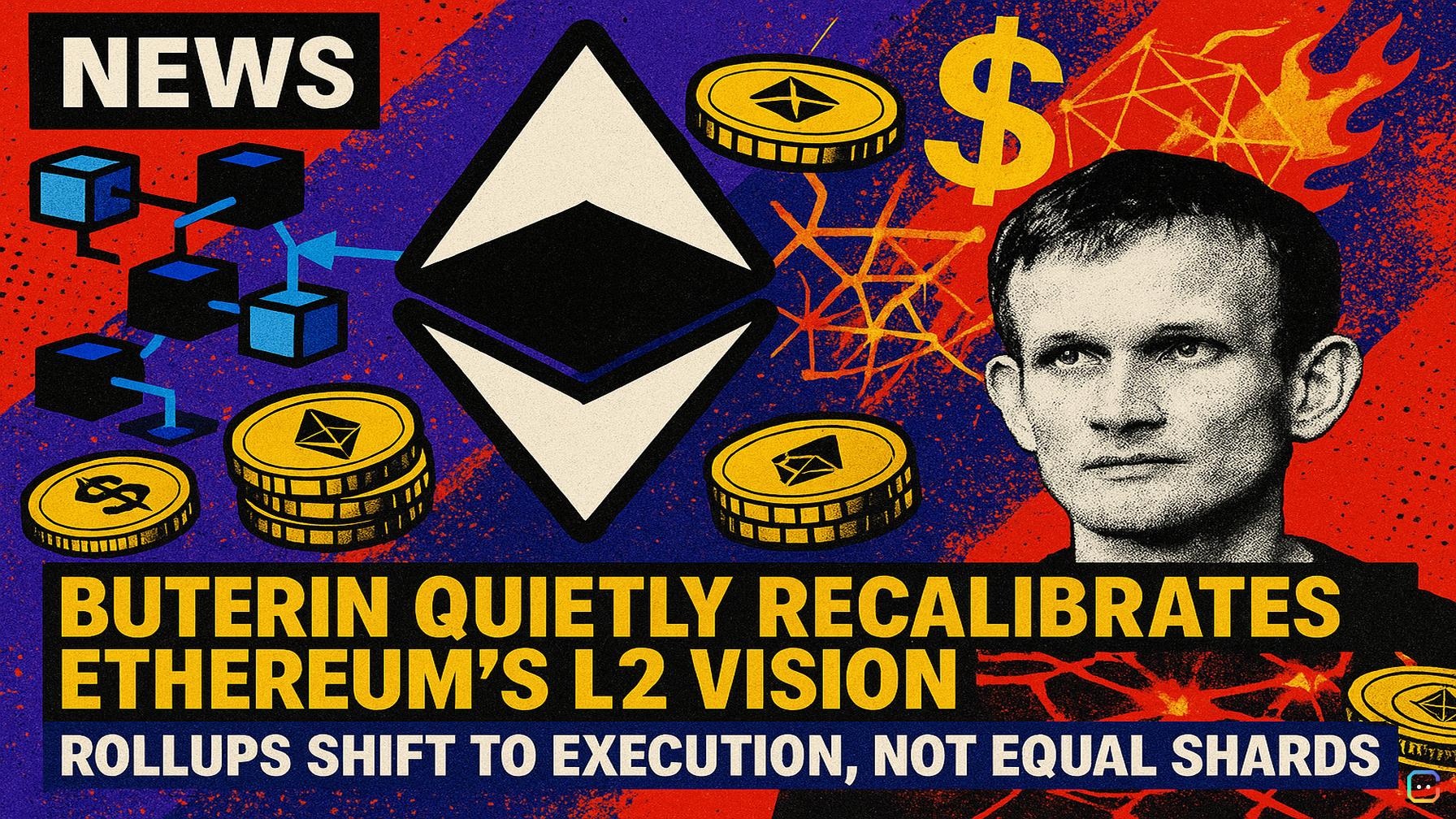
Vitalik Buterin is quietly recalibrating Ethereum’s layer-2 story — and the network data backs him up.
In a February 3 essay, Buterin said the original “rollup‑centric roadmap” no longer captures how Ethereum is evolving. That reassessment comes at the intersection of two trends: Ethereum’s base layer is scaling faster than many expected, while progress toward fully decentralized rollups has been slower. The result is a shift from treating every L2 as a near-equal “branded shard” of Ethereum toward a more pluralistic ecosystem where rollups serve different roles.
Key on‑chain signals
- Value secured: According to L2Beat, total value secured across Ethereum rollups is $40.3 billion — down 13.2% year‑over‑year. Value peaked near $50 billion in mid‑2025 and has trended lower into early 2026.
- Activity: By contrast, rollup usage has surged. Rollups are now processing roughly 3,470 user operations per second (UOPS), a sharp increase from near‑flat activity earlier in 2025. The uptick began around September 2025 and has largely been sustained.
What the divergence means
The gap between rising transaction volume and falling value secured suggests rollups are increasingly being used for cheap, high‑throughput execution — paying gas and moving data — rather than as places to custody large pools of capital under Ethereum’s L1 security. In short: rollups are winning on usability and cost efficiency, but many are not yet living up to the decentralization and security expectations of the original roadmap.
Why Buterin is rethinking L2s
Buterin points to several structural realities:
- Ethereum’s base-level gas fees have stayed low for extended periods, and core developers are preparing for meaningful gas‑limit increases in 2026. That reduces the pressure on L1 to offload block‑space via rollups.
- Numerous L2s face practical or regulatory constraints that prevent them from fully decentralizing. Some teams retain control over sequencing or upgrades for operational, compliance or safety reasons, which means treating every L2 as having the same social and security responsibilities as L1 is unrealistic.
Implications for the ecosystem
- A more diverse L2 landscape: Expect networks optimized for distinct tradeoffs — some focused on maximal security and decentralization, others on throughput, cost, or regulatory compliance.
- Changing user expectations: Developers and users may increasingly see many rollups as execution layers rather than safes for large on‑chain capital.
- Policy and design shifts: Ethereum governance and tooling will likely adjust to a world where not all L2s are equivalent — with clearer signaling about which rollups can be trusted for what.
Bottom line
Ethereum is moving from a one‑size‑fits‑all L2 vision toward a pluralistic stack: rollups will remain central to everyday activity, but their roles will be more differentiated as L1 capacity grows and decentralization timelines vary across projects.
Not investment advice.
Read more AI-generated news on: undefined/news