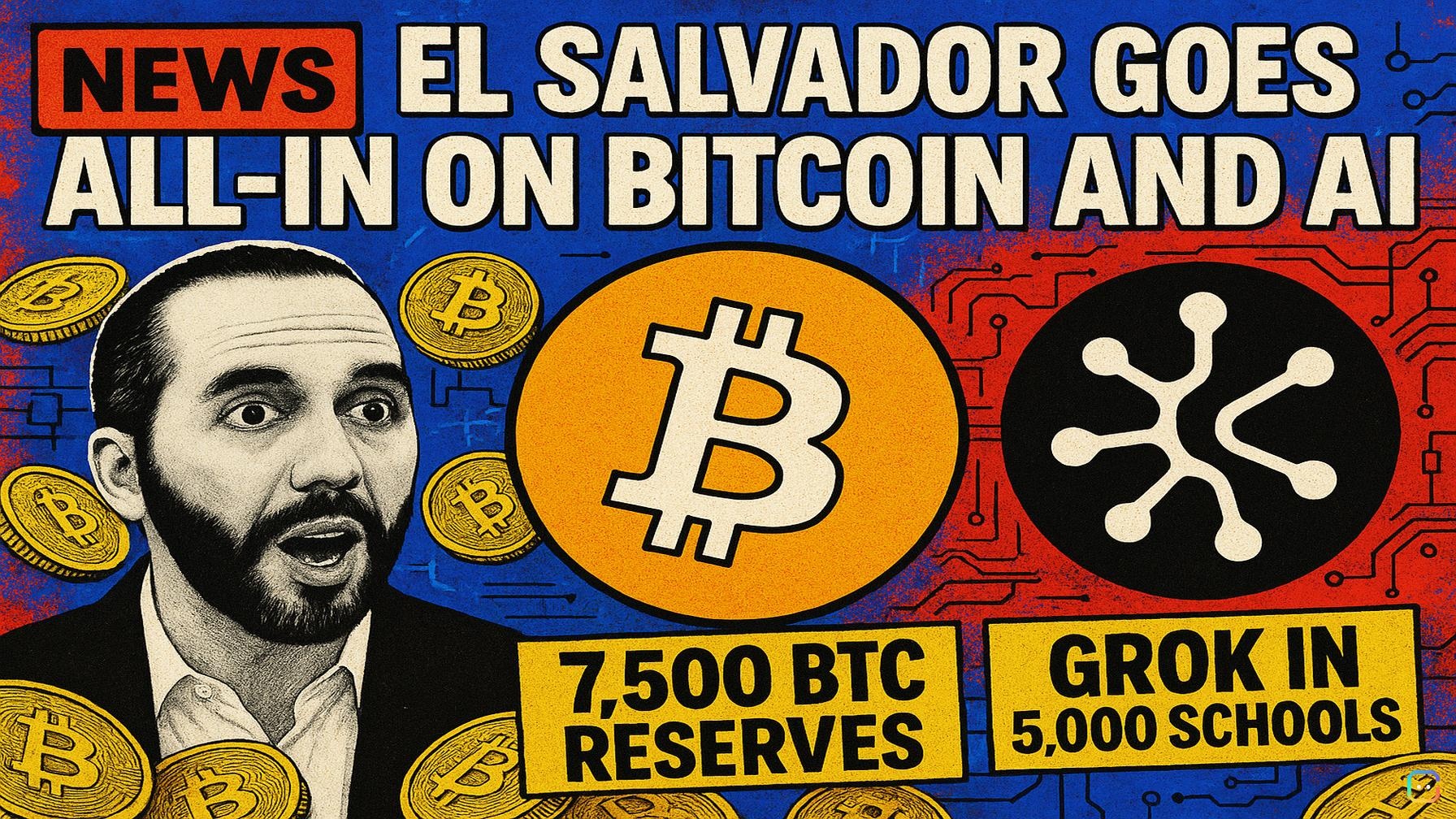
El Salvador kicked off 2026 by doubling down on a two-pronged technology bet: Bitcoin and artificial intelligence. On January 1, the country’s National Bitcoin Office declared it had gone “all-in” on Bitcoin and AI for the year — a signal that reflects years of deliberate policy, not a sudden pivot.
What El Salvador is doing
- Bitcoin: Since making BTC legal tender in 2021, El Salvador has continued to accumulate bitcoin through multiple market cycles. By late December 2025 the country’s holdings stood at roughly 7,500 BTC (around $660 million), according to BitBo. Notably, the government bought more than 1,000 BTC during the market weakness in November 2025, shifting from steady daily purchases to tactical accumulation amid volatility. Officials frame these holdings as long-term national assets—reserve infrastructure that supports monetary sovereignty and innovation—treating price swings as operational risk rather than policy failure.
- AI: In December 2025 El Salvador struck a high-profile partnership with Elon Musk’s xAI to roll out Grok across 5,000 public schools. The program targets more than one million students and thousands of teachers with an adaptive digital tutor aligned to national curricula, emphasizes localized datasets, and aims to build responsible AI frameworks. The initiative is part of a broader push to diversify the economy beyond remittances and tourism.
Economic context and IMF stance
El Salvador’s tech-first approach is taking place against improving macro conditions. The IMF has acknowledged stronger-than-expected economic growth and now appears less explicit in discouraging Bitcoin accumulation, while continuing dialogue on transparency and fiscal risk management. Rising remittances, steady investment, and these policies underpin projected GDP growth near 4% into 2026.
Why this matters beyond El Salvador
El Salvador’s strategy reframes Bitcoin from a speculative asset to an element of sovereign reserve infrastructure. Nation-state participation brings patient, large-scale demand and policy continuity—factors that could slowly alter Bitcoin’s supply dynamics if other countries adopt similar approaches. Coupling a fixed-supply monetary asset with AI-driven governance and public infrastructure programs also changes the narrative: rather than being displaced by new tech, rule-based, scarce monetary systems may become more attractive at the sovereign level.
Bottom line
El Salvador’s January proclamation is the latest chapter in a multi-year experiment: steady BTC accumulation, tactical buying during selloffs, and ambitious AI deployments for education. Whether this nudges other nations toward similar reserve strategies remains to be seen, but the country is betting that technology-led abundance—rather than scarcity-focused orthodoxy—will define its next economic phase.
Disclaimer: This content is informational and not investment advice. Cryptocurrency trading carries high risk; do your own research before making decisions.
© 2026 AMBCrypto.
Read more AI-generated news on: undefined/news