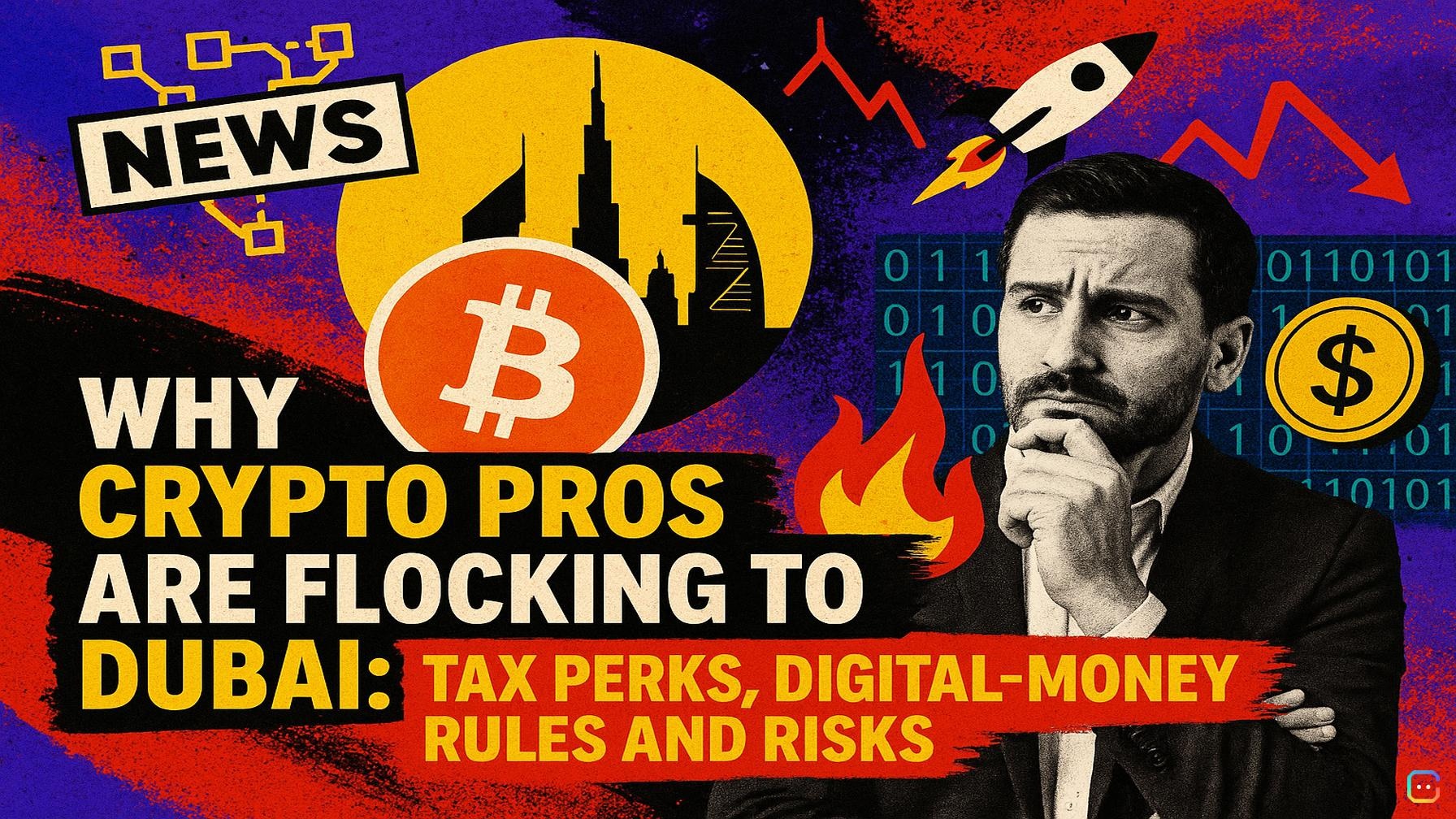
Headline: Why Crypto Pros and High-Flyers Are Flocking to Dubai — and What It Means for Digital Money
When Liverpool-born estate agent Aidan Doyle swapped the UK for Dubai three years ago, his annual pay jumped from about £30,000 to roughly £500,000 — a dramatic illustration of how the Gulf city has become a magnet for professionals, entrepreneurs and wealth worldwide. Doyle’s story is one of many that underlines why Dubai’s property boom and business-friendly ecosystem are drawing not just the ultra-rich but also middle-income migrants seeking rapid career and income gains.
A playground for money and mobility
Dubai — one of the seven emirates that make up the UAE — markets itself as a modern, efficient gateway between East and West. It offers an appealing package: no personal income tax, advanced digital infrastructure (including 5G), world-class hospitals, luxury real estate and a calendar of cultural and business events. That mix has attracted everyone from tech-savvy remote workers and social-media influencers to billionaires such as Lakshmi Mittal and Mukesh Ambani, who have bought multimillion‑dollar beachfront properties. High-profile sports stars, including Roger Federer and Cristiano Ronaldo, have also invested in Dubai real estate.
The numbers underline the scale of the rush. Knight Frank data show Dubai led global cities in Q4 for sales in the $2.5m–$10m bracket, ahead of New York, Los Angeles, Hong Kong and London. In the $10m+ tier, Dubai recorded 9,050 sales — outpacing New York (6,577) and London (3,089). The city’s population is expanding rapidly too, growing by roughly 200,000 people a year and reaching about 4 million residents.
Why it appeals to crypto and finance communities
For people in trading, investment and digital finance, Dubai’s combination of tax advantages, permissive residency routes and growing fintech ecosystem is especially attractive. During the pandemic the city became a hub for professionals working remotely, while its sunny backdrop helped it become a social-media darling. Residency can be obtained through property purchases or significant bank deposits — a pragmatic route for those who want a base to run businesses and manage global wealth.
Critics and risks
The city’s rise isn’t without controversy. Detractors accuse Dubai of tolerating illicit financial activity, including money laundering and permissive trading in cryptocurrency, in ways that would be unacceptable in London or New York. The UAE government disputes these accusations and points to law-enforcement actions such as last year’s deportation of Sean McGovern, a leader of the Kinahan organised-crime group, to Ireland — reportedly the first extradition of its kind between the two countries. At the same time, some members of the Kinahan family are believed to still live in Dubai, highlighting the challenges of policing cross-border criminal networks.
Regulation and the crypto angle
For the crypto community, one of the most consequential developments is the UAE’s effort to build regulatory frameworks around digital money. Economist Brunello Rosa, co-author of Smart Money, argues the UAE has recognised the need to structure digital currencies in layers — from central bank digital currencies at the base, to private‑institution-issued digital money, and finally cryptocurrencies — and has started to put rules in place where other jurisdictions are still catching up. That regulatory clarity is a draw for firms seeking a jurisdiction that balances innovation with oversight.
Investors and commentators point to Dubai’s deeper advantages too. Nigel Green of deVere describes the city as where trading, tax efficiency and forward-looking policy converge in a strategically located hub. “Capital follows energy like that,” he says.
Social and economic trade-offs
The rewards, however, come with trade-offs. Wages are highly skewed: top professionals can earn multiples of what most residents make, producing a disparity larger than in many European cities, according to Azad Zangana of Oxford Economics. Costs can be managed by living in less central suburbs, but long working hours, traffic congestion and summer heat that can reach 50°C remain common complaints. Some expats also say the intense work culture can offset the higher pay.
A real-estate market that keeps selling
Despite occasional chatter about bubbles or crashes, brokers like Doyle say demand outstrips supply. Dubai’s image sells itself: luxury property, business-friendly residency, and a lifestyle that combines modern amenities with easy travel to Europe and Asia. Doyle — now an Instagram influencer on real-estate investing — admits he misses the English countryside but says his three-year plan to return has evaporated as his business and life in Dubai continue to grow.
What crypto readers should watch
- Regulatory evolution: The UAE’s work on digital-money frameworks is a major development for crypto firms seeking clearer rules and a hospitable jurisdiction.
- Wealth inflows: High-net-worth migration and property investment keep liquidity and demand strong in luxury markets, which can influence local fintech and tokenization projects tied to real estate.
- Compliance spotlight: Ongoing concerns over money-laundering and organised crime mean compliance standards and enforcement actions will be key signals for international firms considering operations in Dubai.
Bottom line: Dubai’s combination of tax benefits, modern infrastructure and regulatory experimentation on digital money is making it a powerful magnet for global finance and crypto communities — but that attractiveness comes with scrutiny and real social trade-offs that investors and professionals should weigh carefully.
Read more AI-generated news on: undefined/news