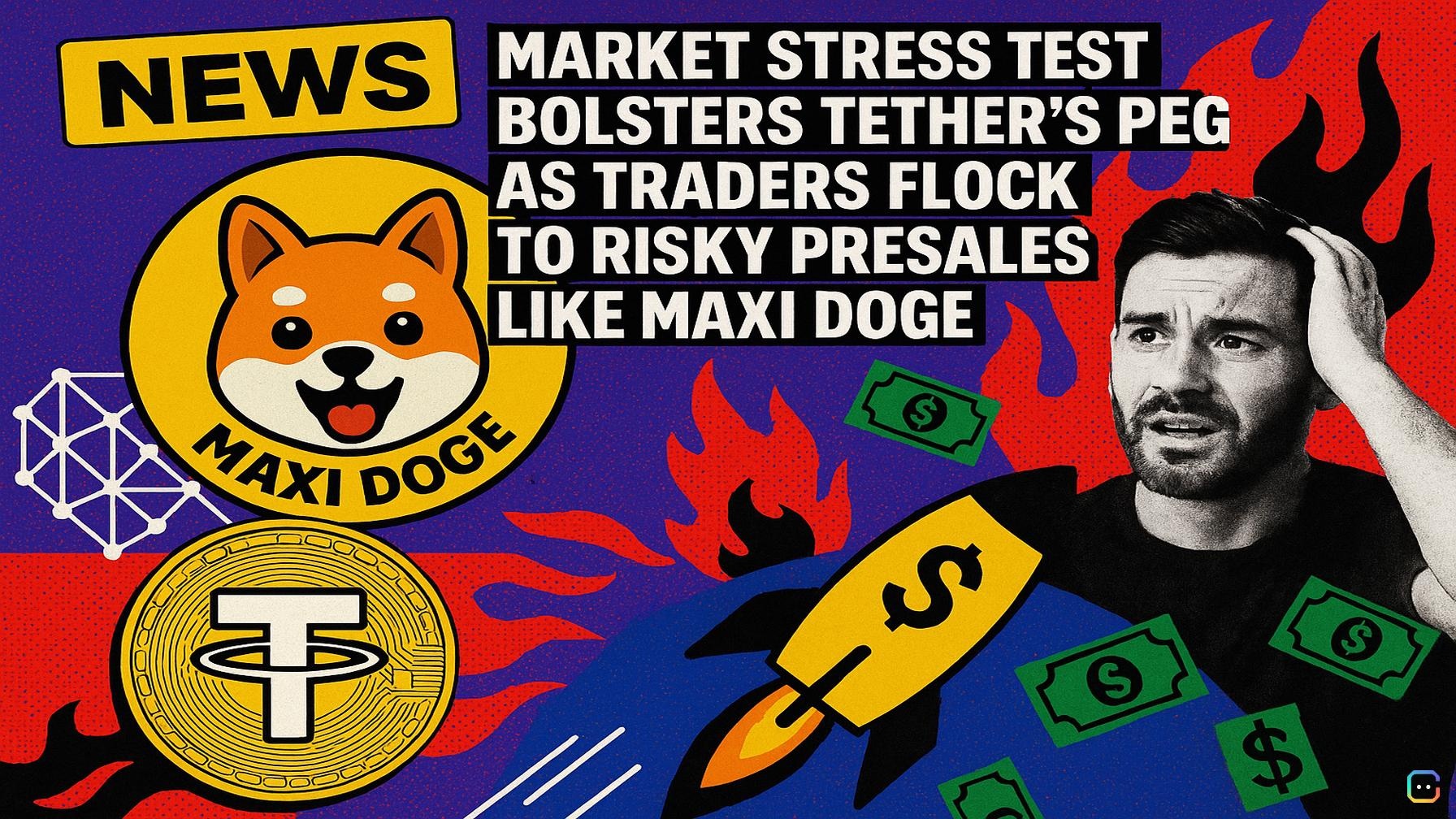
Headline: Market stress test shines spotlight on Tether’s peg — while some traders pivot into high-risk presales like Maxi Doge
The crypto market’s current downturn is acting like a stress test — separating fragile projects from those that can withstand severe liquidity pressure. Two clear themes have emerged: a massive flight to stablecoins, led by Tether (USDT), and a parallel tranche of risk-on activity as certain traders rotate into early-stage, high-upside tokens.
Tether as the market’s liquidity lifeboat
- As Bitcoin and Ethereum slide, trading volumes in USDT have surged, signalling traders aren’t exiting crypto entirely — they’re moving to the sidelines. Historically, this accumulation of stablecoins functions as “dry powder” that can fuel medium-term rallies when risk appetite returns.
- For a stablecoin, the key metric isn’t price appreciation but peg integrity and capitalization. Right now USDT is trading in a very tight band — roughly $0.9998 to $1.0002 — a range that suggests arbitrage bots are actively closing gaps and market mechanics are holding up.
- Tether’s ability to process very large daily redemptions without losing parity is being interpreted as a sign that market infrastructure has matured. The broader bullish thesis hinges on Tether’s market cap expanding even while risky asset prices fall — a divergence that creates a “coiled spring” of buying power for the next leg up.
Key risks and signals to watch
- Trust is the real technical resistance for USDT. If Tether can maintain the $1.00 peg throughout this correction, it will reinforce institutional confidence. Analysts are watching the USDT–USDC spread on centralized exchanges closely: a widening positive spread in favor of USDT would suggest it’s the preferred on-ramp for offshore leverage and dip-buying activity.
- Conversely, sustained weakness below $0.995 could trigger a broader secondary capitulation across markets.
Where the risk-on capital is going
- While conservative capital parks in USDT, on-chain analytics show some high-net-worth wallets are aggressively deploying into early-stage projects to capture outsized returns during the recovery. One prominent example is Maxi Doge ($MAXI), currently in presale.
- Project snapshot (as reported): Maxi Doge has raised more than $4.58 million in its presale, with presale tokens priced at $0.0002803. Etherscan records indicate two whale wallets recently moved significant sums into the project — roughly $314K each, totalling about $628K.
- The team markets the project with a “Leverage King” culture aimed at retail traders who treat volatility as opportunity rather than risk. Features cited by the project include holder-only trading competitions and a “Maxi Fund” treasury intended to support ongoing marketing — a common strategy used to sustain attention in the meme-token space.
Risk profile and final take
- Maxi Doge represents the high-beta end of the spectrum: attractive for traders seeking leverage-style returns without using derivatives, but carrying all the liquidity and execution risks of unlisted, early-stage tokens. It’s the kind of asset where outsized gains are possible — and outsized losses are too.
- The broader narrative is straightforward: stablecoins like USDT are currently preserving liquidity and signaling potential buying power; a smaller, more aggressive cohort is reallocating that capital into presales and meme-style tokens in anticipation of the market rebound.
This article is for informational purposes only and is not financial advice. Crypto markets are volatile; always perform your own due diligence before investing.
Read more AI-generated news on: undefined/news