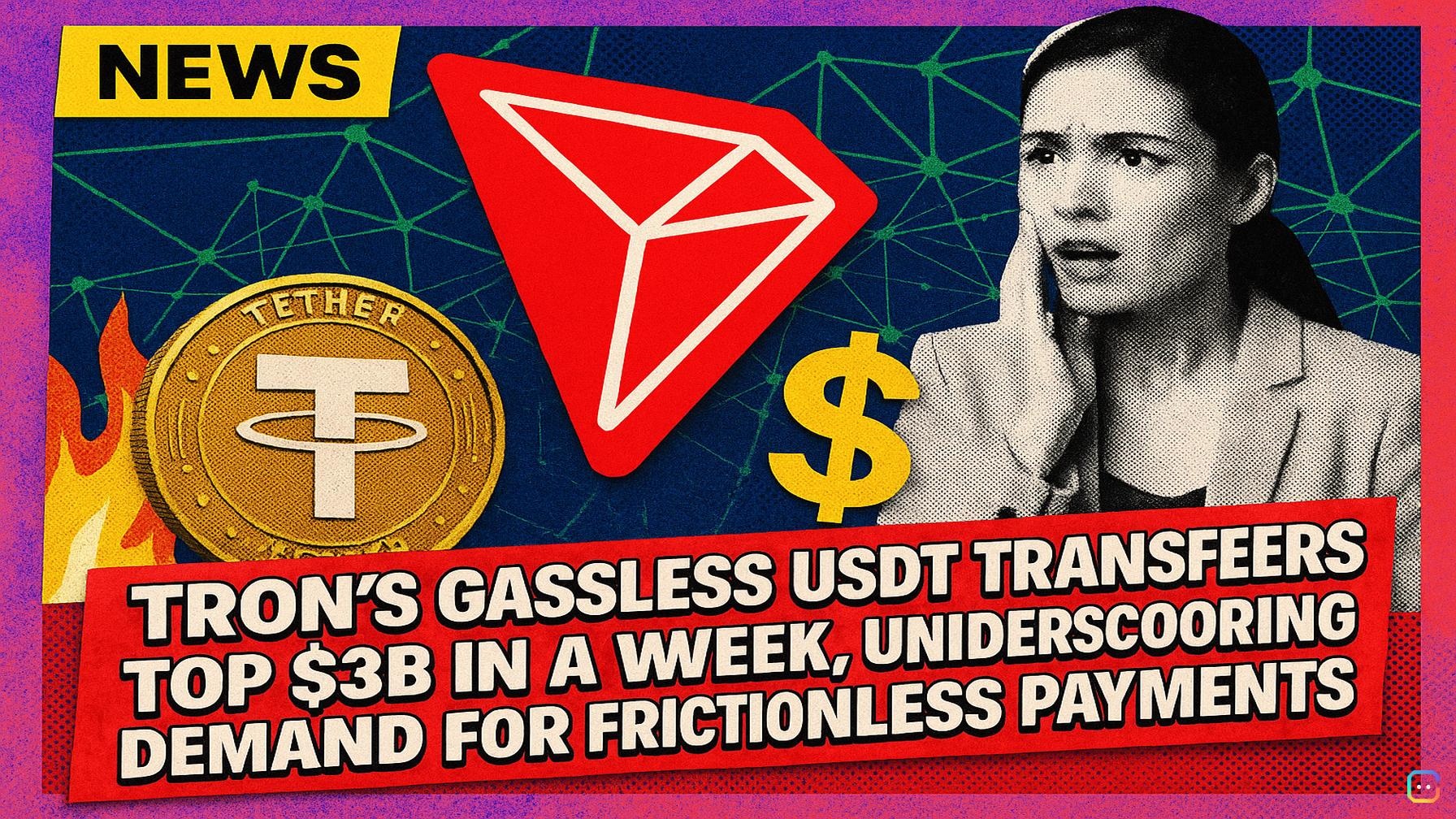
Headline: TRON’s gasless USDT transfers top $3 billion in a week, underscoring demand for frictionless stablecoin payments
TRON’s gasless USDT transfer volume hit roughly $3 billion over a seven-day period, highlighting strong appetite for stablecoin rails that remove the need for users to hold a native gas token. That figure measures active settlement volume—the value moving through gasless transfers—not total value locked (TVL) in TRON protocols. The distinction is important: this is about money flowing, not capital sitting idle in DeFi.
How gasless transfers work
TRON’s gasless model lets users send USDT without manually holding TRX to pay network fees. Transaction costs are abstracted away or handled as part of the transfer flow (for example, by relayers, wallets, or deducting fees differently depending on implementation). It doesn’t mean the network has no costs—those still exist—but the user experience is cleaner, and that matters a lot for payments.
Why it matters for stablecoin use
For people moving dollars on-chain—remittances, merchant payments, treasury moves, exchange settlements, market-making flows—stopping to buy a separate token just to send a stablecoin is a major UX hurdle. Gas abstraction transforms that interaction to feel more like traditional payments, where consumers don’t worry about the plumbing behind a transfer.
TRON’s role as a payments rail
TRON has emerged as a leading network for USDT movement thanks to low fees, broad exchange support and deep USDT liquidity. It may not always capture the same developer hype as Ethereum, Solana or newer L1s, but for stablecoin settlement it’s become a practical workhorse. The cumulative gasless transfer volume—now above $114 billion—shows this is not a niche pilot in a few wallets but a substantial transaction rail.
Transfer volume vs TVL: don’t conflate the metrics
Transfer volume reflects how much value is moving through a network; TVL measures how much value is locked inside protocols. TRON’s surge in gasless USDT transfers supports the payments narrative—stablecoins moving cheaply and smoothly—not necessarily a claim about DeFi capital being locked on the chain. Supply, transfer volume, transaction counts, active addresses, TVL and exchange balances each tell different parts of the story; mixing them up leads to misleading conclusions.
Broader trend: gas abstraction across chains
TRON isn’t alone in pursuing easier stablecoin transfers. Sui, BNB Chain, Solana, Ethereum Layer 2s and others are building sponsored transactions, gas abstraction and payment-specific flows because stablecoins are among crypto’s most tangible, real-world products. If digital dollars are to be used regularly, the experience must be seamless.
What to watch next
The key question is adoption: will more wallets, merchants and payment platforms build on TRON’s gasless model? If they do, fee abstraction could become a baseline expectation for stablecoin networks, and users may stop asking which token pays gas—they’ll simply expect transfers to work.
Data and credits
This report is based on TRON and Tronscan stablecoin transfer data and primary source disclosures. Written by the News Desk; edited by Samuel Rae.
Read more AI-generated news on: undefined/news