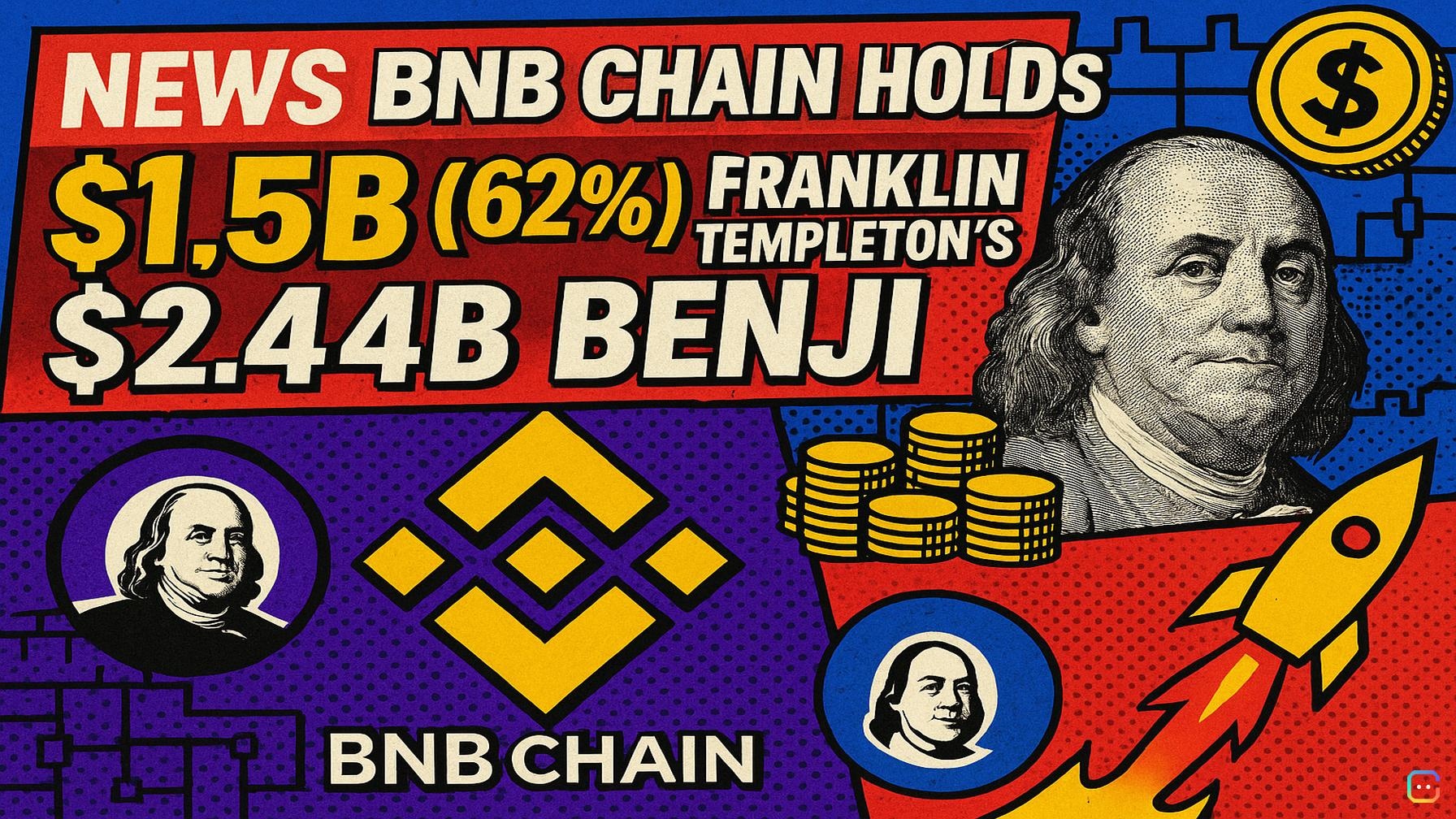
BNB Chain has emerged as the largest on-chain host for Franklin Templeton’s Benji tokenized money market fund, signaling a meaningful shift in where institutional real-world assets (RWA) are settling.
Key facts
- Benji’s total assets under management: $2.44 billion.
- Assets on BNB Chain: about $1.5 billion — roughly 61.7% of Benji’s AUM.
- Stellar holds roughly $573 million; Ethereum holds about $159 million.
(Source: Franklin Templeton Benji platform disclosures / primary documentation.)
Why this matters
This isn’t Franklin Templeton abandoning Ethereum or Stellar — Benji is explicitly multi-chain — but the distribution is revealing. BNB Chain now hosts the single largest share of these tokenized institutional assets, which is a notable institutional signal for a network often associated with retail trading, exchange-linked liquidity, and low-cost DeFi.
RWA are moving beyond theory
Tokenized treasuries, money market funds, private credit and similar products are becoming concrete bridges between traditional finance and blockchains. Once assets go on-chain, the choice of settlement layer matters: fees, throughput, execution reliability, custody integrations, tooling, compliance, and liquidity all shape the business case for issuers and institutional users.
Why BNB Chain gained ground
BNB Chain’s low transaction costs and high throughput make it attractive for asset flows that require frequent transfers, settlement, or reconciliation. For institutional tokenized products, those operational costs can add up — so “cheap” is meaningful beyond retail convenience. That said, cost is only one factor: security, compliance readiness, custody support, and ecosystem liquidity remain essential.
A reminder about multi-chain reality
The data should not be oversimplified into “Franklin Templeton left Ethereum/Stellar.” Benji continues to operate across multiple networks. The more accurate takeaway is that institutional tokenized assets are likely to remain multi-chain: different issuers, investors, custody partners, and regions will favor different settlement environments. Ethereum’s liquidity, Stellar’s payments focus, and BNB Chain’s low fees each have roles to play.
Implications for BNB Chain and the wider market
- Credibility boost: Hosting substantial Franklin Templeton assets gives BNB Chain an institutional narrative beyond retail DeFi.
- Infrastructure pull: Serious assets often attract tooling — custody, compliance, stablecoin and yield products — which can deepen ecosystem growth.
- Not a sure thing: This concentration doesn’t automatically move token prices, guarantee other issuers will follow, or create instant DeFi composability around these assets. RWA balances can shift as conditions change.
Bottom line
BNB Chain’s position as the largest current host of Benji assets is a useful, concrete data point in the RWA story. It shows institutional tokenized assets can and do gravitate toward networks that offer the right mix of cost-efficiency, infrastructure, and distribution — and that the competition for RWA settlement is a multi-chain race, not a winner-take-all sprint.
This report is based on Franklin Templeton Benji platform disclosures. Written by the News Desk; edited by Samuel Rae.
Read more AI-generated news on: undefined/news