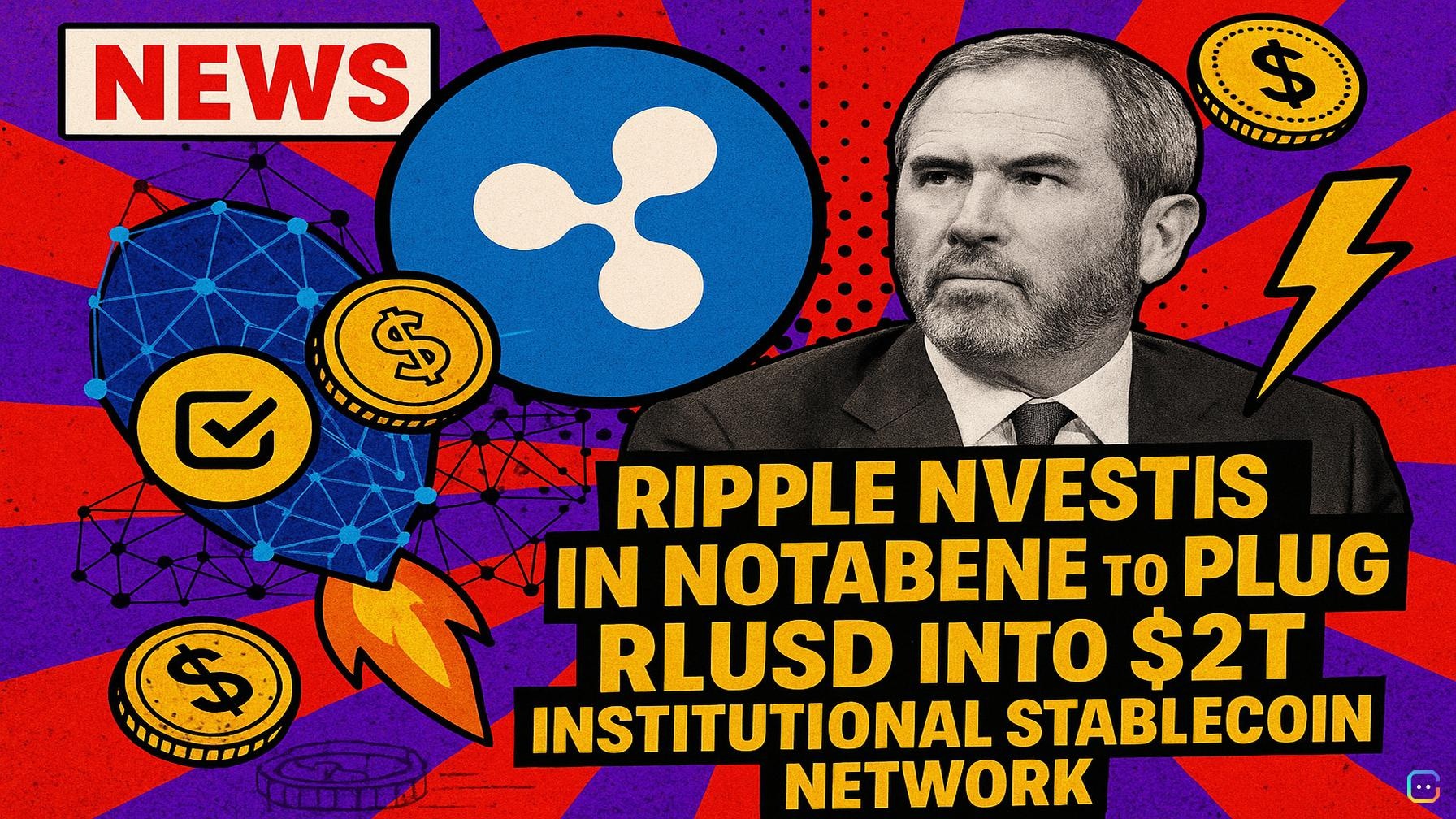
Ripple makes a strategic play to bring its RLUSD stablecoin into a $2 trillion institutional payments network through a new deal with compliance provider Notabene.
The companies announced an undisclosed Ripple investment in Notabene and a commercial pact to integrate Ripple USD (RLUSD) into Notabene Flow, the latter’s business-to-business stablecoin payments platform. Notabene says its network already connects regulated digital-asset firms that together process more than $2 trillion in annualized transaction volume — giving RLUSD a rapid route into one of the largest institutional rails for stablecoin payments.
What the deal does
- Notabene will add RLUSD to Notabene Flow, making the stablecoin available across its regulated institutional network.
- The two teams will also explore “trusted payment authorization” features to support Ripple Payments, aiming to enable institutions to approve transactions while preserving compliance and operational controls.
- Ripple’s investment gives it access to Notabene’s regulated counterparty connections without acquiring the company; the stake size was not disclosed.
Compliance-first pitch
Notabene positions itself as removing a central barrier to corporate stablecoin adoption: transactional uncertainty. CEO and co-founder Pelle Braendgaard said institutions need clear answers on who they’re paying, why, and how payments can be authorized within their risk controls. Notabene’s infrastructure, he argued, supplies identity, purpose and approval signals through links to regulated institutions — and paired with an enterprise-ready stablecoin like RLUSD, can help move programs out of pilot mode into production at scale.
Ripple emphasized the same point. Jack McDonald, SVP of Stablecoin at Ripple, framed Notabene as part of the compliant plumbing institutions require to move money internationally: “Together we’re helping build the compliant infrastructure institutions need to move value at global scale while expanding the utility of RLUSD,” he said.
Regulatory and market backdrop
The partnership arrives as Ripple expands regulated access for RLUSD in Europe. On July 18, the European Securities and Markets Authority (ESMA) updated its Markets in Crypto-Assets register to list Ripple Payments Europe SA as an authorized crypto-asset service provider — a status Ripple says enables its European payments arm to offer crypto services across 29 EU countries. That follows Ripple’s earlier MiCA authorization in Luxembourg and its existing electronic money institution license there, which together let the company provide crypto asset and stablecoin payment services to banks, fintechs and corporates via a single integration.
In the U.S., Ripple is also pushing for clearer federal rules. CEO Brad Garlinghouse backed Chief Legal Officer Stuart Alderoty’s appeal on July 22 for Congress to pass the Digital Asset Market Clarity (CLARITY) Act, arguing it would strengthen AML/KYC standards and give regulators clearer powers — a legal framework Ripple says would boost institutional confidence in moving larger flows of digital assets.
Broader interest in RLUSD
RLUSD has drawn additional attention beyond Notabene: the stablecoin’s renewed interest coincides with initiatives such as BNY Mellon’s plan to build a 24-hour settlement system for the U.S. Treasury market, though that effort is separate from the Notabene integration.
Bottom line
The Ripple–Notabene tie-up is a compliance-first push to scale regulated stablecoin payments at institution-level volumes. For Ripple, it’s a fast route into an already-large network without an acquisition; for Notabene, it’s a way to offer its clients an enterprise-ready stablecoin option as regulated firms move from pilots toward full production.
Read more AI-generated news on: undefined/news