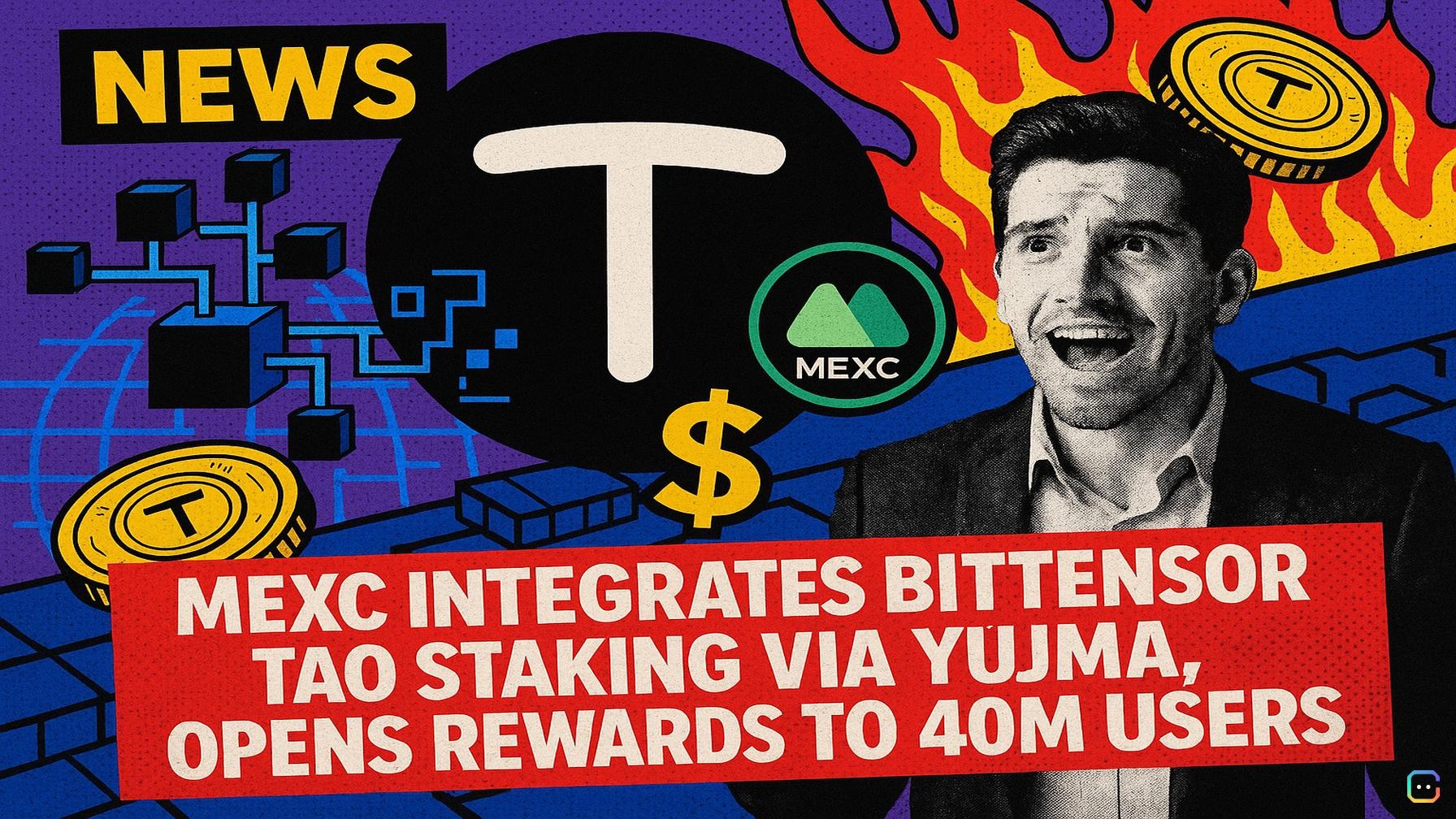
MEXC has added Bittensor’s TAO staking to its platform, giving the exchange’s reported 40 million users a simpler route to earn rewards from one of the largest decentralized AI networks. The integration is powered by validator operator Yuma, which will run the validator infrastructure while MEXC delivers the customer-facing staking product.
What this means for users
- MEXC customers can now delegate TAO without moving tokens to a dedicated Bittensor-compatible wallet or manually selecting a validator on-chain.
- The service is live across MEXC’s user base, which the exchange says spans 170+ countries and lists more than 3,000 cryptocurrencies across spot and derivatives markets.
How the underlying system works
- Bittensor uses TAO as its incentive and staking token. Holders delegate TAO to validators, which then use that stake to take part in the network’s consensus and to allocate token emissions across “subnets.”
- Subnets are specialized markets for digital services such as machine-learning inference, model training, compute, storage and prediction systems. Validators evaluate miner outputs across subnets and assign weights that influence how TAO emissions are distributed.
- Bittensor’s documentation says this competitive, market-like mechanism — sometimes referenced in network descriptions as Yuma Consensus — is intended to align incentives between token holders, validators and miners. The network currently lists 128 subnets offering services that range from AI inference to coding assistants and financial modeling.
What Yuma’s role includes
- Yuma will handle validator operations for TAO staked via MEXC, performing the assessments and stake allocations that determine reward distributions. The announcement did not disclose expected annual yields, lock-up periods or minimum staking amounts for the exchange product.
- It’s also unclear whether users staking through MEXC will gain direct exposure to individual subnet Alpha tokens; MEXC and Yuma identified the offering specifically as TAO staking with Yuma providing the validator connection.
Context and recent market moves
- TAO traded near $199 at the time of the announcement, giving Bittensor an approximate market capitalization of $1.91 billion — placing the token among the larger crypto assets tied to decentralized AI.
- The integration comes amid governance tensions inside Bittensor. Yuma publicly criticized a proposed governance overhaul called “Root Reborn,” arguing during TAO’s June price pullback that the plan could transform validators from neutral operators into active capital managers and potentially invite collusion, frontrunning and preferential treatment. Supporters see Root Reborn as a response to structural pressures in the token economy; critics warn of concentrated governance power, liquidity stress and regulatory risk.
- TAO experienced a sharp June correction: it peaked near $283 on June 15 and fell roughly 20% to about $225 by June 19 as governance concerns, derivatives liquidations and weaker risk appetite weighed on the market. Despite its objections to the Root Reborn proposal, Yuma has continued to serve as a validator and now helps connect millions of exchange accounts to Bittensor’s reward system.
Why it matters
The MEXC–Yuma integration lowers the onboarding friction for mainstream exchange users to participate in Bittensor’s staking economy, potentially broadening the pool of staked TAO and increasing network participation. But key details on yields, lockups and Alpha-token exposure remain unspecified, and the unresolved governance debate could shape how validators operate and how rewards are distributed going forward.
Read more AI-generated news on: undefined/news