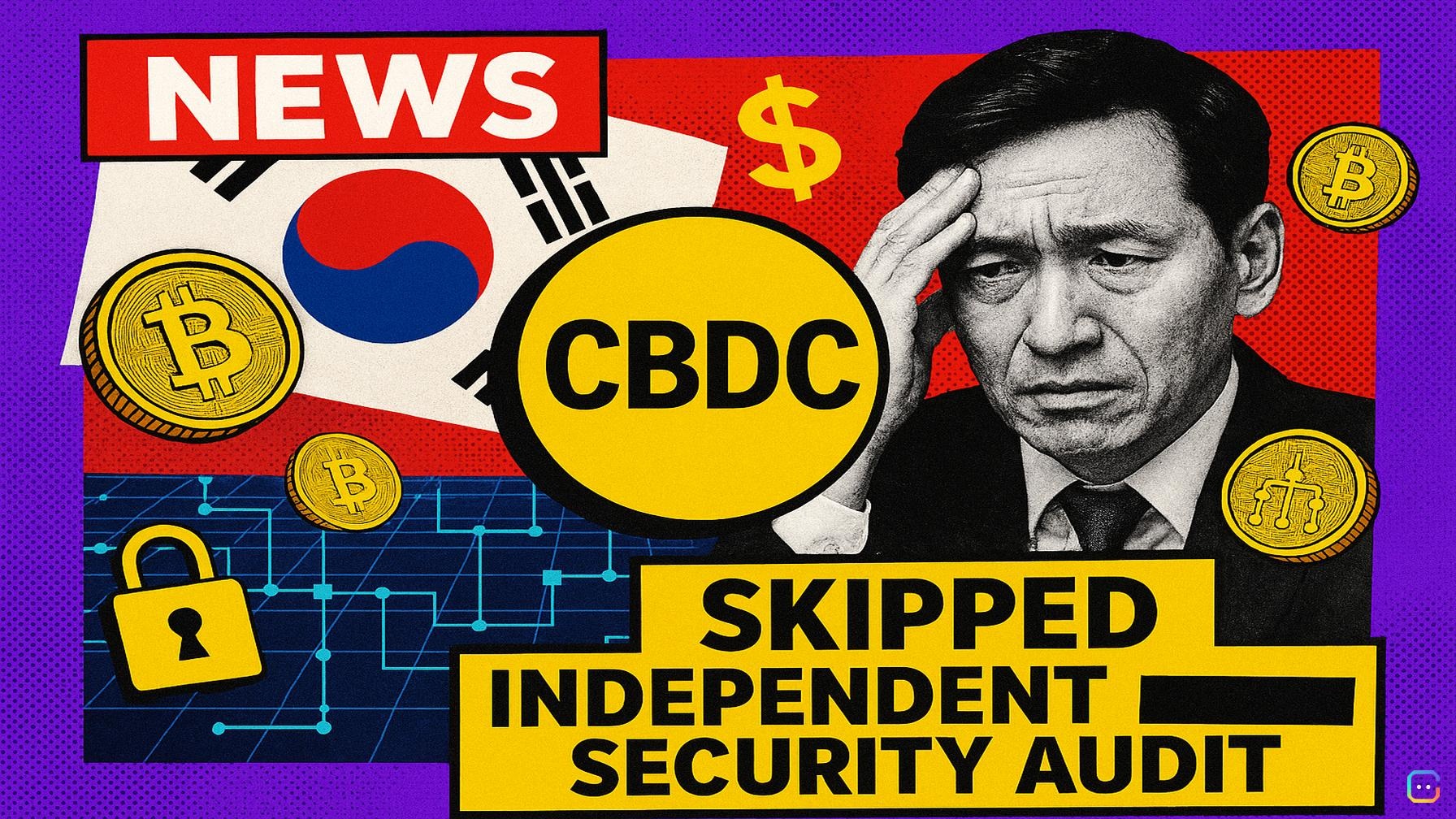
Headline: South Korea’s CBDC Pilot Skipped Independent Security Audit, Raising Questions About Oversight and Trust
South Korea’s first retail central bank digital currency (CBDC) pilot moved ahead without any independent government security inspection, according to reporting by Maeil Business based on documents from the Financial Supervisory Service (FSS). That revelation has reignited debate about oversight, audit independence and the credibility of early CBDC experiments as Seoul balances public-sector digital money with a growing private stablecoin push.
What happened
- The Bank of Korea’s initial CBDC pilot—Project Han River, which ran April–June last year—did not undergo a separate, external government security audit after testing, Maeil Business found.
- Pre-launch security work in February consisted of an IT security review and vulnerability checks that relied partly on self-inspection teams from participating banks (Woori Bank and NongHyup Bank), the Financial Security Institute and cybersecurity firm SK Shields.
- Maeil says the submitted documents show no evidence that outside auditors carried out independent inspections either during or after the pilot.
Bank of Korea response
- The central bank has defended its approach, saying extensive security reviews were completed before launch and that additional inspections were unnecessary. It framed the process as compliant with supervisory procedures set by the FSS.
- In its public write-up on the pilot, the Bank of Korea disputed claims that “deposit tokens” used in testing were vulnerable to IT security risks—yet critics say the bank chiefly relied on its own assessments rather than independent third-party verification.
Why this matters
- The pilot tested infrastructure that could form part of South Korea’s future payments backbone. When participants help assess the very systems they tested, observers argue that objectivity and market confidence are weakened.
- Maeil flagged limited supervisory coordination: the FSS records show only one formal CBDC-related consultation between banks and regulators in the past three years (Shinhan Bank on an insurance product tied to deposit tokens). Banks also reportedly lack dedicated teams for CBDC and deposit-token supervision.
Industry reaction
- An unnamed industry source told Maeil that real-world CBDC trials should not only validate tech but also build public trust. Independent security verification and post-pilot external audits would strengthen that credibility.
Policy context and next steps
- Project Han River involved seven commercial banks and had planned Phase 2 features like peer-to-peer transfers and merchant payments. Bloomberg reported in June 2025 that the Bank of Korea paused prep for Phase 2 after banks raised concerns about implementation costs and unclear commercial models.
- Regulators are increasingly shifting attention to privately issued, won-backed stablecoins and the legal frameworks needed to govern them—most notably under the proposed Digital Asset Basic Act.
- Government action continues on multiple fronts: Gyeonggi Province launched South Korea’s first government-backed blockchain stablecoin pilot (scheduled August through February 2027), and on July 19 central authorities released a roadmap including measures to make the won freely convertible and to legislate won-backed stablecoins. The roadmap—prepared by the Financial Services Commission, Bank of Korea, FSS and Korea Securities Depository—also mentions expanded institutional CBDC pilots (tokenized government bonds, deposit tokens) and participation in the BIS’s Project Agora for cross-border payment infrastructure.
Technical distinction
- The Bank of Korea emphasizes that deposit tokens are different from privately issued stablecoins. Under the central bank’s vision, deposit tokens would represent commercial bank deposits on blockchain layers built atop the wholesale CBDC system, with potential uses such as government subsidies, public vouchers and other digital payment services.
Bottom line
The absence of an independent post-pilot security audit has left a gap between technical testing and public assurance. As Seoul pivots between central-bank and private digital currency initiatives, calls for transparent, external verification—alongside clearer regulatory coordination—are likely to grow louder from industry stakeholders and the broader crypto community.
Read more AI-generated news on: undefined/news