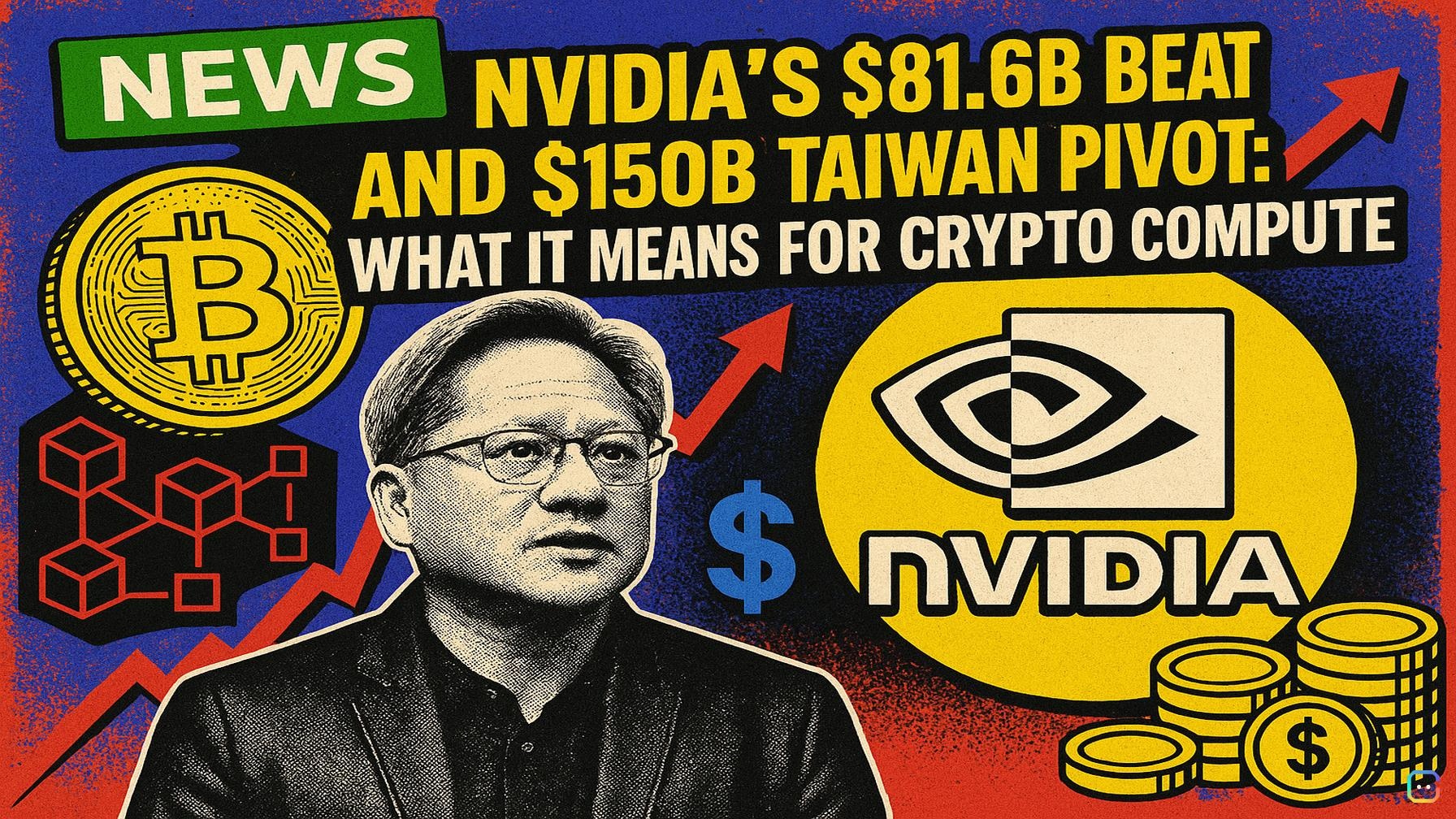
Nvidia’s rally isn’t just momentum — it’s fueled by jaw-dropping results and an aggressive pivot into Taiwan that matters to crypto investors watching compute infrastructure.
Quick take
- Nvidia posted $81.6 billion in quarterly revenue (reported May 20, 2026), up 85.23% year-over-year, with non-GAAP gross margin at 75%.
- Data Center revenue was $75.25 billion, up 92%; networking surged 199%.
- Free cash flow: $48.55 billion for the quarter and $96.58 billion for the fiscal year.
- EPS beat: $1.87 vs. $1.77 expected — the 12th straight quarter of beats.
- Market price: $202.81 (at time of writing); consensus 12-month target ~ $305 (about 50% upside). Over 90% of analysts rate NVDA Buy/Strong Buy; targets range from $180 to $500.
Why crypto traders should care
Nvidia’s chips are a backbone for large-scale AI compute and increasingly for decentralized projects that need massive off-chain computation (ML inference, L2 rollups with ML optimizations, on-chain data indexing, zk-proof generation accelerators, etc.). Strong top-line growth and enormous cash generation mean more supply of high-end accelerators, expanded global infrastructure, and continued enterprise demand — all factors that can indirectly affect token projects and protocols that rely on large-scale compute providers.
China risk — real and priced
The headline growth came with a catch: Nvidia shipped zero H20 Data Center compute units to China this quarter (compared with $4.6 billion a year ago), and Q2 guidance assumes none as well. Hyperscalers make up roughly half of Data Center revenue, so customer concentration and the China exposure are meaningful risks. Still, Nvidia managed an $81.6B quarter and guided to $91B for Q2 with China effectively sidelined — a notable proof of resilience.
Taiwan bet: $150 billion annually and a new HQ
Nvidia announced plans to invest $150 billion annually in Taiwan and open a new headquarters there by 2030. CEO Jensen Huang framed Taiwan as central to the AI revolution: “Taiwan is the epicentre of the AI revolution. This is where the chips come, packaging comes, this is where the systems are made, this is where AI supercomputers were created. The number of partners we work with here in Taiwan, incredible.” For markets, that’s a signal of supply-chain prioritization and long-term capacity expansion — relevant to both AI and any blockchain projects relying on geographically dispersed compute.
Valuation vs. growth
Nvidia’s trailing P/E is about 31.06 and PEG roughly 0.59, suggesting to bulls that the stock still trades like a “normal” chip name despite hypergrowth. Analysts’ targets and the wide $180–$500 spread reflect disagreement mainly over how much the China exposure should drag valuations down.
Shareholder returns and capital allocation
- Dividend raised from $0.01 to $0.25 per share on May 18, 2026 (yield ~0.49%).
- Board authorized $80 billion in new buybacks on top of $38.5 billion remaining.
- Net income for the quarter: $58.32 billion; the company returned $20 billion to shareholders in three months.
Outlook
Guidance and supply commitments are aggressive: Q2 guidance of $91 billion is backed by $119 billion in supply commitments, and analyst projections shown by Nvidia imply growth into 2027 even as comps get harder. The company is also driving long-term projects — Vera Rubin ramp, sovereign AI builds in the UK, Germany, France, South Korea, India, and the Taiwan HQ — suggesting the story extends far beyond a single earnings cycle.
Bottom line for crypto readers
Nvidia’s dominance in high-performance AI compute and its huge cash generation make it a systemic player for industries that depend on raw compute — including many crypto-native projects increasingly requiring off-chain AI and heavy parallel processing. The near-term wild card is China exposure: if that remains restricted, some upside may be capped; if it reopens materially, upside could be much larger. Either way, Nvidia’s scale and capital deployment are reshaping compute markets that crypto protocols increasingly inhabit.
Read more AI-generated news on: undefined/news