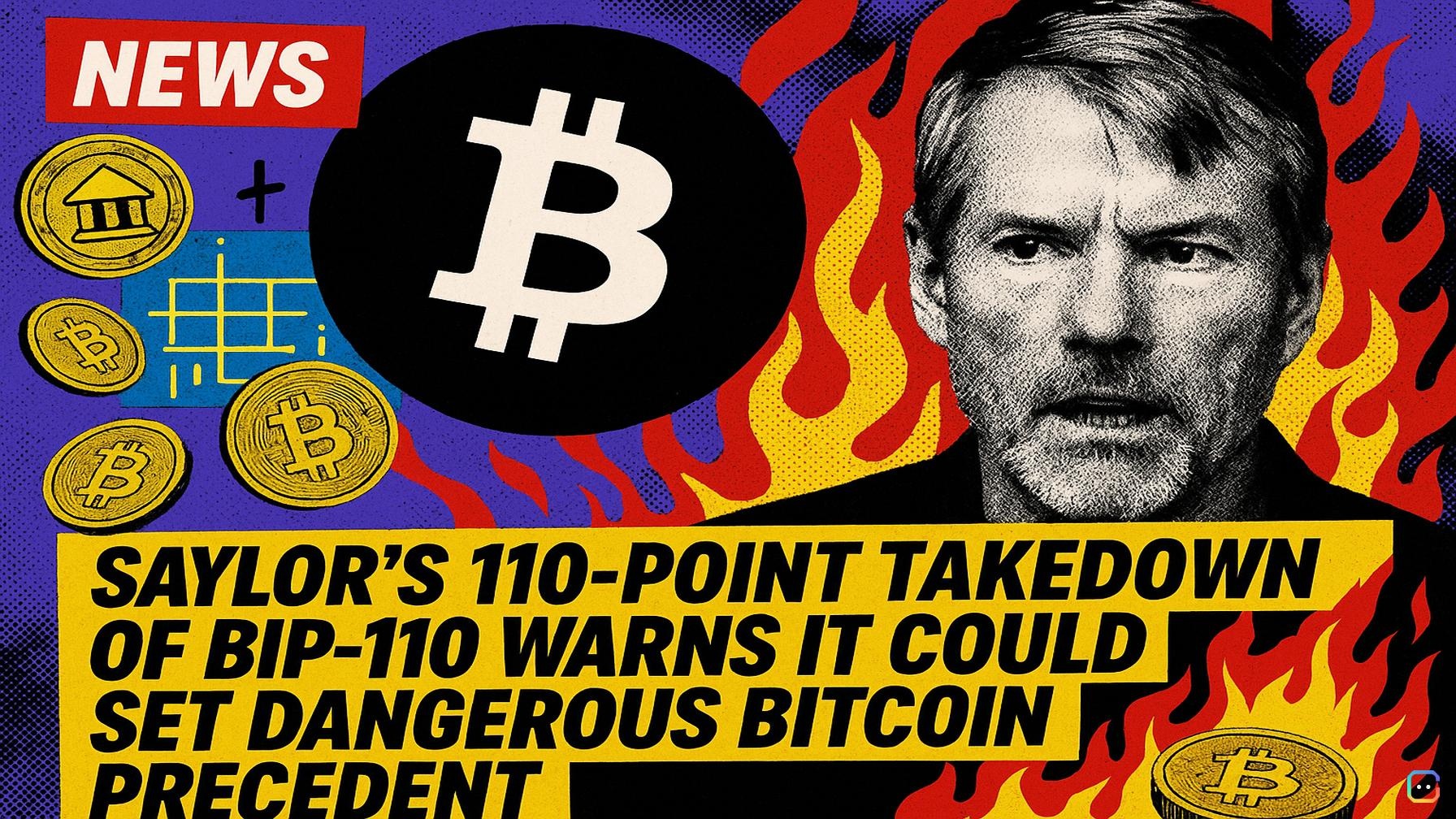
Michael Saylor publishes 110-point rebuttal to BIP-110, warns of dangerous precedent
Michael Saylor has taken his opposition to BIP-110 public with a detailed 110-point essay arguing the proposal would do more harm than the perceived problem it seeks to fix. In a post titled “110 Reasons BIP 110 Is a Bad Idea,” the Strategy executive chairman frames his critique as a defense of “neutral rules, hard consensus, open markets, and permissionless innovation,” saying he supports goals like cheap validation and affordable payments but rejects BIP-110’s remedy.
What BIP-110 would do
BIP-110 is a soft-fork proposal that would, for roughly a year, tighten Bitcoin’s consensus rules to limit techniques used to embed arbitrary data in transactions — the inscriptions and Ordinals that have increasingly occupied block space and pushed fees higher since 2023. Backers, including developer Luke Dashjr and the Bitcoin Knots camp, cast it as an anti-spam measure. Critics warn it could reject valid transactions and risk a network split.
Saylor’s central objections
- Precedent over patchwork fixes: Saylor’s chief concern is precedent. Bitcoin, he argues, “cannot read intent” — the network cannot distinguish whether bytes are an image, a proof, a contract, or the basis for a future app — so rules that ban certain encoding methods will also block legitimate uses. “Spam is not a consensus primitive,” he writes; mere disapproval of a use is not the same as invalidity.
- Slippery slope for future restrictions: He warns changing consensus to police one contested use sets a template others could reuse against privacy tools, new custody models, stablecoin settlement or token systems. The restrictions would expire after about a year, he notes, but the precedent “does not.”
- “Iatrogenic” harm: Saylor labels BIP-110 a “Bitcoin Iatrogenic Proposal” — borrowing the medical term for treatments that cause harm — because he believes the cure could be worse than the disease.
Activation design and network risk
Saylor also attacks BIP-110’s activation mechanics. The proposal lowers the miner-signaling threshold to 55% (from the roughly 95% used in past soft forks) and removes the usual option for a proposal to quietly expire. Signaling has been running below 1% according to the proposal’s monitoring dashboard, far short of the 55% bar, and Saylor warns that mismatches between signaling and enforcement “can divide the network.”
A fight over Bitcoin’s character
Framing the debate as a question of identity, Saylor argues Bitcoin’s resilience stems from neutral rules and hard consensus that contain disagreement, not from guardians policing purity. “Bitcoin does not need guardians of purity. It needs guardians of neutrality,” he writes.
Where the industry stands
Saylor’s stance aligns him with Blockstream CEO Adam Back, Casa’s Jameson Lopp, and Bitcoin advocate Samson Mow — all of whom have pushed back on BIP-110 — placing them in opposition to Dashjr and the Bitcoin Knots camp.
Timing and market context
BIP-110’s mandatory signaling window opens in August, with activation targeted around September 1 if thresholds are met. Saylor’s manifesto arrives as Strategy shifts its corporate posture: the company has moved from a “never sell” Bitcoin policy to “active capital management,” pausing additional BTC purchases while building a $3 billion cash reserve to cover stock dividend payments and debt interest. Strategy CEO Phong Le has said the firm won’t worry about its debt unless Bitcoin fell into the $8,000–$10,000 range. On prediction market Myriad, users now put just an 8% chance on Strategy holding more than 1 million BTC by year-end, down from 17% a week earlier.
Bottom line
Saylor’s 110-point essay reframes the Ordinals debate from one about block space and fees to a broader governance and precedent question: should consensus rules be changed to police contested uses, even temporarily, when doing so could constrain future innovation and risk fracturing the network? With signaling set to begin next month, the clash over BIP-110 is moving from argument into a possible activation showdown.
Read more AI-generated news on: undefined/news