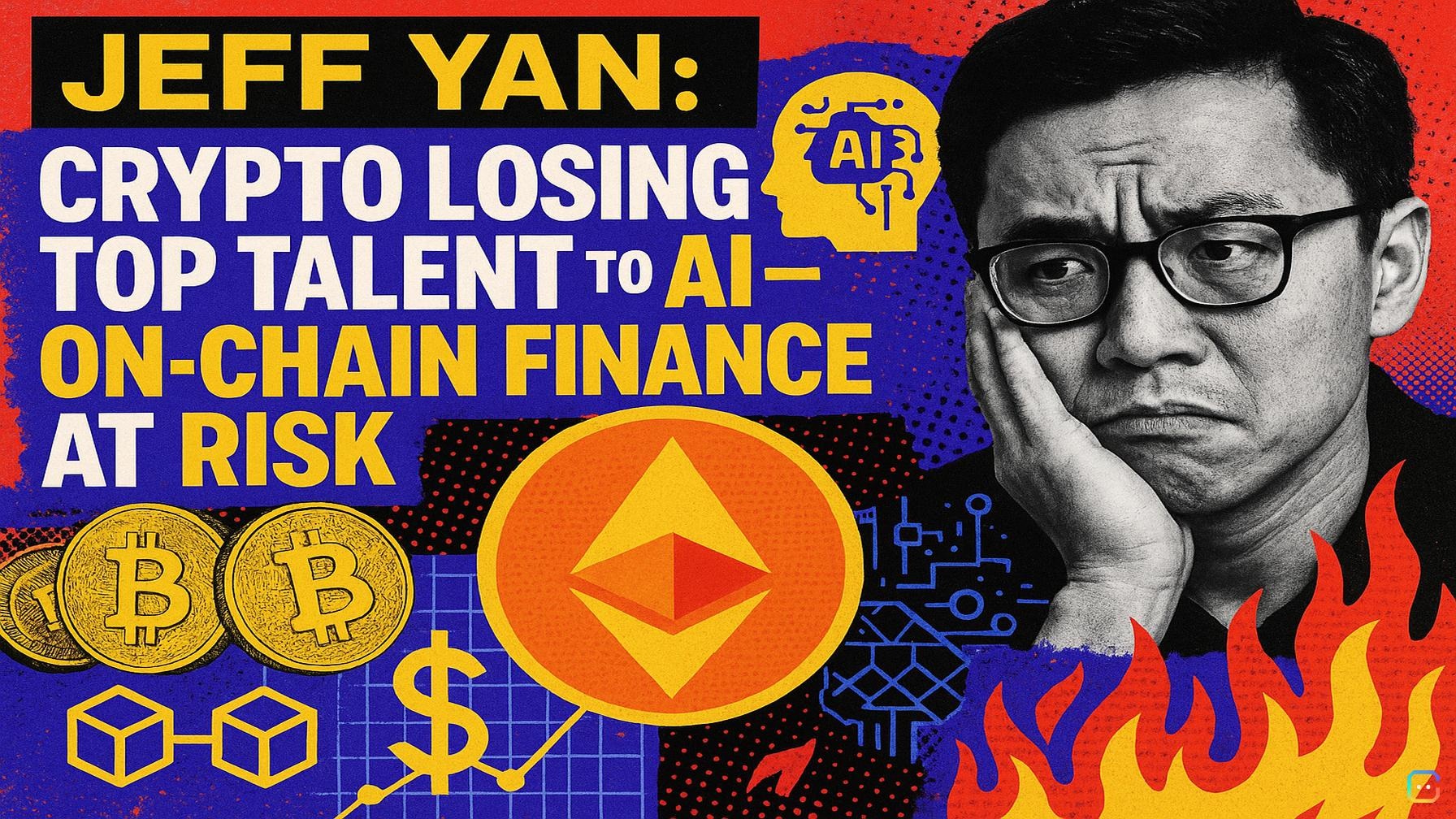
Headline: Hyperliquid co‑founder Jeff Yan warns crypto is losing top talent to AI — and on‑chain finance could suffer
Jeff Yan, co‑founder of Hyperliquid, told the VALR podcast that one of the biggest challenges facing crypto today is its shrinking share of top entrepreneurial talent. With the AI boom capturing headlines, funding and social prestige, Yan says many ambitious founders are choosing AI over crypto — leaving relatively few people willing to tackle the hard, system‑level problems in fintech and on‑chain finance.
Yan urged prospective founders to look past an industry’s surface appeal and instead study the real problems it aims to solve. He argued that rebuilding financial systems “from first principles” remains a uniquely difficult and valuable opportunity: turning academic ideas into robust market designs that work at scale requires both entrepreneurial judgment and deep economic design knowledge. In Yan’s view, on‑chain finance is precisely the kind of space where entrepreneurs can shape new market structures and financial infrastructure.
The talent shift toward AI is being reinforced by rapid technical progress and geopolitical competition. Chinese models have recently gained prominence — for example, Kimi K3 hit first place on the Frontend Code Arena — a development that prompted former White House crypto czar David Sacks to warn about America’s position in the AI race. Sacks argued that rules on data centers, state‑level mandates and proposed federal reviews could slow U.S. developers while Chinese teams continue to advance. He likened the moment to the early internet era and called for a regulatory approach that lets companies build permissively while targeting only specific safety risks.
The AI boom’s gravity also has financial consequences. Former Fidelity fund manager George Noble cautioned that an AI investment bubble could produce losses far larger than the dot‑com crash — estimating a shock as much as 17 times worse. Noble tied the risk to the enormous sums being poured into AI infrastructure: if those investments don’t deliver expected returns, losses could ripple beyond tech firms and strain the broader financial system. By comparison, the dot‑com collapse wiped about $5 trillion from the Nasdaq.
Yan didn’t frame AI’s rise purely as an existential threat to crypto’s finances; his bigger concern is people. On‑chain finance will need more capable entrepreneurs to translate complex theoretical work into usable financial markets that serve users at scale. Without that talent, Yan warned, the industry risks falling behind even as the underlying problems it seeks to solve — from market design to scalable decentralised infrastructure — remain deeply important and technically demanding.
Read more AI-generated news on: undefined/news