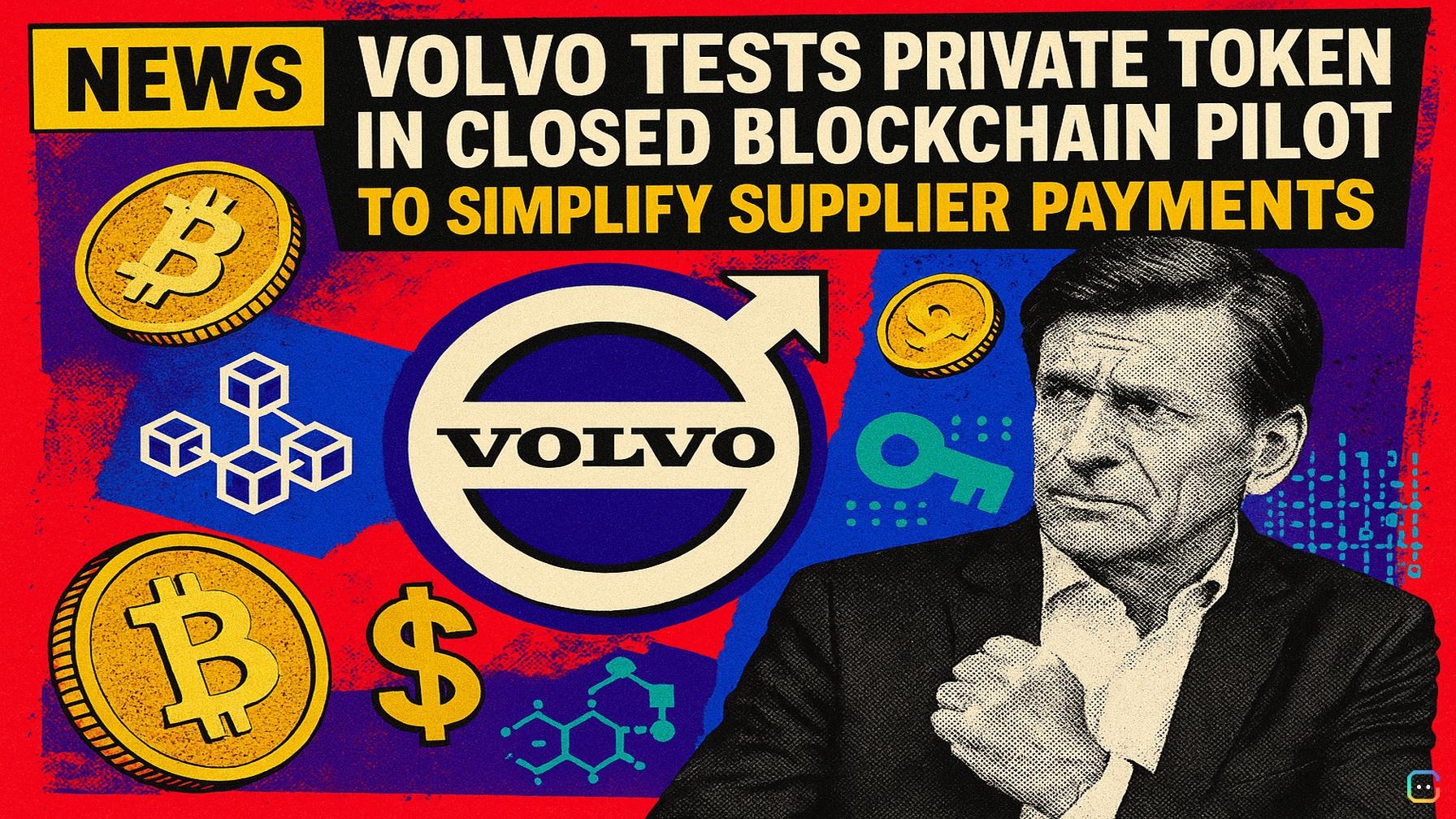
Volvo Group has quietly experimented with its own proprietary cryptocurrency as part of a closed blockchain trial aimed at simplifying transactions and record‑sharing with suppliers, the company revealed in a recent Cardano Foundation interview.
What happened
- Ivan Branco, Volvo’s Head of Information Management, AI and Analytics, said the pilot created an enclosed blockchain environment linking Volvo with material and transport suppliers. Rather than minting a public token, Volvo issued a private digital asset specifically for the project.
- The trial focused on whether a shared ledger and token could streamline payments and transactional data among manufacturers, logistics providers and suppliers inside a controlled network. Branco confirmed transport partners were included in the explorations.
- Volvo has not disclosed the token’s technical design, which blockchain was used, or whether the experiment involved transactions with real economic value.
Why it matters
- The effort moves beyond blockchain’s more familiar role in provenance to test native settlement inside supply networks. A proprietary token in a closed system can, in theory, reduce reconciliation friction, speed supplier payments and give members a single, tamper‑resistant source of truth without exposing operations to a public cryptocurrency market.
- Volvo is also studying blockchain to improve traceability and supply‑chain records — for example, tracking component origin through multiple tiers of suppliers. That capability becomes critical when sanctions, trade restrictions or product‑compliance regimes (like Europe’s Digital Product Passports) require reliable provenance data.
- Practical use cases highlighted include remanufacturing, where accurate lifecycle information about components supports reuse and refurbishment.
Background and precedent
- Volvo’s experiment builds on prior blockchain work in its automotive businesses. In 2019 the group partnered with supply‑chain firm Circulor to trace cobalt sources, aiming to flag minerals linked to conflict or child labor. Sweden’s Polestar also adopted blockchain to improve cobalt traceability in its battery supply chain.
- The current test differs by placing transactional settlement and shared records at its core, not solely material tracking.
Challenges and current status
- Branco pointed to notable barriers: integrating blockchain with legacy systems, scalability and maintenance concerns, and limited internal expertise on enterprise blockchain technology.
- Volvo has not announced any plans to release the cryptocurrency publicly or roll the system out company‑wide. The initiative remains an internal exploration and has not reached industrial‑scale deployment or produced a public roadmap.
What to watch
- Whether Volvo moves from pilot to production will depend on solving integration and scaling challenges and proving clear commercial benefits to suppliers. For enterprise-focused blockchain proponents, the project is an eye‑catching example of companies testing private digital assets and closed ledgers to solve supply‑chain pain points — but it also underscores why broad adoption remains a work in progress.
Read more AI-generated news on: undefined/news